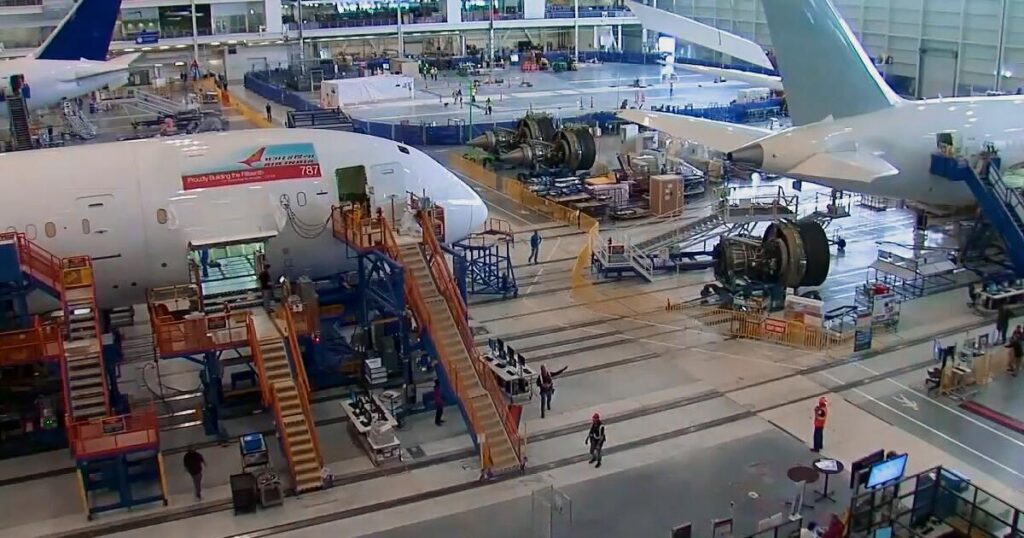
“Downfall: The Case Against Boeing” examined the aerospace company’s profit-hungry recklessness that led to 346 deaths in two 737 Max crashes.
The film was in keeping with director Rory Kennedy’s career; the youngest daughter of Robert F. Kennedy, she has spent the last quarter-century directing documentaries that explore a wide array of weighty topics that often seek to hold the powerful accountable and to improve the lives of those on society’s margins: life in Appalachia (“American Hollow”); security issues and nuclear power (“Indian Point: Imagining the Unimaginable”); the AIDS crisis around the globe (“Pandemic: Facing AIDS”), American torture (“Ghosts of Abu Ghraib”), and high-tech inequity (“Without a Net: The Digital Divide in America”).
Kennedy, who was born after her father was assassinated, credits not only him but her whole family with inspiring her. “There were people around me doing pretty extraordinary things and trying to make the world a better place and I was definitely influenced to pursue a sense of justice and a sense of fairness in the world because of my family.”
She had focused on Boeing after it became clear they were misleading the public with their initial claims of pilot error in those crashes and the government regulators had let the company get away with placing the bottom line over safety. “You want to trust these companies to do their jobs and the government to do their job but they weren’t,” Kennedy said in a recent video interview. “I was hoping that ‘Downfall’ would really help Boeing be held accountable.”
When Kennedy finished the 2022 documentary, she thought she was done with the topic. She had never returned to a subject for a sequel. Yet her latest documentary, debuting on Netflix Wednesday, is “Freefall: A Reckoning for Boeing,” which portrays the airplane maker’s continuing malfeasance as not just greedy but malevolent.
“When I finished ‘Downfall,’ I had zero intention to make ‘Freefall,’” she says.
But then John Barnett, a whistleblower whom Kennedy interviewed for “Downfall,” died by suicide in the midst of depositions for a case against Boeing. Kennedy, who had come to consider him a friend, felt that the corporation’s mistreatment of Barnett and their relentless pressure campaign against him had driven him to his death. “John died because of Boeing,” she says, pointing to a moment in his deposition on his last day alive, in which the emotionally fragile former employee asks for a break but is denied one by Boeing’s lawyers. “That’s what started ‘Freefall.’ I felt what he had committed his life to needed to be told.”
Additionally, Barnett’s death inspired other whistleblowers to come forward despite their fears of retaliation from Boeing. “I don’t push people to be part of my films, but they reached out to us personally with harrowing stories of what was happening inside of Boeing,” Kennedy says. “They wanted their perspective to be shared. So I felt compelled to make a second film.”
Further fuel for “Freefall” was the fact that while President Biden’s Department of Justice pursued criminal charges against Boeing executives, once it was under President Trump, they walked away. And while Boeing initially seemed chastened in its behavior, Kennedy said that after the MAX planes got approved, “they seemed to revert right back to their old ways.”
(In just the last few months since the film was finished, there has been another Boeing crash, another window blowout and the revelation that the FAA found that 31,000 seats on 737 MAX planes are improperly installed and may disengage during an emergency.)
“Downfall” meticulously laid out the evidence against Boeing and the callous and even deceitful behavior of its executives, but it was generally matter of fact in its tone, even as grieving families and a few politicians, most notably Democratic Rep. Peter DeFazio of Oregon but also Republican Sen. Ted Cruz of Texas, expressed moral indignation.
But outrage pulses more readily through in “Freefall.” Kennedy says that this shift in tone didn’t stem from her personal feelings but from the whistleblowers and the families who lost loved ones.
“It organically came from the people we focused on,” she says. “My job is to harness what I’m experiencing from the people who I’m documenting and I try to focus on that over my own journey and emotions.”
There was plenty of anger to harness. The film spells out the gargantuan payouts that each Boeing CEO has received, despite the crashes and questions about their actions and the company’s faltering value. Kennedy also notes that Boeing’s lawyers argued that the people who died on the two flights went down so quickly that they didn’t suffer so they should get less money. “That was so outrageous and inhumane and a gut punch to the families,” she says. “And so many people are now suggesting it has gotten even worse there. That is just unacceptable and unjust.”
The new film remains focused on Boeing but seems to paint a broader portrait of just how dangerous unregulated, unfettered capitalism is, especially under a tentative or disinterested federal government. “It is a larger story about capitalism,” Kennedy acknowledges, adding that Boeing is “one of the most subsidized companies in American history, so taxpayers are paying for this company to destroy itself while the CEOs become some of the richest people in America.
“It’s important for people to be aware of what’s happening and the idea that a big job of our government is to correct capitalism,” Kennedy says. “Things are out of balance right now and I do think there have been times where the public interest is the focal point and not the interest of companies.”
Kennedy believes that if CEOs and other top executives had been held criminally responsible, it would change behavior not only at Boeing but throughout the country.
She knows her film won’t single-handedly change the world or even alter specific policies, but she does believe it can have an impact.
“If people watch and then want to see changes made it can contribute — with a lot of other efforts from a lot of other people — to holding people accountable and improving policies and making people’s lives better,” she says. “There are steps that can be taken, but you have to prioritize it and decide this is important to the American people. And we have a chance this fall to voice our opinion as voters.”
The post Rory Kennedy’s ‘Freefall’ reexamines Boeing after whistleblower’s death appeared first on Los Angeles Times.