Zohran Mamdani’s landmark victory in the New York City mayor’s race was powered by an unconventional coalition of traditional Democratic voting blocs and newer voters. Whether motivated by party loyalty or the candidate’s message, more than one million New Yorkers cast ballots for him — part of the highest turnout in a mayoral election in more than 60 years.
In his nine-point win, Mr. Mamdani largely expanded on the base he built during the primary in neighborhoods across the city. He swept communities of every income level, save for New York’s wealthiest enclaves, where his top opponent, former Gov. Andrew M. Cuomo, performed best. In the city’s bluest districts, Mr. Mamdani ran up the score with high turnout that overwhelmingly favored him.
Mr. Cuomo performed strongly in some of the city’s more conservative corners and did well with the voters who supported President Trump last November.
Mr. Mamdani’s success with different voting groups — from older, moderate Black voters to young white progressives — highlighted the breadth of his coalition. Taken together, the results underline how New York City’s diverse, unruly and often competing interest groups coalesced into a novel voting bloc that could offer national Democrats a road map for future competitive elections.
Though New York’s politics tend to sit to the left of the rest of the country’s, the city’s Democrats, when given the choice between a moderate, well-known establishment candidate and a left-leaning political newcomer, opted for change.
Mr. Mamdani’s performance and his ability to turn out voters could now reshape the politics of the city for a generation. Here are the demographic trends that contributed to his win on Nov. 4:
Young voters turned out in droves.
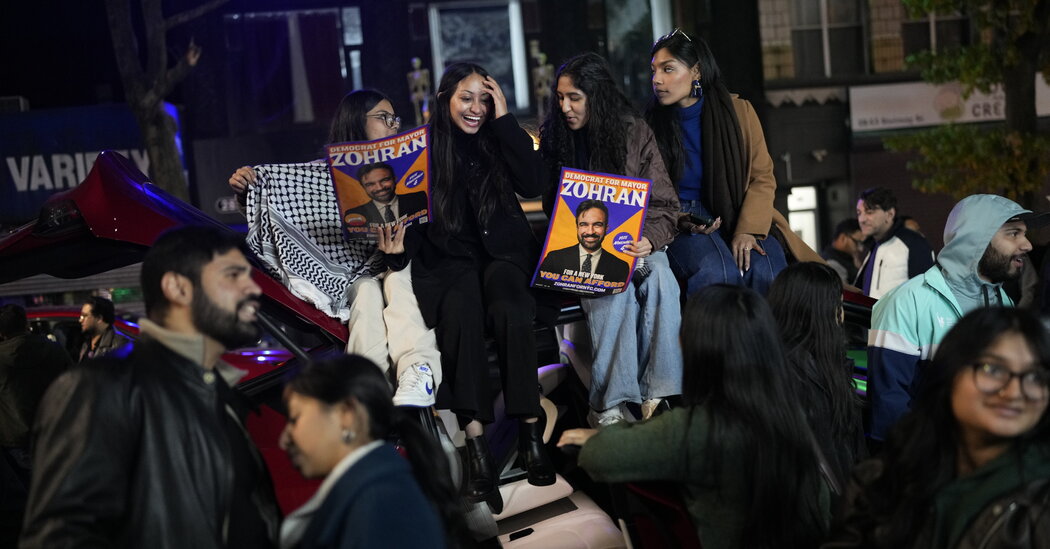
The people-powered machine that galvanized millennials and Gen Zers for Mr. Mamdani during the primary delivered again last Tuesday. In precincts where the median age is under 45, his average margin of victory was 30 points — among the highest of any demographic group.
Voters younger than 45 — about 46 percent of registered voters in the city — made up about 43 percent of those who cast their ballots in person early or on Election Day. That outpaces the 2022 midterms, when Gov. Kathy Hochul, a Democrat, narrowly fought off a challenge from Lee Zeldin. That year, younger voters made up 36 percent of those who voted. (Mail ballots, which are still being accounted for in the 2025 election, generally make up a small share of overall votes.)
In interviews, young voters said they were motivated by Mr. Mamdani’s message about making New York affordable and felt his policies could make the city more livable. Many pointed specifically to his plan to freeze rents for rent-stabilized apartments.
“I feel like a lot of people are out of the loop. Especially politicians are out of the loop when it comes to everyday struggles of people,” said Gaoussou Dibassy, 19, who described struggles to afford public transportation and groceries. “Mamdani brings a refreshing sense that he understands us, and that he knows what we’re going through, and he’s looking to address the problems that will actually impact our lives.”
Ultimately, Mr. Mamdani won decisively in the precincts that are home to the largest share of renters, winning them by more than 20 percentage points.
Mamdani’s outreach to Black voters paid off …
Black voters, the Democratic Party’s most loyal voting base, offered tepid support to Mr. Mamdani during the primary. Mr. Cuomo handily outperformed him in the city’s heavily Black precincts, winning those where at least 60 percent of residents are Black with 62 percent of the vote. Mr. Cuomo did particularly well in key Black communities in Southeast Queens and the Bronx.
Many Black voters expressed concern about Mr. Mamdani’s thin record and ambitious policy plans, saying that his support of a rent freeze in particular could harm Black homeowners. Establishment Democrats and Mayor Eric Adams, who is Black, amplified those concerns and described Mr. Mamdani as the avatar of young, white newcomers who were displacing longtime Black residents.
But Mr. Mamdani’s campaign focused on making up ground with Black voters through concerted outreach efforts and several key endorsements.
By Election Day, the standing of Mr. Mamdani and Mr. Cuomo in 479 precincts with large numbers of Black voters had flipped. Mr. Mamdani won those areas with 61 percent of the vote, among his strongest performances in the city.
At one polling site in Jamaica, Queens, Carmen Patrick, 73, said she made a last-minute decision to vote for Mr. Mamdani on Election Day. She had been leaning toward supporting Mr. Cuomo, but changed her mind when President Trump endorsed him that week.
“I don’t want one of his lackeys there,” she said of Mr. Trump. Still, Ms. Patrick, a retired hospital worker, added that she was “questioning how” Mamdani would accomplish his goals.
… But gentrifying neighborhoods remained some of his biggest strongholds.
The rapidly shifting demographics in New York have been a source of anxiety for many voters — but the mayoral campaigns saw the changes as a political opportunity.
Even as Mr. Mamdani fought off perceptions that he represented the interests of gentrifiers, in neighborhoods where the nonwhite population is shrinking he notched some of his strongest performances. In parts of the city where the Black or Hispanic population share had declined and the white population share had grown since before the pandemic, Mr. Mamdani won by more than 50 percentage points.
Mr. Mamdani’s allies contend that his campaign’s focus on affordability will carry over to his approach to governing, benefiting the city’s natives as much as its newcomers. The mayor-elect has pledged to push for policies that will keep more of the city’s longtime residents of color in their communities while helping the city’s younger, newer residents eke out a living.
Cuomo performed well in districts that voted for Trump in 2024.
The president outperformed his 2020 margins in his deep-blue hometown last November. This year, Mr. Cuomo picked up some of the same corners of the city: He won by more than 42 percentage points in the precincts that the president won in 2024.
Mr. Trump threw his support behind Mr. Cuomo during the last days of the campaign, saying he saw the former governor as a better alternative to Mr. Mamdani, who he falsely claimed was a communist.
Curtis Sliwa, the Republican candidate, won just over 7 percent of the vote citywide. While nearly 242,000 Republicans voted, Mr. Sliwa garnered just over 146,000 votes. That means that even if nearly all Sliwa’s voters were registered Republicans, 40 percent of the total Republican vote went to another candidate.
Mr. Sliwa faced considerable pressure from conservatives and allies of Mr. Cuomo to drop out of the race and consolidate the anti-Mamdani coalition. But even if all of Mr. Sliwa’s votes had gone to Mr. Cuomo, Mr. Mamdani still would have won.
Mamdani engaged with South Asians and Muslims.
Mr. Mamdani’s campaign tried to engage South Asian voters from Day 1. Many of his earliest supporters were immigrants from Bangladesh and Pakistan and were probably among the tens of thousands of New Yorkers who voted this year for the first time.
Muslim voters, too, emerged as a new political force on behalf of Mr. Mamdani, who will be the first Muslim mayor of New York. About a half-million Muslims live in the city, according to a recent survey of religious congregations by the Association of Statisticians of American Religious Bodies.
Some Muslims pointed to the final weeks of the campaign as a driver of their turnout, saying that the Islamophobic attacks Mr. Mamdani faced from his opponents in both parties inspired them to support him.
Ultra-Orthodox Jewish voters remained steadfast for Cuomo.
The city’s Orthodox Jewish communities voted overwhelmingly for the former governor, as they had done in the primary. Mr. Cuomo won precincts in Borough Park, Dyker Heights and south Williamsburg, all of which have large ultra-Orthodox communities. In some of those precincts, Mr. Cuomo received more than 90 percent of the vote.
Mr. Mamdani won in Crown Heights with 71 percent of the vote, carrying nearly every precinct in a community that has been gentrifying but still has a large Black population. The handful of precincts he lost there were in an area near Eastern Parkway with a large Orthodox Jewish population, where Mr. Cuomo won with 70 percent of the vote.
The broader Jewish electorate in New York was much more split, pre-election polling indicated. Mr. Mamdani’s criticism of Israel and its conduct in the war in Gaza starkly divided many of the city’s Jewish residents, reflecting the differing views on Israel within the community.
Tim Balk and Wesley Parnell contributed reporting.
Maya King is a Times reporter covering New York politics.
The post The Demographic Trends That Shaped Mamdani’s Win appeared first on New York Times.