Victor Cha is the president of the geopolitics and foreign policy department at the Center for Strategic and International Studies and a professor at Georgetown University.
One thing that’s consistent about U.S. nuclear nonproliferation policy is its inconsistency.
After the denuclearization of Libya, the U.S. government embraced a view that all denuclearization should follow the CVID model — for complete, verifiable and irreversible denuclearization — that succeeded there.
But clearly that is not the case right now, as President Donald Trump moves in opposite directions on Iran and North Korea’s nuclear programs. On Iran, Trump has taken the absolutist stance that it should never be allowed to have a nuclear weapon. But he is taking the pragmatic, accommodationist approach of negotiation, threat-reduction and managing a nuclear North Korea.
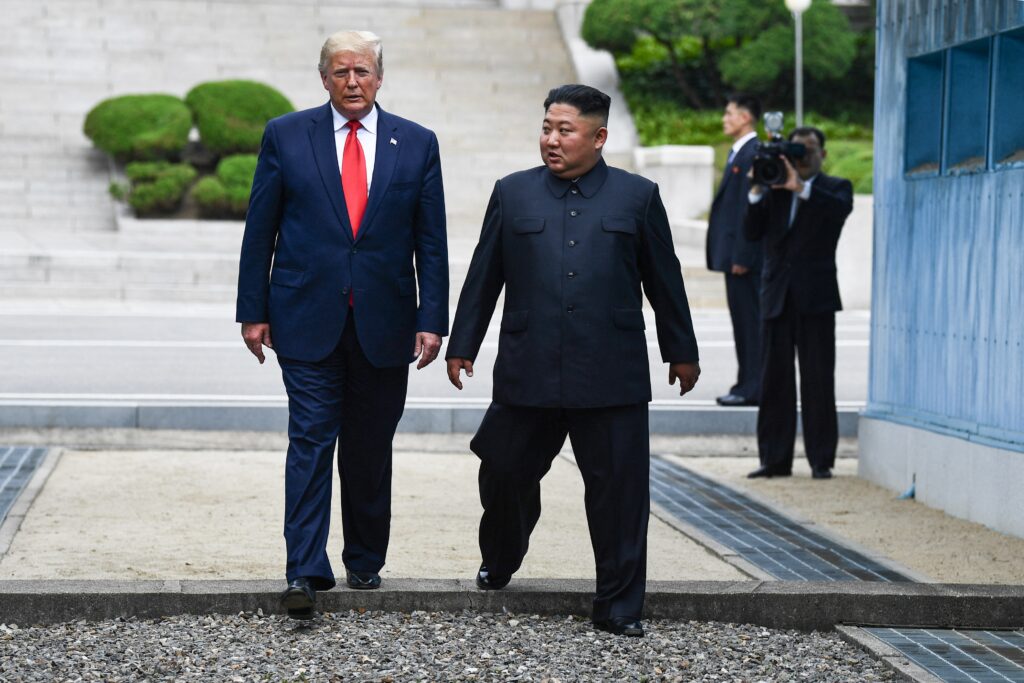
This lack of consistency was unmissable in Trump’s remarkable message last week ordering that U.S. participation in joint military exercises with South Korea be scaled back. The pullback was the first concrete move by the president to engage North Korean leader Kim Jong Un this term, but he took a similar action after his first meeting with Kim in Singapore in 2018, when he suspended all exercises with South Korea.
In his post, Trump said he sees the lack of nuclear and long-range ICBM tests by North Korea since his return to the presidency as “unthreatening and respectful” behavior. He also, of course, may be trying to move the headlines away from the quagmire in Iran.
Trump has acknowledged that North Korea is an established nuclear power before, even as he refuses to contemplate that concession with Iran. But it would be unfair to call this a double standard. The disparate approaches are rational given the states of the two nuclear programs. Iran’s program — in its nascent stages and based at known locations — was targetable for a preemptive strike. But in North Korea the cat is long out of the bag. With some 60 weapons and enough fissile material for about 30 more, as well as several types of delivery systems, North Korea is not susceptible to a CVID solution.
The different policies are also a function of the efficacy of sanctions. In Iran’s case, there is still global support for economic sanctions, which are essential to an absolutist approach. But China and Russia are fully supporting North Korea, rendering the U.N. Security Council’s resolutions against it effectively defunct.
Finally, and critically, the different approaches are encouraged by key U.S. allies.
The progressive South Korean president Lee Jae Myung does not want to risk a military confrontation on the peninsula and so welcomes Trump’s diplomatic efforts with the North. But Israeli Prime Minister Benjamin Netanyahu has encouraged the United States to demand CVID with Iran, and has been willing to use military force, and absorb military retaliation from Iran.
Uncharacteristically, China may even be supportive of more dialogue between Trump and its communist ally in order to avoid more U.S. uses of force in its neighborhood and to dial back the Russia-North Korea relationship, which has grown stronger from their alliance against Ukraine.
One further complexity to the inconsistency: While Iran and North Korea are contending with different U.S. policies, they are also learning from each other. The two have a history of missile cooperation, and the U.S. attack on Iran has surely further convinced Pyongyang that its nuclear weapons can deter the U.S. military. Moreover, North Korea has to have taken heart from America’s inability to completely destroy Iran’s capabilities. And Iran, of course, will also draw conclusions from the diverging Trump approaches. It may even look to Pyongyang to help it reconstitute its program.
Nonproliferation policy is often a choice between bad and worse, and it’s an inconvenient truth that one size will never fit all situations. An irony is that Trump’s hard-line approach to Iran may demonstrate an “or else” resolve that strengthens his diplomatic hand with North Korea, while success in that diplomacy could strengthen Iran’s determination to hold out against the U.S. onslaught. When nuclear disaster forever lurks around the next bend, the absolutist and pragmatic roads have a way of converging.
The post There’s real logic beneath Trump’s split nuclear strategy appeared first on Washington Post.