The American manufacturing sector has without a doubt been rebounding this year. Factories are hiring; production is rising. In July, manufacturing activity reached its highest level since 2022.
President Donald Trump credits his “massive tariffs” for the good news, declaring in a recent speech in Las Vegas that “manufacturing is exploding at the fastest pace in many years.” This month, the White House trumpeted “an economic revival across our manufacturing industry.”
For some firms, Trump might be right. Much of the job growth has occurred in two sectors — metal products and cars and other transportation equipment — that are subject to tariff protection from foreign competition. “Tariffs can certainly help some sectors,” said Max Dvorkin, an economic policy adviser at the Federal Reserve Bank of St. Louis. “ … And those are the ones in which we see modest expansion.”
But what’s happening is hardly the broad “golden age” Trump has promised. Despite the recent uptick in hiring — 29,000 jobs since January — manufacturing employment remains well below the post-pandemic peak it hit under President Joe Biden in 2023. Overall, the industry has lost about 62,000 jobs since Trump took office in January 2025. And the recent momentum is small in historical terms, economists and manufacturing experts said: At the current pace of growth, it would take nearly five years to get back to the Biden-era peak, according to a Washington Post analysis of Labor Department data.
“Maybe the manufacturing job market has improved,” said Joseph Politano, an economic policy analyst who writes the Apricitas Economics newsletter. “But I think a better way to phrase that is that it’s getting bad less quickly.”
Meanwhile, the role of tariffs in spurring this growth is not especially clear. Other factors, like the boom in artificial intelligence and data center construction combined with the war in Iran and lower interest rates are probably bigger drivers of hiring, said Susan Houseman, an economist at the Upjohn Institute for Employment Research, a nonpartisan research organization in Kalamazoo, Michigan. “Industry employment is largely being driven by demand and macroeconomic conditions, not tariffs,” she said.
What is clear is that tariffs have had a negative impact on other manufacturing sectors, especially certain factories that rely on imported goods, economists said. While metal and transportation equipment manufacturers have gained more than 41,000 jobs since January, manufacturers of food, furniture, and rubber and plastic products have shed more than 32,000 positions, Labor Department data show.
“If somebody says ‘these tariffs created jobs in steel,’ I would say that can be true. But that’s obtuse to the point of misleading if you don’t also point out that they cost all these jobs in the steel-consuming sectors,” said Gary Winslett, associate professor of political science at Middlebury College. “Part of what I think the Trump administration is doing here is an awful lot of cherry-picking.”
White House spokesman Kush Desai said this year’s modest growth is a sign of things to come: “With trillions in manufacturing investments pouring in … the Trump industrial resurgence is just beginning.”
Desai said declines in manufacturing employment during Biden’s final year in office were “a direct result of his left-wing, anti-growth agenda.” This year’s “rebounding manufacturing employment proves President Trump’s pro-growth agenda has fully reversed this trend,” he said.
However, even many tariff proponents say it is too soon to see a genuine resurgence in manufacturing jobs. The re-shoring of factories is a process that takes years not months, they say, as well as a stronger industrial policy than the Trump administration has so far implemented.
“The data is showing early signs of manufacturing stabilization,” said Nick Iacovella, executive vice president of the Coalition for a Prosperous America, which advocates for tariffs and industrial policy, and has consulted with Trump administration trade officials. “But it takes time [and the right policies] for a company to build a factory. These don’t pop up overnight.”
Mainstream economists say American manufacturing employment is unlikely ever to reach its 1970s peak of 19.5 million jobs. The labor market has undergone a seismic shift toward service jobs, and American manufacturers have not surpassed 13 million jobs since the Great Recession. Today, the sector makes up about 7 percent of all U.S. jobs.
The manufacturing jobs engine revved up during the latter part of the coronavirus pandemic, when Americans sheltering at home spent big on televisions, exercise equipment and myriad other goods. That wave of growth later waned as Americans redirected spending toward experiences such as dining out, travel and entertainment — a decline that endured with Trump’s return to the White House last year.
Determined to execute on his campaign promise that good-paying manufacturing jobs would come roaring back, Trump slapped tariffs on scores of countries on April 2, 2025 — a date he called “Liberation Day.” The announcement tanked markets and rocked U.S. manufacturers who rely heavily on imported parts to make finished products such refrigerators and tractors.
In February, the U.S. Supreme Court struck down the Liberation Day tariffs, saying Trump had illegally used emergency powers to impose the duties. In response, Trump has turned to a variety of other laws to impose new tariffs, including levies on more than 80 countries that the administration said are importing goods produced using forced labor.
In the meantime, manufacturing employment started growing again in January, albeit at a sluggish pace.
One source of growth — and a likely beneficiary of tariffs — has been metal forgeries and metal fabricators. Aluminum, copper and steel and some fabricated products derived from them have been subject to import duties of up to 50 percent since last summer.
At Revere Copper, the country’s first copper rolling mill founded in 1801, tariffs and the data center construction boom have begun to reverse decades of declines following the passage of free trade agreements that resulted in a shrinking workforce and plant closures, said Amy O’Shaughnessy, vice president of sales and marketing.
The company has hired about 100 workers between two plants in Upstate New York and North Carolina since 2023.
“Trump 2.0 kicked in tariffs that are just the best thing that could have happened,” O’Shaughnessy said, adding that between tariffs and data centers, it’s “allowed us to increase prices” and invest in the company’s factories and workforce for the first time in three decades.
Some other manufacturers say they are paying higher prices for imported metal but that the new trade conditions have helped them expand their base of clients, allowing them to hire.
“In the last six or seven months, we’ve seen a great uptick in business,” said Bill Jones, president of Penn United Technologies, a precision tools manufacturer near Pittsburgh that supplies such industries as auto and nuclear energy.
Jones said his business lost hundreds of jobs to factories in China after the trade deals of the 1990s. The 700-employee company, Jones said, has hired about 50 employees and added dozens of job postings since Trump retook the White House.
“Our customers are launching new products, and they’re buying from us,” Jones said, “not taking it halfway around the world.”
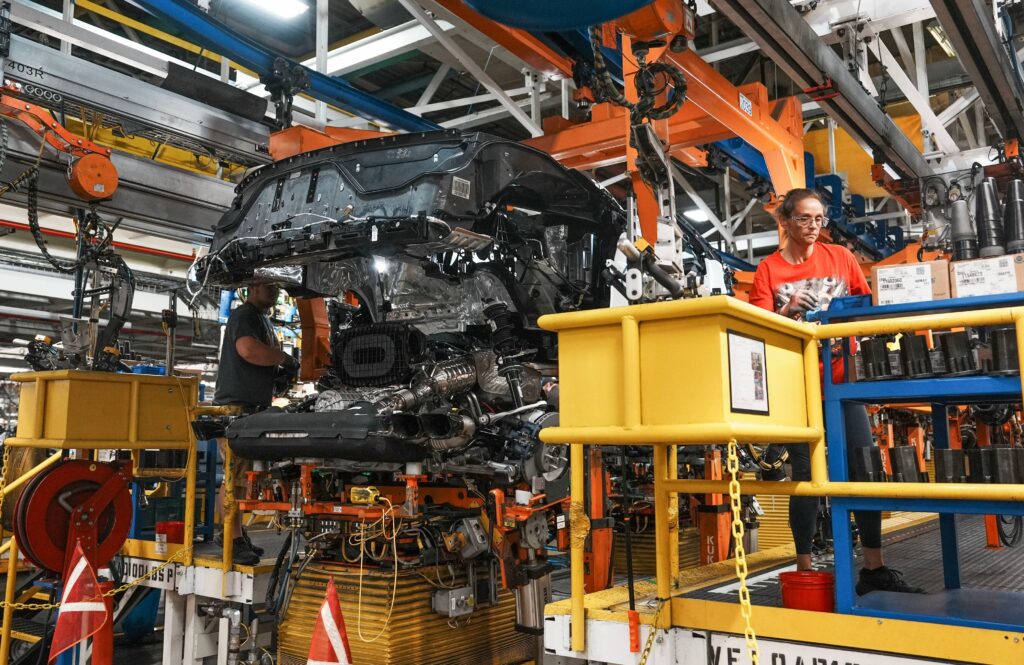
Another sector that has added jobs is transportation manufacturing, which includes cars and car parts, buses, heavy-duty trucks and airplanes. That sector probably has possibly also been buoyed by Trump’s auto sector tariffs, economists said.
“It’s somewhere between possible and likely,” said Susan Helper, an economist at Case Western Reserve University who also served as the chief Commerce Department economist in the Obama administration. “If import prices go up, there’s some substitution of foreign production for domestic production.”
However, a third sector with job gains is electrical parts manufacturing, which includes wires, batteries and generators used in data centers. There the AI boom is largely responsible for increased demand and job growth, economists said. The role of tariffs is unclear — and could be positive, economists said.
That’s not true for all firms affected by metal tariffs. Independent Can, a producer of tin cans near Baltimore, has raised prices by about 12 to 15 percent as the cost of imported steel, the primary component of tin cans, has surged, said Rick Huether, the company’s CEO. Domestically produced tin plate has quality and delivery issues, making it difficult to rely on U.S. producers, he said.
“It has definitely affected our business,” said Huether, who employs around 400 workers in factories in Maryland and Ohio and said he is trying to avoid layoffs.
Austin Ramirez, president of Husco, which manufactures hydraulic and electromechanical components of cars and construction equipment in Waukesha, Wisconsin, said tariffs have raised the price he has to pay for imported parts. But tariffs have done little to shift his purchases to domestic suppliers, as the president hopes.
Instead, Ramirez said he has mostly turned to Southeast Asia and Eastern Europe, where levies are lower.
“Most parts either aren’t made here or they’re just so much more expensive that it still makes more sense for me to pay a large tariff,” Ramirez said. “It’s been a major, major headache.”
The post American manufacturers are hiring again. Could tariffs be the reason? appeared first on Washington Post.