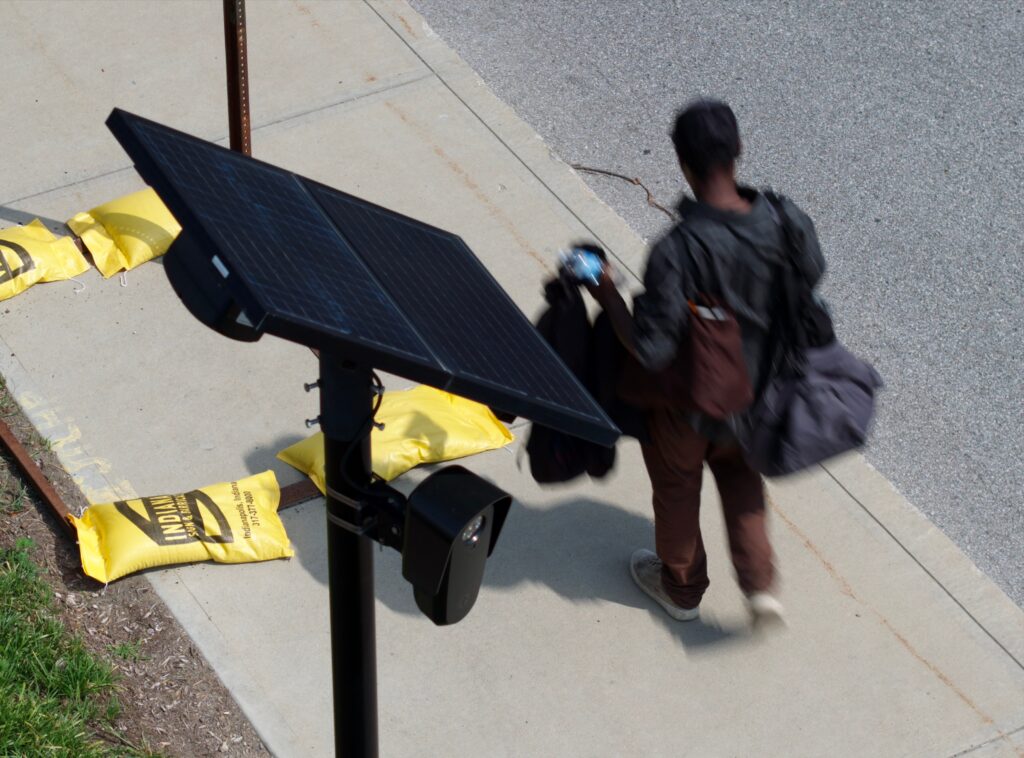
Last month, as Indianapolis residents called for tighter restrictions on police surveillance, Police Chief Tanya Terry sought to reassure the public that her officers were using the 301 Flock cameras spread throughout the city solely to investigate crime.
In a July 17 op-ed published in the Indianapolis Business Journal, she wrote that her department has “clear policies” to ensure the camera network, which captures images of passing license plates, “is used for its intended purpose: solving crimes and saving lives.”
About three weeks later, a reporter at The Washington Post asked Terry’s department about potentially suspicious activity from one of its own officers. Using publicly available information, The Post found that an Indianapolis officer appeared to use Flock cameras to track vehicles used by his wife and two close personal acquaintances, searching 3,759 times over a 10-month period — an average of about 12 lookups per day.
Indianapolis soon suspended the officer without pay, started administrative and criminal investigations of his use of Flock, and is recommending his termination, according to Terry. The officer, whom The Post is not naming because he has not been charged with a crime, did not respond to requests for comment.
In an interview, Terry acknowledged that, until recently, the department had no regular practice of auditing officers’ searches. The case, she added, has been “a learning process for us.”
Law enforcement agencies around the country are vigorously defending their use of Flock against rising community concerns that officers are using the nationwide network of cameras to spy on ordinary citizens who are not suspected of any crime. Some critics, angered by the cameras’ ubiquity, have even vandalized them.
But many of these same departments have embraced Flock’s powerful surveillance system without establishing basic procedures for monitoring its use, a Post investigation has found, based on police and court records, interviews with more than a dozen police officials and Flock usage logs made available through public records requests.
At least 69 police officials have been accused, charged with or convicted of misusing Flock’s system or other license-plate readers for unauthorized purposes, The Post has found, and in at least 15 of these cases, someone outside of the police department — including victims, activists and journalists — first identified the potential misuse.
To understand how departments might identify officers improperly using the system, The Post used publicly available information to find three officers whose search histories showed signs of potential misuse. All three of their departments, when contacted by The Post, said they did not regularly audit officers’ use of the system.
Records and interviews show that departments across the country do not regularly audit their officers’ Flock use, a practice recommended by the company, and some law enforcement agencies have no formal training programs or written policies describing how the technology should be used.
Last week in New Bedford, Massachusetts, a police officer testified that “there was never any training for” Flock in the department, according to a recording of a court hearing, where a judge extended a restraining order against an officer who told the court she used the tool to search for her ex-girlfriend’s vehicle as part of an investigation. A spokeswoman for the department declined to comment.
In Haines City, Florida, authorities did not audit how police were using Flock during the nearly two-year period in which one officer repeatedly searched his wife’s vehicle, a department spokeswoman said. The officer confessed to a superior and was arrested and charged earlier this month after The Post inquired about the searches.
And in Highland Heights, Ohio, the police department had no policy governing the use of Flock and had not conducted any audits of its officers’ Flock usage until this week, when The Post asked officials about one officer who appeared to have searched the locations of five license plates more than 1,000 times each, the police chief said in an email.
Thirteen states require law enforcement agencies to audit how their officers use license-plate readers, for example, by periodically reviewing whether individual searches were done for legitimate investigations. Flock offers departments tools for simplifying these audits, including automatic scans for suspicious usage that the company plans to make default for all customers in the coming months.
Post journalists identified the possible misuse of license-plate readers by officers in Indianapolis, Haines City and Highland Heights, triggering investigations of all three and discipline measures against two of them, by analyzing data on Have I Been Flocked. The website publishes Flock search logs that have been provided in response to public records requests covering thousands of police departments.
The Post identified the most suspicious usage patterns among this data, including dozens of officers who appeared to have been the only officer to search a single license plate hundreds, or even thousands, of times. Then journalists attempted to find links between these license plates and the officers searching for them, using social media profiles, court records and other publicly available information.
The fact that journalists were able to find apparent misuse without the tools afforded departments highlights “a need for systematic auditing that just isn’t happening now,” said Max Isaacs, director of technology law and policy at the New York University School of Law’s Policing Project. “I think at a lot of agencies, you just don’t have anyone really looking.”
Flock, an Atlanta-based start-up backed by prominent tech investors, has acknowledged that officers are abusing its systems and says it is working to give agencies tools for catching them. The company maintains digital dashboards that create a permanent record every time an officer uses the tool to search for the location of a car, including the date, time and reason they performed the search.
These logs are intended to be used by departments to monitor officers’ use, but there is no uniform policing standard for the best auditing practices. The company declined to comment on its customers’ different approaches to oversight.
Eric Atstupenas, general counsel for the Massachusetts Chiefs of Police Association, recommends that all agencies dedicate one person or team to be responsible for reviewing a portion of these logs on a regular basis.
“Somebody has to own it, and somebody has to actually read the logs,” said Atstupenas, whose group provides training and support to nearly 400 law enforcement officials in the state.
Upon learning about The Post’s reporting, the Indianapolis and Haines City police departments disciplined the officers, opened criminal investigations and pledged to issue new policies mandating audits of Flock usage. The officer in Highland Heights, who worked part time, had her access to Flock removed and will not be scheduled to work while the department conducts an investigation, Chief Dennis Matejcic said in an email.
“Public trust is the foundation of effective policing,” the Indianapolis Metropolitan Police Department said in a Facebook post announcing its disciplinary actions against the officer on Aug. 13, one week after The Post notified the agency of the officer’s searches. “When conduct falls short of our standards, we will acknowledge it, correct it, and improve.”
Walker Lasbury, founder of Eyes Off Indiana, a local advocacy group, said the fact that the department did not identify this misuse through its own oversight highlights the need for regulation of license-plate readers in the state, which has no laws around police use of the technology.
“The problem is, we don’t have the safeguards in place to identify this kind of misuse, let alone prevent it,” Lasbury said.
A spokesperson with the Indianapolis police said the department supports statewide standards for the appropriate use of license-plate readers.
Haines City police officer Christopher Goodson, 31, was arrested after The Post began making inquiries into his Flock usage, according to a police affidavit. Goodson said he searched for his wife’s plate several times to keep track of their kids, the affidavit said.
When investigators checked Goodson’s Flock usage, they found he had searched the license plate repeatedly over the course of nearly two years. Though neither his wife nor her vehicle were ever involved in a criminal investigation during this period, the affidavit said, Goodson had entered various terms into the Flock software suggesting the searches were related to cases involving drugs, assault, theft or a wanted fugitive.
On Aug. 11, one day after The Post made inquiries about Goodson’s use, he was charged with two felonies in connection with abusing access to official computers and falsifying official records. He did not respond to requests for comment.
Brooke Hart, a spokeswoman for Haines City police, said in an interview that the department did not conduct any audits of the Flock system before this but is reviewing its policies now. “This incident has definitely been an eye opener for us,” she said.
Cris van Pelt, an Iowa-based systems engineer and software developer, founded Have I Been Flocked out of his own desire to see how more police were using Flock. In an interview, van Pelt said the usage patterns on the site suggest that a large number of officers may be improperly using these tools without being detected.
Last year, when Michael Williams, a community organizer in Joplin, Missouri, checked Have I Been Flocked to see how police in his hometown were using Flock, he discovered that one officer had searched two license plates more than 900 times over a 13-month period.
“We saw his account searching this one plate like crazy,” Williams, who runs the activist group DeFlock Joplin, said in an interview. Compared with the other search logs on the site, he said, this looked “like a super obsessive pattern.”
After Williams requested public records about these searches from the Joplin Police Department, the agency investigated the officer and found he violated department policies around police equipment and systems, officials said in a January press release. The officer no longer works at the department, the release said.
Joplin began requiring monthly audits of its officers’ Flock usage, the release said. The officer, who was never charged with a crime, did not respond to requests for comment.
Last week, Flock said it planned to update its software to automatically review all “abnormal activity,” a previously voluntary feature that the company said was used by about a third of the 7,000 law enforcement agencies that use Flock nationwide.
After turning on that tool, called Audit Assistance, police in Savannah, Georgia, said they discovered misuse of Flock by four officers and two civilian employees, the city said in a press release. All six employees were terminated, and the department plans to conduct weekly audits of its Flock usage. A department spokesperson did not respond to requests for comment.
The automated feature may be especially helpful to departments with fewer than 10 officers, which account for roughly half of the law enforcement agencies in the country, according to the Bureau of Justice Statistics. These departments have fewer resources to help them learn new technologies and fewer people to help oversee their use.
Chief Michael Goins, who runs a five-person department in Prairie Grove, Illinois, said he was still learning about Flock’s administrative tools last year when one officer used Flock to run hundreds of searches of four people he was personally connected to, he said. The officer was terminated from the department and charged with official misconduct, a case that is ongoing, court documents show.
After that incident, Goins said he began auditing the tool, checking how his employees are using it.
“Police officers are human just like other people and susceptible to temptation,” Goins said.
The post We found cops who misused Flock. Their police departments didn’t know. appeared first on Washington Post.