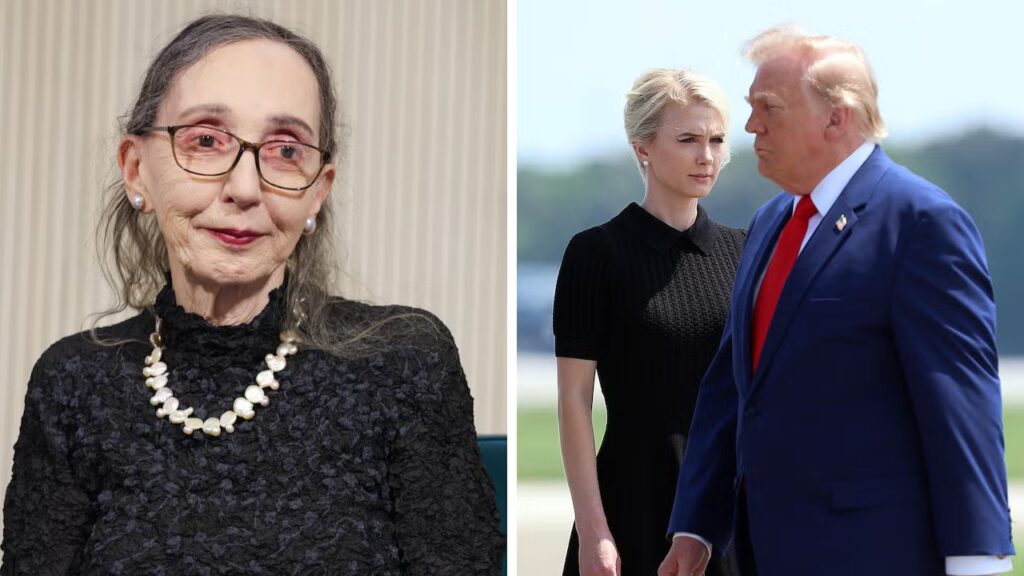
As scrutiny around Donald Trump’s relationship with 35-year-old aide Natalie Harp amplified Tuesday, author Joyce Carol Oates took to social media to compare the assistant’s devotion to the president to Charles Manson and his young female followers.
“The more one learns about Manson, the more disturbing. But Manson himself was very damaged; believed to have been brain-damaged in childhood,” Oates wrote on X, retweeting what she called a “fascinating” comparison that exclaimed Manson’s murderous cult of brainwashed young women may help to “understand the Natalie Harps and Trumpettes.”
“Whatever Trumpettes and the Natalie Harps and Manson girls didn’t get from their father, mother or family they found it in Trump the sex assaulter/Manson the murderer,” the X account @NationGrandma tweeted Monday. “That’s how that works. We are watching the brainwashing live in living color during the 21st century.”
Oates commented elsewhere on Harp as the presidential aide set the internet aflame Tuesday, writing on X that it would have been “easier just to go to graduate school and get an advanced degree” rather than commit her life to Trump. She added that as a fiction writer, she found Harp’s rise to prominence in the public eye “fascinating.”
“Quite a tale to tell of the young woman so bereft by life (apparently) that she has a sort of religious conversion fixing her life upon an elderly ‘father figure’ — (I know, it is absurd to think of T***p as fatherly or familial in any way, but what we call ‘transferences’ are illogical),” Oates reflected, adding that the story would best serve a movie adaptation or a “first-person novella.”
“Having never experienced the phenomenon called ‘transference,’ I can only speculate on its power to transform a life; often, to give meaning to a life bereft of meaning, even suicidal,” she wrote.
Read the author’s tweets in full below:
yes, fascinating. the more one learns about Manson, the more disturbing. but Manson himself was very damaged; believed to have been brain-damaged in childhood. https://t.co/wrDRzxB6qO
— Joyce Carol Oates (@JoyceCarolOates) August 18, 2026
I think that this is an interesting story but don’t feel the alarm or disapproval that many do; that is the predilection of a fiction writer–that “story” is in itself fascinating. quite a tale to tell of the young woman so bereft by life (apparently) that she has a sort of… https://t.co/4ahiQ4AhUC
— Joyce Carol Oates (@JoyceCarolOates) August 18, 2026
somehow, & maybe many of you won’t agree, but it’s easier just to go to graduate school & get an advanced degree. https://t.co/4ahiQ4AhUC
— Joyce Carol Oates (@JoyceCarolOates) August 18, 2026
Oates was just one of the innumerable voices online weighing in on Harp and Trump’s relationship this week after Sen. Jon Ossoff (D-Ga.) name-dropped her briefly during a campaign rally on Sunday. The senator said Trump wants to “build his ballroom and travel with Natalie” instead of doing his duties as president.
The nonspecific mention of “Natalie” led to a widespread effort to untangle what Ossoff meant by the aside — with many on the right railing against the senator for insinuating an inappropriate relationship between the president and his staffer simply for pointing out the fact that they travel together. Harp, after all, was reportedly the only female companion brought on the president’s secret third plane out of Turkey at the NATO summit last month while others, including former Press Secretary Karoline Leavitt, were left on a decoy Air Force One flight while under threat from Iran.
White House officials responded to Ossoff’s Sunday speech by labeling him a “feminine theater kid” and “lightweight” (spokesperson Davis Ingle) and coining the term “Jon Jackoff” (communications director Steven Cheung).
In short, Harp is a devoted personal aide to Trump who began working at the White House in January 2025. She’s a former host from the One America News Network and memorably said at the 2020 Republican National Convention that Trump saved her life via his signing of the Right to Try Act that allowed her experimental treatment for Stage 2 bone cancer. (There have since been reports that Harp’s experience with the treatment was fabricated.)
“When I failed the chemotherapies that were on the market, no one wanted me in their clinical trials,” Harp said at the time. “They didn’t give me the right to try experimental treatments, Mr. President. You did, and without you, I’d have died waiting for them to be approved.”
That mentality has appeared to fan Harp’s desire to serve the president — and according to biographers Maggie Haberman and Jonathan Swan, Trump knows it. In “Regime Change,” their book on Trump 2.0, the authors recount the president telling other staffers that “all of you will go off and make money. She’ll never leave me.”
The post Joyce Carol Oates Shares ‘Fascinating’ Parallels Between Natalie Harp’s Trump Devotion and Charles Manson Girls appeared first on TheWrap.