The American Israel Public Affairs Committee, the powerful pro-Israel lobby, has spent tens of millions of dollars on key congressional campaigns, but its latest mark is a California Democrat in a once-sleepy race.
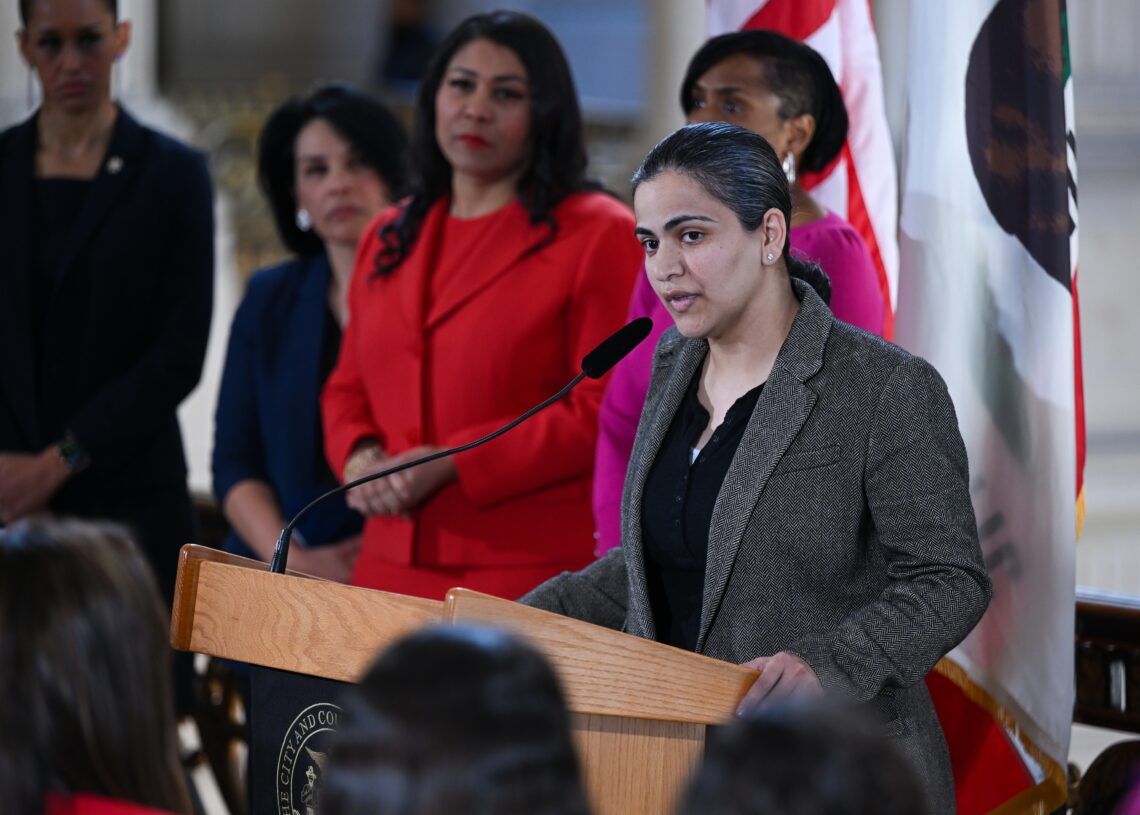
AIPAC’s super PAC, United Democracy Project, poured nearly $2.5 million into a Tuesday runoff between two Democrats competing for the House seat vacated by former representative Eric Swalwell (D). The groups have run ads against state Sen. Aisha Wahab, a progressive endorsed by the California Democratic Party, and boosted her moderate opponent, Melissa Hernandez, a San Francisco Bay Area transportation official. The winner will serve the rest of Swalwell’s term after he resigned amid a sexual assault allegation.
Wahab is considered the favorite in the election to replace Swalwell, who had a generally pro-Israel voting record. Wahab and Hernandez will face off again in November for a full two-year term.
The outside spending in the runoff plunged it into the battle between the Democratic Party’s moderate and progressive flanks, which are often divided on support for Israel. As the war in Gaza approaches its three-year mark, killing tens of thousands of Palestinians and leaving more displaced, public support for Israel has plummeted, especially among Democrats. In Washington, a striking number of House Democrats recently voted to cut off military aid to Israel.
The AIPAC group has spent tens of millions of dollars this year on Democratic primaries with mixed results. Support from AIPAC has been used as a cudgel against Democratic candidates, as it has become increasingly synonymous with the party’s broader struggle over where it stands on supporting Israel in foreign policy.
Abdul El-Sayed, a fierce critic of military aid to Israel, narrowly won the Democratic primary for an open Senate seat in Michigan in early August, despite AIPAC spending more than $30 million to oppose him. El-Sayed turned AIPAC’s intervention in the race into a regular attack on his opponent Rep. Haley Stevens, a staunch Israel supporter. But the group has had more success influencing House races, which are usually lower profile.
In the California contest, Wahab has said she considers the war in Gaza a genocide and opposes military aid to Israel. Hernandez has said she believes Israel had a right to defend itself after the Oct. 7, 2023 attack by Hamas that left about 1,200 dead, but that the destruction in Gaza has “gone too far.”
Neither candidate has focused on Israel during the campaign, but the groups with ties to AIPAC spent about 75 percent of the more than $6 million in spending by groups outside the campaigns in July and August.
Wahab, the first Muslim elected to California’s state Senate, has decried AIPAC money spent on attack ads against her.
“As to AIPAC, right now, a national division around Party leadership and their donors has gotten tripped up into this hyper local contest featuring candidates of vastly different offerings,” Wahab said in a statement. “Voters will decide, not DC, who they want.”
In a statement Monday responding to questions about AIPAC spending, Hernandez said none of her donors “sets my agenda.”
“The coalition that is actually on the ground with me is local,” she said.
AIPAC’s aid has largely hinged on a candidate’s stance on Israel, but the political advertising the group funds rarely mentions Israel. In California’s 14th Congressional District, the ads from groups associated with AIPAC have attacked Wahab’s state Senate record, including on legislation related to child sex predators. Wahab’s campaign has said the attack ads are misleading.
In the 14th district special primary on June 18, Wahab’s vote share was 26 percentage points higher than Hernandez, but neither candidate received a majority so they advanced to a runoff.
Wahab also had a similar lead in the June 2 regular primary for a full term. Their Democrat-Democrat matchups were enabled by California’s unique primary system, where the top two vote-getters advance regardless of party.
Other groups who aim to counter AIPAC’s influence in politics have spent six figures to support Wahab, including the liberal pro-Israel, pro-peace group J Street and the pro-Palestinian super PAC, American Priorities.
Another PAC, Bold America, which received some funding from AIPAC, spent $2.6 million to boost Hernandez.
AIPAC’s super PAC, the United Democracy Project, and Bold America did not respond to requests for comment.
AIPAC has been among the biggest spenders in other House primaries, notching wins in races including the contest to succeed retiring Rep. Steny Hoyer (D-Maryland) and the challenge to Rep. Thomas Massie (R-Kentucky), a fierce critic of Israel. But its preferred candidates also lost in a pair of Illinois primaries and a special election in New Jersey.
AIPAC’s defenders have said the organization has faced unfair and outsize criticism compared to the other special interest groups that have spent on American elections.
Robert Dempsey, national political director for Our Revolution, the Bernie Sanders-founded advocacy group that has endorsed Wahab, called the cash influx a “real desperate attempt” to boost Hernandez.
“Really what this means is just more establishment trying to put their thumb on the scale and just get another moderate elected just to maintain the status quo,” he said.
The post After bruising loss in Michigan, AIPAC turns to California for win appeared first on Washington Post.