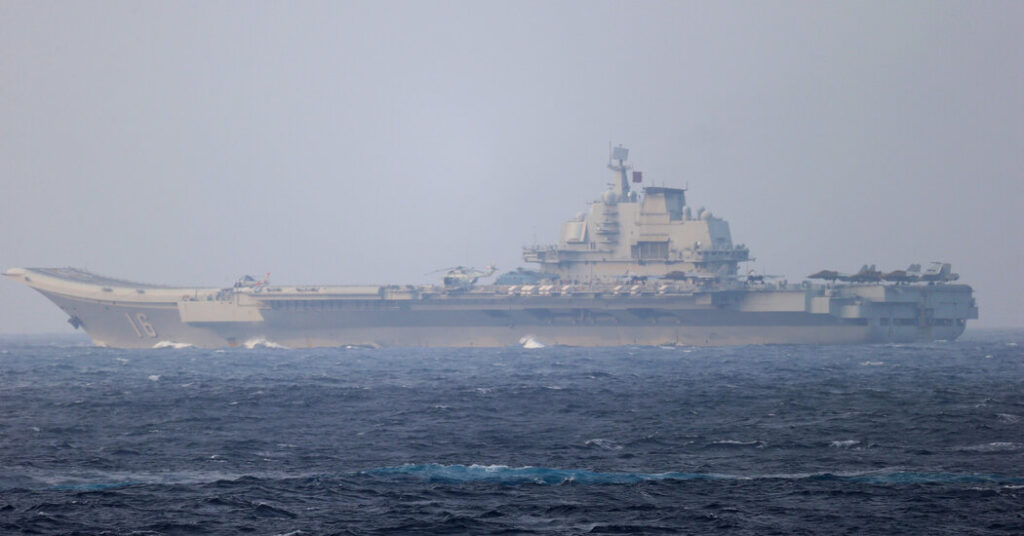
Japan on Sunday accused China of training military radar on Japanese fighter jets near Okinawa, adding to tensions between the two countries that have escalated over the last several weeks.
Japan’s defense minister, Shinjiro Koizumi, held an emergency news conference shortly after 2 a.m. on Sunday to detail the event and chastise the Chinese government, saying it had committed a “dangerous act.” Hours later, China disputed the account, saying that its navy had been holding training exercises in the area and that Japan’s claims were “inconsistent with the facts.”
China has unleashed a wave of political and economic reprisals against Japan in recent weeks over its support for Taiwan, a self-governed democracy that China claims as its territory. The feud has put the region on edge, with China stepping up patrols near disputed territories and vowing to “resolutely respond.”
Japan’s Defense Ministry said it recorded two separate incidents on Saturday in which Chinese F-15 fighter jets directed radar capable of aiding strikes at Japanese F-15 aircraft flying over international waters southeast of Okinawa’s main island. The area is close to islands claimed by both China and Japan. The Chinese aircraft were launched by the Liaoning, China’s first aircraft carrier.
“This radar lock-on incident constitutes a dangerous act that exceeds the scope necessary for the safe flight of aircraft,” Mr. Koizumi said in a statement at the emergency meeting. “We view the occurrence of such an incident with utmost regret, and we have lodged a strong protest with the Chinese side while making a stern demand for measures to prevent any recurrence.”
Chinese officials took issue with Japan’s claim. Wang Xuemeng, a spokesman for the Chinese Navy, said in a statement that the Liaoning was carrying out “routine carrier-based fighter jet flight training” that had been announced in advance.
“We solemnly demand that Japan immediately cease its slander and smear campaign and strictly restrain its frontline actions,” Mr. Wang said. “The Chinese Navy will take necessary measures in accordance with the law to resolutely safeguard its own security and legitimate rights and interests.”
Relations between China and Japan deteriorated in early November, when Japan’s prime minister, Sanae Takaichi, told the Japanese Parliament that a hypothetical Chinese attack on Taiwan could incite a military response from Tokyo. China responded furiously, accusing Ms. Takaichi of crossing a “red line” and demanding a retraction.
Ken Jimbo, a professor of international politics and security at Keio University in Tokyo, said that China appeared to be increasing the scale and scope of exercises by the People’s Liberation Army near Japan and Taiwan, as it has done during previous disputes.
“China aims to condition the region to accept greater P.L.A. activity around Japan and Taiwan,” he said, “especially to deter potential Japanese or U.S. involvement in a Taiwan contingency.”
To punish Japan, the Chinese government has urged millions of tourists to avoid Japan, restricted Japanese seafood imports and increased military patrols. It has also tried to curb Japanese culture in mainland China, canceling events by Japanese entertainers and halting the release of Japanese films.
The fighter jet episode on Saturday recalled another flare-up in 2013, when Tokyo accused Beijing of directing military radar at a Japanese naval vessel and helicopter near disputed islands. China also denied that accusation, saying Japan was trying to fan tensions.
Pei-Lin Wu and Miharu Nishiyama contributed reporting.
Javier C. Hernández is the Tokyo bureau chief for The Times, leading coverage of Japan and the region. He has reported from Asia for much of the past decade, previously serving as China correspondent in Beijing.
The post Japan Says China Aimed Military Radar at Its Fighter Jets appeared first on New York Times.