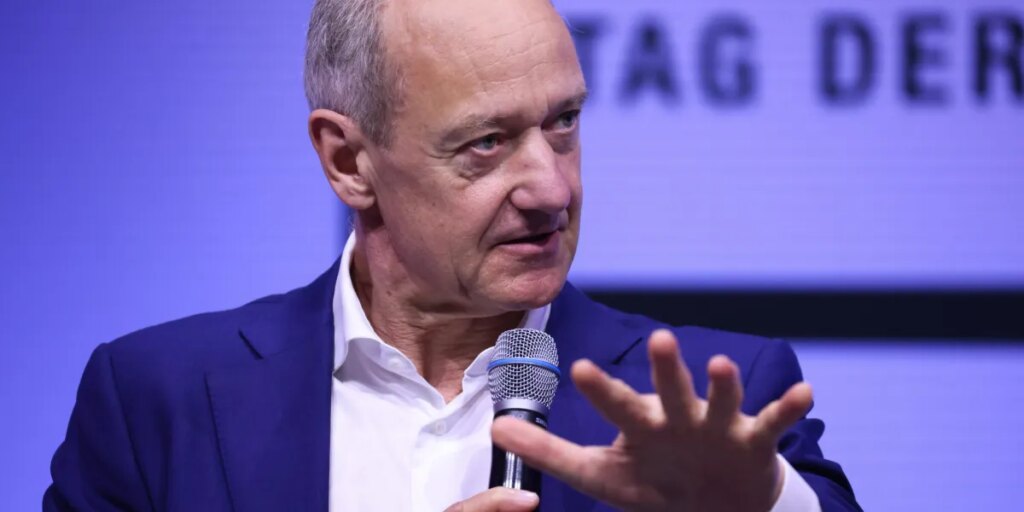
Keeping your email inbox under control can feel like a full-time job in itself—with endless streams of messages making it difficult to separate what actually matters from the noise. Roland Busch, the CEO of Siemens, has a decisively minimalist approach: skipping email etiquette in favor of efficiency.
“I try to keep my inbox below 100. If you have more than 100 emails in your inbox, you lose the overview of what’s actually on your plate,” Busch told Business Insider. “I accomplish this by answering messages quickly and using a few words.”
Oftentimes, those few words are simply “OK” or “No.”
“I make it simple and fast. My team is trained to communicate this way. If I need to write something longer, I dictate my response while walking through the office.”
That same emphasis on efficiency extends to how the 61-year-old manages his time with his direct reports. Rather than scheduling recurring one-on-one meetings, the leader of the $256 billion German engineering company—No. 143 on the Fortune Global 500—keeps his door open and lets his executives come to him when they need to.
“Because I value efficiency, I don’t have recurring meetings with my direct reports. I tell them, ‘You come to me whenever you need me,’” Busch said. “It could be five times a week or once a month. I don’t need to entertain people, and they don’t need to entertain me.”
From physicist to CEO of Germany’s largest publicly-traded company
Busch joined Siemens in 1994 and spent nearly three decades climbing the ranks before becoming CEO in 2021. During his tenure at the helm, Siemens’ stock has more than doubled, and the engineering giant is now the largest company in Germany and third-largest in Europe by market capitalization.
But Busch said the biggest influences on how he leads didn’t come from traditional leadership backgrounds like obtaining an MBA from business school. Instead, he holds a Ph.D in physics, and his first role at Siemens was researching energy technologies including fuel cells, offshore wind, photovoltaics and high-temperature superconducting transmission lines.
That scientific training has been core to how he approaches the complexity of running a global company, he said.
“As a CEO, you’re always making decisions with incomplete and ambiguous information. Physics taught me how to de-layer a problem, separating the core issues from the less important ones,” Busch told BI. “Once you isolate the core variables, you have a much better chance of making the right decision.”
Fortune reached out to Siemens for further comment.
Meetings are increasingly a thorn in the side of CEOs—with Jensen Huang and Jamie Dimon cutting them back
Busch isn’t the only CEO pushing back against the traditional meeting-heavy corporate calendar.
Nvidia CEO Jensen Huang has said he similarly eliminated one-on-one meetings with his dozens of direct reports.
“I don’t do one-on-one’s with any of them,” Huang said at the Stanford Institute for Economic Policy Research summit in 2024.
His rationale is rooted in transparency: there shouldn’t be much he tells an individual executive that he wouldn’t want the rest of the company to know, he said.
“In that way, our company was designed for agility,” Huang added. “For information to flow as quickly as possible. For people to be empowered by what they are able to do, not what they know.”
Southwest Airlines CEO Bob Jordan has also warned that executives can mistake a packed calendar for productivity.
“When you first start, it’s easy to confuse busyness and going to meetings with leadership,” Jordan said on a panel of CEOs at the New York Times DealBook Summit last year. “…Because what we all find, I’m sure, is there’s no time to ‘work,’ and you confuse going to meetings with the work.”
Jordan has since made it a goal to keep his calendar clear every Wednesday, Thursday and Friday afternoon, giving himself time to focus on work outside of meetings.
“It’s so that you can work on things you need to work on. You can think about what’s important right now. You can call people you need to talk to,” he added.
But few CEOs have been more vocal about their disdain for bad meetings than JPMorgan Chase CEO Jamie Dimon. In his 2024 letter to shareholders, Dimon offered a blunt prescription for what he sees as a major drag on corporate productivity: “Kill meetings.”
He reiterated the point at Fortune’s Most Powerful Women summit last fall, arguing that employees should give meetings their full attention rather than multitask.
“None of this nodding off, none of this reading my mail,” Dimon said. “If you have an iPad in front of me and it looks like you’re reading your email or getting notifications, I tell you to close the damn thing. It’s disrespectful.”
The post Siemens CEO keeps his inbox below 100 with 2-letter replies—and has no recurring meetings with direct reports: ‘I don’t need to entertain people’ appeared first on Fortune.