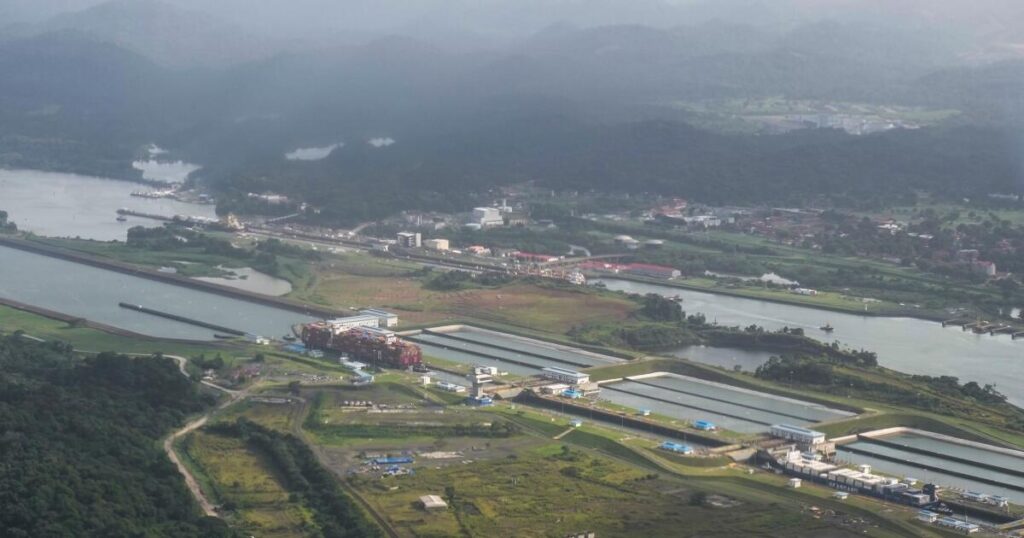
With waterways from the Panama Canal to the Strait of Hormuz and the Red Sea facing disruptions, Mexico is pitching a land route in the south as an alternative for global trade.
Mexico has invested at least $4 billion since 2019 to connect the narrow strip of land between a port in the Gulf of Mexico and another in the Pacific coast. The funds have gone toward putting more than 500 miles of rehabilitated railway into service, upgrading structures, modernizing ports and acquiring land for industrial development. Now, the Interoceanic Corridor of the Isthmus of Tehuantepec, or CIIT as the land route is known, is waiting for the cargo to arrive.
Mexico’s bet is that the 190-mile rail link between the two oceans could become a key route for freight containers and serve as a complement to the nearby Panama Canal, where droughts have driven up wait timesfor crossing from a couple of days to as long as three weeks. The El Niño weather phenomenon promises to make it worse.
Other global chokepoints are facing pressure, slowing trade and boosting costs. In the Middle East, the Iran war has brought traffic through the Strait of Hormuz to a halt. Elsewhere, Yemen’s Iran-backed Houthi militant group has threatened shippingvia the Bab el-Mandeb Strait in the Red Sea.
The reality is it would take years to permanently alter historical shipping routes. Even optimistic forecasts from the government aspire to moving 1.4 million containers a year by 2035, barely a fraction of the close to 20 million currently passing yearly through the Panama Canal. The two ports continue to lean on products they’ve long handled, such as oil or chemicals.
For Mexico, bringing its new trade route to life is also part of a broader attempt at boosting activity in the south of the country, where more than half of the population lives in poverty. It’s a critical opportunity for an administration working to revive investment at a time of weak economic growth.
“Mexico is trying to finally realize a logistical dream that dates back more than a century in what appears to be a truly serious attempt,” said Marco Cancino, an economist and public infrastructure expert at Inteligencia Pública, a Mexico City-based think tank.
But turning that geographic promise into an industrial corridor means confronting difficult terrain, scarce infrastructure, entrenched poverty — and a location far from the manufacturing centers of central and northern Mexico.
“The government’s challenge now is to make the corridor so attractive that there’s no question it’s a viable logistical option,” Cancino said. “So far, there’s serious doubts that it can be done.”
Mexico’s bet
In Coatzacoalcos, a muggy city that prospered during Mexico’s 20th century oil boom, weathered apartment blocks stand beside the faded signs of businesses long since closed. The airport has a single waiting area for the handful of flights it receives, while the highway that connects it to the city remains a two-lane road and is rarely congested.
Twice weekly, workers at the Port of Coatzacoalcos unload a rail ferry arriving from Mobile, Ala., under a punishing summer sun. Rail cars carrying chemicals like polyethylene and phosphates are rolled directly onto tracks that extend across the Isthmus of Tehuantepec. Then the port grows quiet, for days on end.
Mexico’s pitch is all about location. Salina Cruz, on the Pacific, is less than four days from Los Angeles and about 15 days from Shanghai — compared with as many as seven days and about 20 days, respectively, from Panama. Coatzacoalcos, on the Gulf of Mexico, is about 36 hours by sea from Houston and Mobile, and roughly two weeks from Rotterdam, Netherlands, and Marseille, France.
Mexican officials say freight can cross the “dry canal” by rail in seven hours, with the full port-to-port transfer completed in as little as 24 hours. Transit through the Panama Canal takes about eight to 10 hours once underway, but queues at either entrance can add to days-long delays.
“The idea is to position the corridor as a high-quality and a competitive alternative for the different disruptions that now we can see are going to be more frequent,” said Alejandra García Velásquez, the corridor’s general manager for business development and investment attraction, while showing the Atlantic port recently. “It will take a little more time to be part of an alternative.”
For the government, transporting goods across the strip of land is just the start of its goal of driving economic development, García Velásquez said. The bigger prize is persuading manufacturers to set up plants there that would generate raw materials, components and finished products, creating a recurring cargo along the railway rather than relying on companies to divert their shipments from Panama.
To do so, it’s aiming to bid plots of land for “development hubs” that would include industrial parks in the area. Only five of the 14 development hub concessions have been awarded, while the government has rescinded at least two other previous concessions after companies missed their investment commitments, according to people with knowledge of the matter. A spokesperson for the Navy said that nine of the development hubs are under CIIT’s control in order to “optimize implementation times and ensure that investment has the greatest possible impact.”
The plan aims to capitalize on the so-called nearshoring trend that picked up steam as the COVID-19 pandemic disrupted supply chains and led companies to set up in Mexico to be closer to the world’s largest consumer market in the U.S. That manufacturing activity, which grew in the north close to the border and in the well-connected center, led Mexico to overtake China in 2023 as the largest exporter of goods to the United States.
Despite tariffs enacted by President Trump on a slew of goods, Mexico has one of the most advantageous trade regimes with the U.S. in the world, thanks to the North American trade deal known as the USMCA. Mexican officials anticipate that this trade landscape will persist and stimulate investment, even as uncertainty over the agreement’s rules remains.
The two isthmus ports have started preparing for the pickup in activity. Hyundai transported 900 vehicles via rail from Salina Cruz to Coatzacoalcos in March 2025 ahead of their final shipment to the U.S. A subsequent initiative in July involved moving 3,000 Hyundai and Kia vehicles originating from Asia across the passage, bound for export to Philadelphia and Brunswick, Ga.
“We’re only just beginning to see commercial cargo moving through,” said Martín Zepeda, a former Navy officer in charge of the Coatzacoalcos port.
For now, both ports remain dominated by activities that have little to do with the CIIT. In Salina Cruz, the corridor’s Pacific exit, energy products and oil derivatives represented 95% of all cargo processed through the first half of 2026. While Coatzacoalcos benefits from a more diverse industrial profile — ranging from plastics to construction materials — freight accounted for less than 33% of its total volume this year.
Strategic location
The Tehuantepec corridor has been seen as strategic since pre-Hispanic times and was later used by Hernán Cortés as a launching point for Pacific expeditions. In 1907, Mexico’s President Porfirio Díaz inaugurated a line that carried sugar from Hawaii to Coatzacoalcos for shipment to Philadelphia. But the Mexican Revolution three years later brought the project to a halt. By 1914 when the Panama Canal was inaugurated, the project lost steam.
Despite various attempts at reviving the project, it wasn’t until President Andrés Manuel López Obrador took office in 2018 that the Navy began refurbishing the old rail path and drew plans for industrial parks.
López Obrador, hailing from the nearby state of Tabasco, pushed other projects in the south, including a tourist train in the Yucatan peninsula and a refinery — two projects that are far from breaking even. His successor, President Claudia Sheinbaum, expanded the plan for CIIT to include 14 development hubs. Both presidents have offered unusually generous incentives. Sheinbaum’s administration is overhauling the robust concession model set up by López Obrador after tepid investor interest in the industrial hubs.
A 25% down payment requirement for the land was scrapped, and more flexible terms are now on offer. Five-year concessions can be extended by five years and include the option of buying the land if certain investment targets are met. The longest concessions are as long as 30 years, with the possibility of a 20-year extension. The Navy said it would be able to assess the impact of the new concessions in the medium term.
One bright spot is in the corridor’s Pacific end, where a group including Portugal’s Mota-Engil and Mexican construction conglomerate ICA has completed a majority of its committed investment on an industrial hub. Its proposed logistics hub could handle vehicles, storage and potentially assembly operations.
Project complexity
Mexico’s southeast comes with entrenched challenges that explain why momentum has been slow. Manufacturing chamber Canacintra in July cited a lack of natural gas, weak road connections, insufficient basic services and legal uncertainty as reasons why occupancy remains at zero. Because the route is in a remote location, with high humidity and jungle terrain, road connectivity to the project and reliable electricity has been limited.
Electricity is the biggest constraint, with most sites having access to just as much as 30 megawatts of generation capacity, a fraction of what certain energy-intensive projects need. One proposed aluminum operation that has been greenlighted in the corridor would require about 400 megawatts. Government officials say an electrical substation will be built, but haven’t specified a timeline.
Another of the project’s complexities lies in integrating three rail lines — the main line across the isthmus, a line toward the gulf and southeast, and a third to Guatemala — with ports, industrial parks, freight and passenger services.
But the path itself has faced setbacks. A passenger train crossing in the corridor’s main railway derailed in December, killing 14 and injuring 98. The government attributed the crash to excessive speed and has announced plans to realign a stretch near the crash site. In July, two units of a freight train derailed on the same line — just days after the shipment of the Hyundai and Kia vehicles — though no one was injured. The case is under review.
Sheinbaum has made the corridor one of her priorities to invigorate economic growth, and holds progress reviews every two Thursdays, according to people familiar with the meetings.
García Velásquez points to the barren landscape and imagines that within a decade it could have specialized terminals for automobiles, containers and bulk cargo, along with a faster railway between the two ports. Still, experts say it’s not clear if the current disruptions in trade will be enough to encourage firms to turn to budding alternatives.
“Global trade has a lot of inertia, and to change this inertia requires a lot of pushes,” said Jean-Paul Rodrigue, a professor in the Department of Maritime Business Administration at Texas A&M University in Galveston.
For now, Mexico has built the crossing. Time will tell if the trade arrives.
Soto writes for Bloomberg. Bloomberg writers Jade Khatib, Alex Newman, Kate Lieberman, and Simon Hampton contributed to this report.
The post As global waterways are squeezed, Mexico pitches a ‘dry canal’ land corridor appeared first on Los Angeles Times.