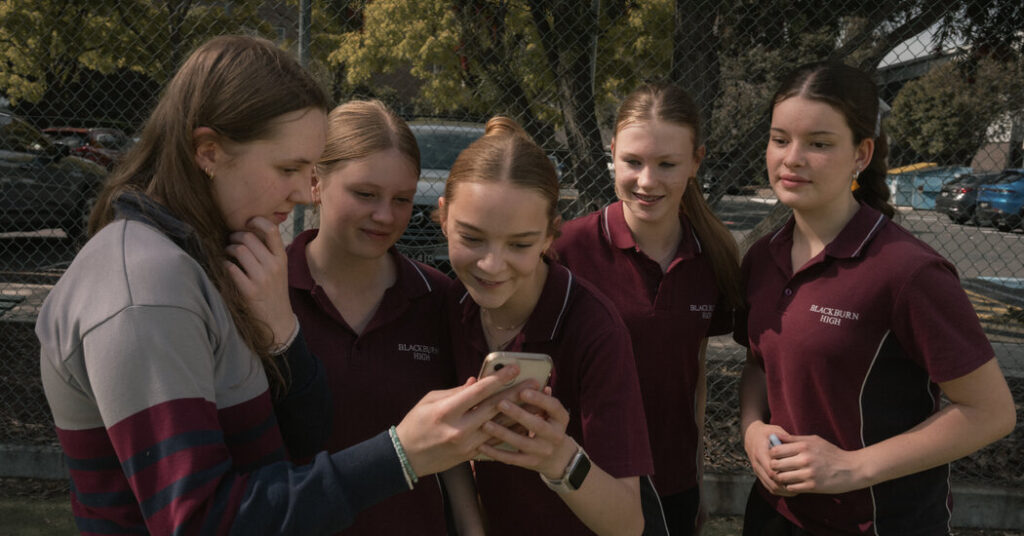
Darcey Pritchard, 15, deleted Snapchat off her phone about a year ago when she felt sucked in by its algorithm.
Her friend Luca Hagop, also 15, recently spent more than 34 hours on Instagram in one week, sharing pet videos and other reels “so random, they’re funny because they’re so unfunny.”
Amelie Tomlinson, 14, keeps up with her friends on Snapchat, and until recently, had almost no one’s phone number.
Her friend Jasmine Bentley, 15, is not allowed on any social media but dreams of being a content creator.
The two sets of friends, living in the eastern suburbs of Melbourne, Australia, offer a small window into the wildly different relationships today’s teens have with social media. But they are united on one front: They do not think a new Australian law that bars children under 16 from having social media accounts, which takes effect on Wednesday, will change their lives much.
Australia passed the law a year ago, setting itself up to be a test case for what many parents say feels like this generation’s Sisyphean task — shielding children from the risks associated with social media until they are capable of navigating it responsibly.
But these teenagers, born around the same time that Instagram and Snapchat were first released, are digital natives. Most know how to use VPNs, which may help them evade the ban. Many fudged their ages when they first signed up, to get around the minimum age of 13 for many social media services. Others have used their parents’ information to get accounts, or have older siblings whose identities they can co-opt.
More than anything, social media is just too deeply embedded into their lives.
“It’s how we communicate,” Amelie said.
Darcey said some of her friends had been talking about migrating to new apps. “You’re not going to stop these people,” she said.
Rewire Impulses?
In recent years, parents around the world have grappled with increasing alarm about social media’s detriments to mental health, potential to enable online bullying and effects on developing brains.
Australia was one of the first countries to pass a nationwide law to address those concerns. Last December, it set 16 as the minimum age for social media accounts, meaning hundreds of thousands of younger children would lose theirs. Other nations, like Malaysia, have followed suit with similar plans.
Australia is putting the onus is on the social media companies to keep younger children off their platforms and will not penalize parents or children who violate the law. Officials, including Prime Minister Anthony Albanese, have tried to tamp down expectations that the law will be an overnight fix.
They say they are supporting parents who feel powerless against the lure of social media and peer pressure among teens. Anika Wells, the minister for communications, described an almost idyllic new reality with children awash in time for sports, baking or learning a new language.
But it will be far from that simple. The lives and friendships of many 13- to 15-year-olds are enmeshed with social media — even if the children are not on it themselves.
For instance, when Darcey and her friends were playing an online guessing game, many of the clues were memes everyone else had seen on Instagram. When Amelie and a friend got to school 15 minutes before the first bell, they made four TikTok videos. When Jasmine puts on makeup, she will record herself, even though she is not on social media. And when Luca’s mother died a few years ago, he found it helpful to type out his feelings on an anonymous server on Discord.
Can a law rewire those impulses?
Currently, 10 social media services are covered by the ban: Facebook, Instagram, Kick, Reddit, Snapchat, Threads, TikTok, Twitch, X and YouTube. The companies have said that they do not believe a blanket ban is the best way to keep children safe, but that they will nevertheless deactivate accounts of children under 16.
“They’re ripping away something that has grown on us and become more part of our lives every day,” Jasmine said.
Two popular apps in Australia in the weeks leading up to the law were “Yope,” a photo sharing app targeting Gen Z, and “lemon8,” a TikTok alternative owned by the same parent company, ByteDance, portending a potential game of Whac-a-Mole with regulators.
‘It’s Not Our Choice’
Luca jokes that Darcey lives under a “1984” regime when it comes to social media and phones, a nod to the all-controlling government in George Orwell’s novel.
Her parents have set daily time limits on apps for her and her two younger siblings — for Darcey, five minutes on YouTube, 30 minutes for WhatsApp, 10 minutes on Spotify — and “downtime” overnight.
It is a careful equilibrium reached after many family discussions and a few charged, tearful fights. But it also means that after school on a recent afternoon, she spent hours talking to her father about her German homework, helping cook dinner and watching “The Simpsons” with her brothers, while her phone sat untouched in the designated spot on the kitchen counter. And when she found herself mindlessly scrolling on Snapchat, she herself decided to get off the app.
Caroline and Joel Pritchard, Darcey’s parents, said it seemed like a lonely uphill battle to restrict their children’s phone usage.
“It almost will feel like a bit of weight off our shoulders for the government to step in and go, hey, it’s just banned,” Mr. Pritchard said. “We can now turn around and say, ‘Hey, it’s not our choice.’”
Darcey, who has been talking and thinking about social media’s effects on her peers through her involvement in a youth-driven initiative called Project Rockit, said that limiting teenagers’ use was only delaying the problem, and letting companies off the hook from making their platforms free of potentially harmful content.
“It shouldn’t be the user’s fault,” she said. “The social media companies really need to take a bit more responsibility.”
Luca, her friend since primary school, has always had free rein over his internet and phone use. He found a creative game building community on Discord — which will not be affected by the law — and enjoys science videos on YouTube.
Instagram, he said, is just an easy pastime, which takes less effort than, say, setting up a board game. Even though at times he has felt “trapped” by its algorithm, he thinks he can outsmart it by shutting down the app when he sees videos he does not like.
“Today I liked a few dog reels in a row, and then I got only dog videos for a few hours,” he said on a recent afternoon, when he had stayed home sick from school.
His father, Adrian Hagop, said he had always trusted that Luca and his older brother were mature and responsible enough to make their own decisions, and believed they should learn to deal with problems they may encounter online, rather than coddle them from unknown perils.
His approach is to let them have those experiences and come to him to talk about it afterward if need be. Even after the ban, if Luca wants to be on social media, Mr. Hagop said he would help him get an account.
“Both my kids are fairly skeptical, so I kind of trust them,” he said. “I think it depends on the kid.”
‘The Horse Has Already Bolted’
When Amelie was trying to persuade her parents to allow her on TikTok, she pleaded her case in a five-page, single-spaced letter about not wanting to feel left out.
Her mother, Catherine Best, said she felt that parents had lost control years ago. When Amelie had just started primary school, Ms. Best deleted YouTube off her daughter’s school-required iPad because she was watching toy unboxing videos nonstop. The school insisted on reinstalling it because teachers used educational videos on YouTube in class.
“That was really the gateway,” said Ms. Best, who said the law was too little, too late. “I feel like the horse has already bolted.”
Amelie said that, like many of her friends, she had two TikTok accounts, both set to private: one for just close friends and the other for a wider group. The account with her friends has her age set to 19, so she was not worried about losing access.
But she was exchanging phone numbers with friends for the first time in anticipation of losing her Snapchat account. This month, the app prompted her to verify her age — set to 16 — with a selfie, and it approved her as being old enough to continue using her account, she said.
Amelie said she recognized how much she reached for her phone. Her screen time “goes nuts” on school holidays.
“It’s just an instinct to pick up my phone,” she said, “which I don’t like.”
Jasmine, a friend of Amelie’s since the beginning of high school, said she felt like her generation’s social media usage was misunderstood by grown-ups. Even though she is not on social media, her group of friends often film TikTok videos when they hang out.
“There’s a lot of creative freedom,” she said. “We’re doing other things than just watching videos and scrolling, there’s a lot more to it.”
Her father, Craig Bentley, said even if Jasmine was inevitably exposed to social media, he felt better knowing she would always be with a friend, rather than scrolling on her own.
Mr. Bentley, a high school teacher, said he had witnessed young minds shift as smartphones grew more pervasive, attention spans growing shorter and self-regulation dwindling.
As for the law, he said, any effect would be for the better. At a minimum, he said, it will send the message that Australia will not stand for these apps taking control of a generation.
“I hope there’s a revolution against it and we all just decide it’s not OK,” he said.
Victoria Kim is the Australia correspondent for The New York Times, based in Sydney, covering Australia, New Zealand and the broader Pacific region.
The post A Grand Social Media Experiment Begins in Australia appeared first on New York Times.