Editor’s Note: Read Julia Curlee’s full essay here.
Subscribe here: Apple Podcasts | Spotify | YouTube | Overcast | Pocket Casts
When Julia Curlee was a kid growing up in Hawaii, she dreamed of becoming an intelligence officer. In 2007, when she took her oath standing on the marble CIA seal, she achieved that goal. But she had another childhood dream too: She’d always had “an unshakable belief that I should have been born a woman.”
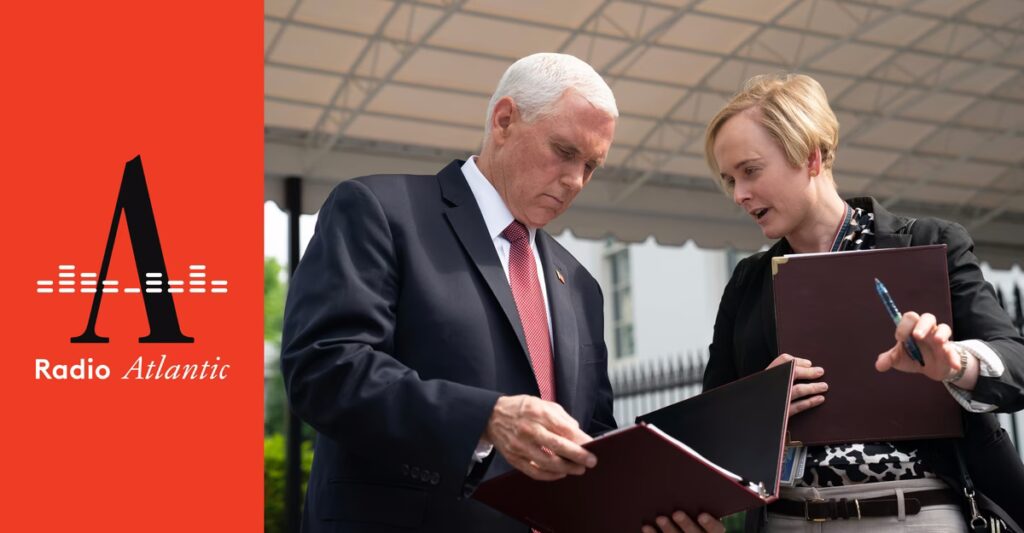
In 2013, Julia Curlee became the first CIA officer to transition openly and keep serving the agency. She felt more effective at her job living as the person she always believed she was—and years ago wrote about her experience under a pseudonym in The Atlantic. Her performance proved her effectiveness: She became the daily intelligence briefer for Vice President Pence during the first Trump administration and a director on the National Security Council in both the Biden administration and the second Trump term.
Less than 70 days after the president returned to office in 2025, Julia was fired from the White House without explanation. She returned to the CIA and, over time, began to feel a lack of support at the agency in an administration that was openly hostile to transgender people. Julia left her dream job with the federal government earlier this year. This week, she is telling her full story for the first time—in an Atlantic essay she wrote and in a conversation with Radio Atlantic.
The following is a transcript of the episode:
Julia Curlee: After everything I had been through with my service to the former vice president, my briefing for this president in the first term, and my war zones, my 20 years, all of it, “Be discreet” meant We need you. We need your service. But we don’t want anyone to know you are here.
Adam Harris: As a high-level CIA officer, Julia Curlee had the ear of one of the most powerful politicians in America: the vice president of the United States. He relied on her to let him know what was going on in the world each day. She held prominent intelligence positions during the last three administrations: Trump 1, Biden, and Trump 2. She is also a transgender woman.
For a long time, Julia had two dreams: to be a CIA officer and to be her authentic self. She realized the first in 2007, when she took the oath on the agency seal; the second in 2013, when she transitioned.
She made a promise when she did: never to hide who she was. Yet in 2017, she wrote two stories for The Atlantic under a pseudonym. She wrote about her experience; she wrote about what it meant for the intelligence community to accept people like her. The agency used it to help recruit on college campuses. Julia was using the discretion that came naturally for a CIA officer.
Now, after being pushed out of the White House and leaving an agency where she no longer felt supported, Julia is telling the rest of the story as herself.
I’m Adam Harris. This is Radio Atlantic, and today: a conversation with Julia Curlee.
Let’s get to questions.
Julia, welcome to the show.
Julia Curlee: Thank you, Adam. Thanks for having me.
Harris: Absolutely. So Julia, you served the United States for more than 20 years in intelligence positions. What was it that drew you to public service?
Curlee: Well, I grew up a barefoot kid in Hawaii, and I always wanted to see what was over the horizon and see the world and all that. And then, at some young, impressionable age, I was ambushed by The Hunt for Red October and the analyst as hero, getting to save the day. And, I don’t know, it sort of came out of nowhere and it sort of bubbled up in my life. And my parents definitely instilled in me a desire to serve our country, and intelligence just caught something in me and I wanted to be a part of it.
Harris: When you joined, was it everything you imagined?
Curlee: Oh, many more late nights and long PowerPoint-presentation sessions.
Harris: So not quite like the movie?
Curlee: Not so much, yeah. I didn’t call in many drone strikes on my way to the PowerPoint presentation that you would sometimes see in the movies. Did not repel off a helicopter into a submarine too many times.
But it was an amazing and wonderful career. I got to travel to 35 countries. I briefed several presidents. It was just all I wanted to do, and I desperately wish I was doing that now. It’s the only thing I ever wanted to do and it was the only plan I ever had.
Harris: And today you’re writing in the pages of The Atlantic, telling your story for the first time under your own name. Why now?
Curlee: Well the institutions that I served through my adult life are under assault. The ability of officers to speak truth to power, to inform policy making so that they make the best decisions on behalf of the United States—that is being eviscerated. And the officers who deliver that, who spend their lives learning about foreign countries, learning how to systematically understand multiple sources of intelligence, convey uncertainty—all of that is being destroyed by an administration that wants to both cherry-pick the intelligence to only receive what they want to hear, and to punish the officers who have the courage to speak that truth to them, to do their jobs and to live up to the values that we inculcate in all of our officers. And so the only way to do that was to leave and to begin to tell my story.
I also felt like I needed to tell the other part of my story, which has nothing to do with my substantive experience in the world, and that’s being a trans person. And I know that the sustained assault on people like me is a part of a broader campaign to try to define who gets to be in public spaces, who gets to have positions of honor.
Harris: I want to talk about that service and about your transition while you were in the service. You transitioned in 2013, and did you have concerns when you were transitioning? What was that first day going into the office like?
Curlee: Well, it was the most terrifying day of my life. And that was in the wake of several war-zone assignments and being rocketed, and I didn’t know whether it would be the last day.
You know, as I already said, I’d always dreamed since I was a kid of being an intelligence officer. The other dream that I’d always had that was unexplainable was just an unshakable belief that I should have been more born a woman.
I didn’t know where it came from. It just was always lurking in the background. And over time in my life, it became this just unshakable darkness that clouded out everything else. And finally, I came to the conclusion I had to transition. The only problem, of course, is that there were no trans people. The last time someone at CIA had tried to transition had been decades before, and it had been terrible. The person had been driven out of the organization, in a hostile workplace, and management had not been supportive. And so I contacted the LGBT group to say, Hey, I’m here. I’m here to meet other people and get some help. And they said, Congratulations, but you’re the only one.
And that is what led me in 2017 to write in pseudonym in The Atlantic under the name Jenny Hall. And it was an opportunity to get the word out that people like me are a part of our national security, that we’re patriots, that we want to serve, that we don’t want any special rights. We just want what everyone else has.
And so I was very happy to get to do that. And in the years following that, CIA actually used those articles on college campuses to recruit people. And I was very proud of that, but I was also very, very happy to disappear back into my day job, in the work.
And so, you know, in short, my transition in those years was a big “nothing significant to report,” in the lexicon of my profession, and that was the best possible outcome.
Harris: So when you talk about the work, this is 2017; the first Trump administration has just begun. What were your concerns? Did you have concerns ahead of that first Trump administration about their policies, or the platform, regarding transgender people?
Curlee: You know, going into that term, it really hadn’t been in the political realm very much. I mean, it honestly wasn’t a big issue. It only really became, in my consciousness anyway, a big political issue when the president, the first time, banned trans people in the military, which was a shock, because for a lot of us it was a rock-solid belief that progress is linear, that things you gained might slow down, but, you know, the long arc, and that things would get better. And this was a case of it regressing in a significant way.
And I knew several trans intelligence officers who were in uniform who were doing the same job that I was doing at CIA, and they were being told that by being honest, by which the previous administration had told them they could be, that they would be thrown out and that their careers would be destroyed just for being themselves. And so I also wrote about that to try to make the case in a good-faith way to our leaders that this was the wrong decision and that it would hurt our national security.
Harris: So you gave the president’s daily brief during that first Trump administration. Can you tell us what it means to do that job and what all it entails?
Curlee: Yeah, so as a baby analyst, you imagine yourself being that briefer in the room with the commander in chief or briefing on Air Force One. It was the thing that most of us aspired to at the end of a long career. And initially I was assigned to the deputy national security adviser in the White House. And boy, it was like cramming for a final exam every morning from midnight to 5 a.m. or so. And then at some point there, you’re whisked downtown and you come to the White House when it’s pitch black and you check in with the Situation Room, and you’ve got these pieces that you’ve been studying. And so I would get to the White House and I would find my—I’d be the first person that would see my policy customer when they came in the door in the West Wing, the deputy national security adviser, at first, and I would be in there for 15, 20, 30, 40, 50 minutes, and it would be 20 questions, and it would be firing things at me and asking me to follow up with taskings. And it was just exhilarating for a person that was a news junkie who wants to be plugged into the information universe, just wanting to be available to help these policy makers make good decisions. And I did that for two years in total for the Trump administration for the first term.
Harris: And so, while you’re in the Trump administration, you begin giving the president’s daily briefing, and you begin giving that briefing to Vice President Mike Pence. What was the experience of first meeting him like?
Curlee: Yeah, so I’d been in the PDB for a few months, and it was wonderful. And as much as I loved roaming the West Wing of the White House before dawn and no one caring apparently that a trans woman was serving the highest levels of the Trump administration, my boss walked into my office one day and said, you know, Julia, what would you think about briefing the vice president? And I looked up at her and I said, This vice president?
And she said, Yeah, I think you’d be the right pick for this. And I took her word for it. And so, the first time I was standing in the driveway at the Naval Observatory when there he was, unmistakably, with his silver-white hair, and he turns to his outgoing briefer and said, You’re gonna abandon me with her? And it was his dad-joke humor, and there I was, and it was just me and Mike Pence.
And I discovered that he was an excellent intelligence customer. He took the book, he took the briefing almost every day, religiously. He took rapid notes and would be firing questions at me. And he really impressed me with how seriously he was taking the job of being this consumer of intelligence, this massive, multibillion-dollar apparatus we’ve built out to help our leaders make better decisions. And he was using it as I would have hoped he would. And in a broader administration where that was not always the case, I really felt like I could really do good, and support him as he participated in these policy conversations. And it was a real pleasure. It was truly the thing that I had been training and and wanting to do since I’d been a kid. It was like the experience that I dreamed of.
Harris: Yeah, so he was really relying on you for your expertise?
Curlee: Yeah, I mean, I would be one of the first people he would see in the morning. It has been described to me that a PDB briefer is—part of your job is, like, helping to filter the world so that a policy maker whose most precious commodity is time can know what are the really big issues to focus on. And I would play that part in his day, in focusing him on the key events happening in one part of the world versus another, teeing up information so that I would know what policy-making meetings he was going into or heading on a foreign trip, and I would be trying to anticipate his needs, and then when he asked a question, ensure that it was rapidly answered as quickly as possible. And so getting to travel with him around the world, getting to be a part of the team that follows the vice president, was truly an amazing privilege.
And for all of the fears and my own trepidations—I wasn’t ignorant of his public persona. It truly was a great experience, and I got to see our government operating as it should.
Harris: There’s probably some dissonance there, right, between that public persona and the private persona? How do you square the difference between the public policy and and the person who you engaged with on a regular basis?
Curlee: I don’t know, and I don’t want to suggest that I know his personal views. What I know is what I experienced. I experienced being treated with great respect, being treated as a serious professional, being trusted. When my tour was over, he asked me to extend. So that was a conversation to have with my wife.
But I had been raised in a CIA that had trained into us that we serve regardless of who sits in the Oval Office, that we are nonpartisan civil servants who will support them with the best information possible. And he was the vice president and needed the best information possible. And so what I would do is I would put that to the side.
It was the fulfillment of what I had always wanted to do, and there were moments like when my tour was finally coming to an end and he invited my family to the White House, and he took my mother’s hand—and this is my mother who had had a really hard time with my transition years before—and Mike Pence took my mother’s hand and says, You must be very proud of your daughter.
And I’m sitting there watching this and I’m thinking, We’ve arrived. There’s no more battles left to be won. I mean, it’s not, that wasn’t true, but it just felt like the two dreams that I’d had since I was a kid, which I had always felt were just completely incompatible.
Harris: You write about the moment that the vice president certified the election and how there was a certain sort of kinship between the two of you around that service, right? That you mentioned the, sort of, bargain, right? The exact quote was, “That was the bargain: service before politics, country before self.”
Can you tell me about that moment? What that moment signified for you?
Curlee: So, this was a few days after January 6 and I had been done briefing him for several months at that point. And he brought us all together, and we were in his West Wing office just down the hall from the Oval, and we went around talking about what serving in this role had meant to us. And I told him that moment, when he had prioritized the country, when he had certified the victory of his opponent in the election, that I was never more proud to have served as his briefer.
And he, you know, he took my hand; we shook hands, and he said that meant a lot to him.
And that is what the bargain meant to me, was the fact that despite our almost certain profound differences of views on many subjects, we could put that aside and treat each other with dignity and do what was right, regardless of our politics and the political cost. And it was a very special moment for me and everybody who was there.
Harris: So, after four years of the Biden administration, the Trump administration comes back for a second time, and people begin to decide whether they should stay or go. So what advice were you getting about what you should do?
Curlee: It was fairly uniform that we should all leave. So during the campaign I had been serving at the White House; I served for about 20 months in the Biden administration as a director for intelligence programs in the NSC. And all throughout that period, it was wall-to-wall TV. I remember standing in the sit room, looking up at one of the many screens and watching these scary images of people like me and hundreds of millions of dollars being poured to create this caricature that somehow trans people were a threat to America and tar the Democratic candidate with association with these scary people. And I’m watching this and in horror that I’m witnessing on the TV the same kind of dehumanization that I’d written PDBs about in my career.
And so, but, despite all of that, despite the warnings from our leadership that they were very afraid for us, that we would be targeted, that it would destroy our careers, that the online mob would be summoned against us—despite all of that, I was the trans woman that briefed Mike Pence. I believed fiercely in the idea of nonpartisan civil service to whoever is the president. And I was not going to walk away from this task that I had been given to help with the peaceful transfer of power of an administration.
And so, the only person in the whole White House, I have to say, who asked us to stay was the president. And I believed it, that was the right decision. And I still believe it still. But almost everyone that decided to do that has paid a price in some form or another.
And so when the politicals departed, about a week out from the turn of administration, I was asked to serve as the acting senior director for intelligence programs. And so I was there when the new team arrived on Inauguration Day. I was there in the West Wing as people were still finding their offices, as people were moving in the furniture and moving in the new furniture, when the vice president arrived and saw his office for the first time. I was there to help the new administration get off the ground. And I did. And for day after day, we did that until the third day, when the administration, while I was briefing the deputy national security adviser, summoned 160 NSE detailees from departments and agencies to a group call and told them they had 15 minutes to get off the compound.
I walked out of my briefing with a handful of taskings that I knew I needed to get to the intelligence community as quickly as possible. And my assistant intercepts me on West Exec, the road between the White House and the EEOB, where my office was, and says, Everyone’s fired except for you. And I was in shock at the recklessness and the callousness of it. And so over the next several days, it was a mess.
And so for the next 69 days, I and the few people from my team that I could bring back served until one day on a Saturday, I’m down in Roanoke, Virginia, with my family, and I get a phone call that says that my tour is over. The chief of staff called. I can’t give you a reason why. You’re gone. You’ll be sent back to CIA. But if you don’t mind, we’d still like you to come in on Monday.
Harris: So you were removed from your position and asked to come back in.
Curlee: Yeah, in the same phone call, you know, fired on Saturday but needed on Monday. But I was warned in that call to be discreet. And I still didn’t understand what was happening until I got off the phone and my iPhone was was bombarded with friend after friend after friend forwarding me a tweet that said, that announced to the world, that there was a trans Biden holdover who hates President Trump in the intelligence directorate, and please give me this person’s name so that I can out them to the world.
And I was terrified of what that would mean for me and my family. But Monday came and I came to work anyway. And I served for another three days to help finish off an important budget item that I had been working on, to turn over a portfolio that I had managed at that point for almost two years, and it was that third night, my last day there, that a list of enemies within the administration was given to the president. And it was yet another purge of people with decades of experience, including my boss at the time.
And, you know, as I was leaving the White House for that last time, with my little box of mementos from two years of serving at the White House, you know, this dream come true, it really hit me what “Be discreet” meant in that point, after everything I had been through with my service to the former vice president, my briefing for this president in the first term, and my war zones, my 20 years, all of it, “Be discreet” meant We need you. We need your service. But we don’t want anyone to know you are here.
And that has stuck with me ever since, and why I have to tell my story, because they’ve taken from me my calling. I can no longer serve. I couldn’t use the bathroom. When I was at the White House, I had to cross the street to coffee shops across Pennsylvania Avenue in order to just get through the day. And the same restrictions followed me back to CIA. And the constant fear of being fired for being who I am just—I couldn’t continue.
But the one thing I can’t allow for me is for the fact that what has happened has already happened. It can’t be undone. And so telling my story is a part of putting that on the record, that someone like me can serve in the White House, can brief a president, can serve honorably, and loves their country.
And so I had to tell this story.
Harris: You mentioned the list of enemies landing on Trump’s desk, and the tweet hunting for the transgender intelligence person in the White House. That tweet and the list came from Laura Loomer, who is a far-right provocateur.
If she never posted that tweet, if that list had never gone out, do you think that you might still be in the White House?
Curlee: I think I probably would have reached my limit at some point in terms of my family, and it would have been time for someone else to come. But I fully intended to keep serving, and at the time it was funny. In that same conversation that I was in with the deputy national security adviser, briefing him on some very sensitive, important programs, he asked me when my tour was over, and I said, Well, sir, it’s been—it’ll be two years and just in a couple months, and, you know, I gotta get home and I’ve got a family. And he said, Hmm, June. I don’t think that’s gonna work for us. And so, I was already starting to think how I was gonna have this conversation again. But I wanted to keep serving, and keep serving at CIA. That was my only plan, and I’m just sad that it became impossible.
Harris: I want to home in on your expertise. You’ve said that what Americans should be concerned about is this wider assault on expertise in this administration, and especially in the intelligence community. So are we already seeing the consequences of that assault on expertise and elimination of expertise?
Curlee: I’m regretting to say we are, and it’s all around us in the evidence of disastrous policies. But to back up a second, you know, the same assault on trans officers, on other minorities, was accompanied by a parallel attack on the ability of our officers to speak truth to power.
So, one of the things that happened early in the new administration was I was asked to send a tasking to the intelligence community on the status of this group Tren de Aragua, which was a Venezuelan street gang. And the tasking was whether the Maduro government had ordered this group to invade the United States, which is the predicate for invoking the Alien Enemies Act almost verbatim, and I tasked it out to the National Intelligence Council, where the chairman of the NIC, which is the most senior analytic body in the intelligence community, dutifully wrote an excellent assessment that reflected the consensus position of the intelligence community. And he and his deputy, when they delivered the product, which did not accord with what the administration wanted to hear, were told that they should rethink their assessment. And when they refused, they were ordered out of the building. And publicly firing one of the most esteemed officers in the intelligence community and their deputy for living up to the values that we inculcate in every young officer was a devastating blow to the whole organization.
And it has had ripple effects all through. And it is just further attacks on officers for assessments that they wrote a decade ago, because they don’t conform with what the president wants to hear, has taught this generation now of officers that your clearance can be revoked with a phone call if you say the wrong thing. And so a muzzle has been put on an organization that is vital to our national interest.
And when you wed that with the destruction of the National Security Council as a policy-coordinating body, which I got to witness firsthand through the purges that unfolded through the first few months of the administration, you’ve lost the very venue in which those concerns and experts and expertise can be delivered to help the president make good decisions. And so it’s not surprising when disastrous outcomes ensue.
So, just for the example, when the country was marching to war in Iran, America launched a full suite of airstrikes showing that the U.S. military is the finest fighting force in the world. And at the same time, the State Department somehow hadn’t planned for the evacuation of half a million Americans and diplomats and officers and their dependents in a war we started.
In any competent administration, regardless of the wisdom of the effort, there would have been a plan. And there would have been a plan to deal with the fact that the Iranians were going to close the Strait of Hormuz. There would have been briefings that would have made clear to the president that decapitating the leadership and killing the supreme leader would not immediately lead to the Iranians surrendering. All of these things are what the intelligence community and the National Security Council should exist to do, to head off these things, to ensure that things that are foreseeable and have been foreseen in multiple public war games for decades about the Iranians would have been delivered and provided context for the administration to make a sound decision or at least plan. And none of it happened.
And as a result, we’re in this debacle where there’s no clear road out, where all the choices are terrible. And we’re looking at ending the conflict in a worse position than when we begun. And there’s, I think there’s a word for that, and it’s called losing a war. And this is a direct result of a climate of fear that the administration has instilled on a workforce that it somehow sees as the enemy within rather than the civil servants who have given their professional lives to helping the country. And we’re all paying for it.
Harris: You wrote that your grandfather told you “Work hard; don’t complain; and the country will take care of you.” Do you still think the country is taking care of you?
Curlee: No, no. It’s hard to feel the sense of betrayal, a bit. And it’s not just me; it’s all of the people who devoted themselves to this ideal of nonpartisan public service, who have been callously thrown away. I’ve got many friends who are transgender in the military, who have faced ruinous financial and life circumstances and had something so important to their identities taken away from them for no reason at all, other than just animus for who some people are.
And that’s why I titled the piece “The Wrong Kind of American,” because it really is that. It is a decision to treat some Americans as not worthy of a full life, of positions of honor, and to treat them as if they’re some sort of threat to society. And it feels as if we’ve just turned our back on the most fundamental ideal that we try to teach everyone, which is that we can rise as far as our talents take us in this country. And that’s a terrible thing.
You know, nine years ago I closed my piece in The Atlantic saying trans kids should know that CIA is always recruiting, because I wanted them to know that there was this amazing life that they could have, that there were some people like them who got to do that, and now I could not in good conscience advise any LGBT American to apply to work at CIA. And that is awful. That is un-American, and I regret saying it, but it’s just true. And I hope that in the coming years that will change and we’ll do what’s right, and we’ll look back at this period in our history with shame and we’ll learn from it.
Harris: Julia, thank you so much for sharing your story and for joining me on the show today.
Curlee: Thank you. It was a privilege.
Harris: That’s all for today’s show.
This episode of Radio Atlantic was produced by Mike Pesoli and edited by Claudine Ebeid. It was engineered by Miguel Carrascal and has original music by Rob Smierciak. Claudine Ebeid is the executive producer of Atlantic Audio, and Andrea Valdez is our managing editor.
If you like what you saw here, new episodes of Radio Atlantic drop every Monday and Thursday.
You can subscribe on The Atlantic’s YouTube page, on Apple or Spotify, or wherever it is you get your podcasts.
And if you want to support this work and the work of my colleagues, you can subscribe to the publication at theatlantic.com/listener.
Until next time, I’m Adam Harris.
The post The Trump Administration Wanted Her Expertise, Just Not Her appeared first on The Atlantic.