Committed anxious types like me rarely find a poem opening as enticing as this one from the late Mary Oliver:
I worried a lot. Will the garden grow, will the rivers
flow in the right direction, will the earth turn
as it was taught, and if not how shall
I correct it?
Why yes, I have worried about that: Will the natural order of things suddenly turn against itself? And what can I, a small, unremarkable being, do to fix it? The poem’s troubles go on to cover aging, illness, regret. And then, with a sigh, it resolves itself. “Finally I saw that worrying had come to nothing. / And I gave it up. And took my old body / and went out into the morning, / and sang.”
Much of Oliver’s now-famed poetry, including “I Worried,” sidles up right next to the reader, assumes a strong kinship, and then doles out a dollop of wisdom that might be interpreted as advice. Oliver rarely commands, but she frequently—especially in her most-shared work—offers statements or questions that read as counsel for the weary. Among many other examples, she slips “instructions for living a life” inside her poem “Sometimes”: “Pay attention. / Be astonished. / Tell about it.” “You do not have to be good,” begins the oft-quoted “Wild Geese.” And there is her more graceful take on YOLO, from “The Summer Day”: “Tell me, what is it you plan to do with your one wild and precious life?”
Prompts such as these turned Oliver from a celebrated scribbler in the 1990s to a lyrical sage in the aughts to today’s still-reigning poet laureate of Pinterest. Her juiciest bits of guidance bounce around on social media like Mel Robbins quotes and are sold on mugs and T-shirts. There’s the burgundy corduroy cap that reads Let the soft animal of your body love what it loves. and the bumper sticker (from the official Mary Oliver Shop) emblazoned with Joy is not made to be a crumb.
An upcoming PBS documentary, Mary Oliver: Saved by the Beauty of the World, knows that popularity has made the artist’s reputation fraught, as popularity often does. It gently considers the question of whether someone so beloved by poetry neophytes can also earn the adulation of the critic class. As the writer Ruth Franklin points out in the film, Oliver never received a full-length review from The New York Times during her decades-long publishing career, even though that career included a Pulitzer Prize, a Guggenheim Fellowship, and a National Book Award. The attention eventually paid to her work seemed to come with an asterisk, as if to designate it as beloved and therefore depthless. In a 2025 essay titled “Is Mary Oliver Embarrassing?,” the poet Maggie Millner argued that Oliver’s critics have “a discomfort with her work’s digestibility, earnestness, and apparent disinterest in other people—and a fear about what the popularity of such work might say about them.”
Then again, what critics of Oliver’s work and celebrity might really fear is that the platitudes have become detached from the poems, that all those feel-good lines aren’t appreciated as poetry. The medium has always been delightfully co-opted this way. Even those who rarely touch poetry can probably name a few sayings that initially came from the medium, such as “a thing of beauty is a joy forever” (from Keats) and even “Water, water, everywhere, and not a drop to drink” (a modification of Coleridge). But when a line of poetry zooms off from the rest of its body, it can’t lift up the whole of the genre with it—and poetry, with its quiet place in the literary firmament, would probably like all the boosterism it can get.
The people who have turned Oliver into their patron saint of undecorated wisdom don’t seem to care whether the literary establishment is on board. Some of the reasons for their reverent following? The advice Oliver offers was hard-earned—throughout a difficult childhood and a long struggle to have her poetry widely read—and didn’t come off as self-help opportunism. Her work, much of which is concerned with the natural world she observed on daily walks in Cape Cod, was personal but never self-obsessed. It left a small but meaningful space for the reader to step into.
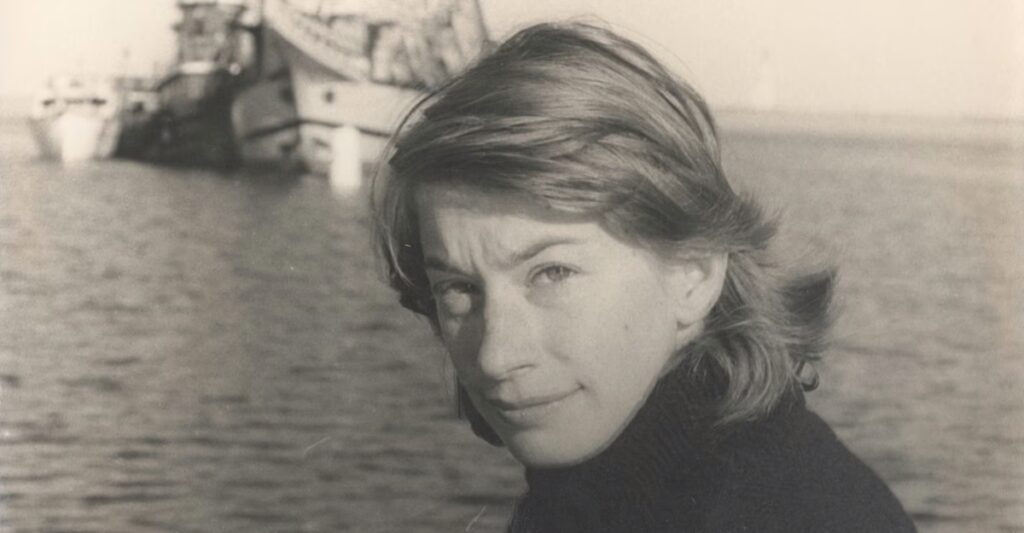
Saved by the Beauty of the World provides the broad strokes of Oliver’s life. Raised in Ohio in the 1930s and ’40s, she grew up in a “very dark and broken house” where she suffered at the hands of her father; the woods and fields offered escape. She briefly attended Ohio State University and Vassar College, then worked at the poet Edna St. Vincent Millay’s upstate New York home, tried out Greenwich Village, and landed in her 20s in Provincetown, on Cape Cod’s tip, where she stayed almost until the last years of her long life (most of them spent with her partner, the photographer Molly Malone Cook). Oliver’s career didn’t explode until her Pulitzer win, in 1984, when she was 49. Before that, she worked at an military-surplus store and did typing for figures such as Norman Mailer; after, she was sought by rafts of admirers, including readers and the students she taught at various institutions, but maintained a private, almost elusive, existence, granting few interviews.
The work Oliver created over five decades isn’t as easily summarized as some of her detractors might say, though it does dwell on a few central themes. There is her earthy imagery—the song of the wren, the “gladness” of the beeches and the oaks and the pines, the glory of an August day. She is a high priestess of the ordinary—not someone who revels in trips to the dentist or afternoons spent giving kids lice treatments, but in finding grace in the fact that life is made of simple moments. The umbrella hanging over all of her writing is her penchant for observing and absorbing—as she puts it so perfectly, “attention is the beginning of devotion”—and her encouragement of her readers to do the same. The poetry is an attempt to ask, over and over, What am I supposed to do? It’s also, sometimes, an answer to that question.
Advice isn’t hard to come by these days: Fit-looking 40-something Instagrammers tell you how to slim down your middle-aged body; columns on manners and ethics or other interpersonal quandaries fill every big-name magazine and newspaper. And yet there is an (often unspoken) assertion that poetry ought not to give advice, that it should exult in the ambiguous. Poetry, perhaps more than any other writing genre, is unfairly assigned a value that is in direct opposition to its usefulness.
In an essay about O, the Oprah Magazine’s poetry issue, the critic David Orr snidely remarked of Oliver’s poetry, “One can only say that no animals appear to have been harmed in the making of it”; he also declared, “There’s a bunch of talk about using poetry to overcome personal challenges (if it worked as self-help, you’d see more poets driving BMWs).” But poetry, like any other writing, is allowed to work toward a goal—so long as it doesn’t lose its structural integrity. Perhaps the problem isn’t that poetry fails to help one overcome challenges, but that its reputation doesn’t give it enough credit for that very thing. (If it did, Ada Limón and Kate Baer might have Z4 Roadsters of their own.)
Even after allowing that poetry can of course offer advice, the question of whether Oliver’s advice is any good is worth debating. I quibble with her notion that one could easily give up worrying: SSRI-usage rates are too high for that to feel possible. And I wonder what she means, exactly, by “good” when she says, “You do not have to be good,” in “Wild Geese”—her next line likens it to walking “on your knees for a hundred miles through the desert repenting,” but surely the matter of goodness involves a more complicated definition than just self-flagellation. Other lines seem so undoubtedly true that it’s no wonder they’ve ended up on apparel. She ends her poem “When Death Comes” with, “I don’t want to end up simply having visited this world.” Do any of us? If poetry is, at least partly, the art of minute observation, Oliver’s work might come off as trite when it expounds so universally.
The claim her friends and admirers make in Saved by the Beauty of the World is that none of this was straightforward for Oliver, either. She wasn’t some sage from on high but a flesh-and-blood woman who struggled through heartache and counted her dollars and was occasionally, as her friend John Waters puts it, a “shit-stirrer.” Oliver professed herself an admirer of Walt Whitman, but the documentary suggests that she may have been more like his contemporary (and poetic opposite) Emily Dickinson—a woman who set herself apart from the world in order to make better sense of it on paper.
Oliver’s poetry was not an act of ease; instead, she rebelled against the way that life presses our head down, away from the wonders of the world. Her advice, for all of its lucidity, is not uncomplicated or effortless. It’s to do something so difficult that most people don’t even attempt it: to notice when we’ve wandered away from how we want to live and to nudge ourselves back. “There are things you cannot reach. But,” she writes, “you can reach out to them, and all day long.” And for that, I’m grateful to have Mary Oliver’s words floating around my Pinterest page. I’d rather live the questioning life of an Oliver acolyte than the certain life of her critics.
The post The Poet Laureate of Pinterest appeared first on The Atlantic.