Electric vehicles offer plenty of benefits. There’s the instant torque, savings on fuel — and, of course, they’re much kinder to mother Earth.
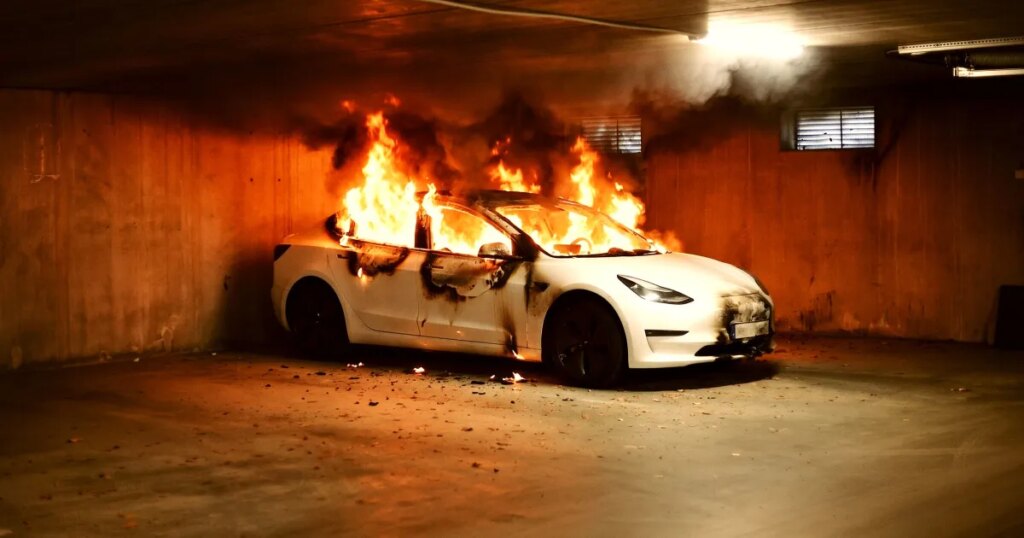
Yet compared to vehicles powered by internal combustion engines, EVs come with a key disadvantage drivers hope they never have to experience: they’re much more dangerous when they catch on fire. (An important caveat, though, is that they catch on fire less often than gas-powered vehicles.)
When they go up in flames, the lithium-ion batteries in EVs are much more difficult for emergency responders to extinguish than standard combustion engines. That’s thanks to a phenomenon known as thermal runaway, basically an accelerating chain reaction fueled by the chemicals found in their cells.
As EVs have exploded in popularity over the last decade, fire fighters have tried all sorts of tactics to control thermal runaway in lithium-ion cells, from hulking submersion containers to chemical mixtures in water to massive wet blankets.
Yet one exhaustive study finds that, for all the experimenting, there really is no better way to extinguish a burning EV than the tried-and-true firehose.
The report, conducted by the UL Research Institutes’ Fire Safety Research Institute, analyzed some 18 experimental burns, nine of which were treated with various suppression tactics. While the 150-page report has plenty of insights about EV fires, its core finding is that innovations like vehicle blankets and chemical additives are no match for the quenching power of thousands of gallons of water.
That’s not to say that a straight-on hose attack is a fantastic choice to fight EV fires, however, but rather the best of a set of weak options. Basically, once thermal runaway kicks off — usually the result of overheating, punctures, or overcharging — water becomes a means to control flames, but is powerless to stop the combustion process itself.
As the report authors write, “applying copious amounts of water to the battery enclosure is wasteful and will not stop thermal runaway.”
And though water is the best tool we know of at this point, its use may inadvertently cause un-ignited cells to erupt. “Likewise, introducing water into an uninvolved battery may increase (re-)ignition risk,” the report explains.
Unfortunately, that means incidents like the 2024 Tesla Semi fire — where firefighters closed a freeway for 15 hours, using 50,000 gallons of water to quell the horrific blaze — are really a best case scenario, at least for the foreseeable future.
More on EVs: You’ll Gasp When You Hear How Many Chinese EVs You Can Buy For the Price of a Single US Car
The post There’s Pretty Much No Good Way to Fight an Electric Vehicle Fire, New Study Finds appeared first on Futurism.