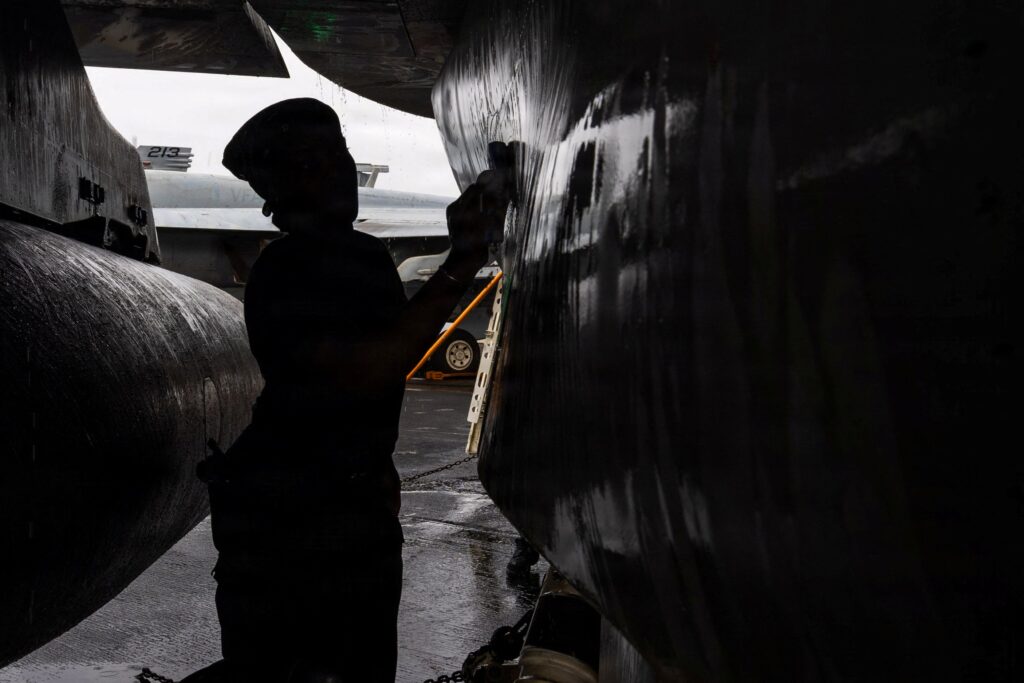
At sea, sailors soon discover that anchoring their deployment to the date it ends is a losing strategy. Going home is always too far away. The better way to mark the time is with shorter-term milestones — mail calls, the next port visit. Yet the days afloat are long; making it through each one is usually the harder struggle. During my two-decade Navy career and years on sea duty, I set my daily clock to food and sleep — chow-chow-chow-rack. Every meal, every wake-up was a tick of the timer. Small routines served as assurances that things were on schedule.
But when missions expand while food, showers and sleep dwindle — and when mail and port calls are canceled, and homecoming dates repeatedly rescheduled — time seems to stop, making life in the middle of the ocean turn from hard to intolerable.
That breakdown matches recent reports of conditions on the aircraft carrier USS Abraham Lincoln, which is on a historic deployment with more than 260 consecutive days at sea. The crew of roughly 5,000 was supposed to be home several weeks ago, but the prolonged war with Iran has extended its operations. For months, worried family members have raised concerns about the well-being of their sailors and the status of the ship, sharing accounts of broken systems, supply shortages and extreme fatigue.
Rep. Mike Levin (D-California), who represents the congressional district neighboring the Lincoln’s home port in San Diego, chronicled the issues on social media: “Moldy showers, broken toilets, laundry down for weeks, long stretches with no hot water, a meal that came down to half a cup of rice and two tortillas. No soap, deodorant, or toothpaste.” Defense Secretary Pete Hegseth dismissed early reports as fake news, and President Donald Trump suggested the deployment hasn’t been nearly long enough. Last week, there were reports that at least two sailors attempted to jump overboard.
Experience teaches that breaks from routine and exceptions to the rules boost crew morale, especially when the days begin to run together. Mail calls bring a taste of home; open-ocean swim calls, a touch of recreation. When not at war, Sundays at sea often mean a relaxed schedule and maybe even grilling on the ship’s deck — a steel beach picnic. After a crew has spent 45 days without a port, Navy regulations allow a beer day for the sailors — a welcome reprieve that most on board hope they’re never eligible for. There’s no expectation that deployments should have the comforts of home; the mission and the culture, particularly at war, require enduring hardship. Still, there is such a thing as too much. An officer aboard the Lincoln captured it succinctly: “Actually literally no one signed up for this and yet here we are, still doing it safely and successfully.”
The most difficult part of nonstop operations and endless time at sea, though, happens off the ship. Connections to home keep you grounded, but the absence from them can create stress that compounds the pressures sailors already face. Two months before my first deployment, my mother was diagnosed with cancer. Though I fought to keep my head in the game, my heart was with her as she battled through chemotherapy and radiation thousands of miles away. Less than two years later, my son was born during a second deployment, and I felt like an absentee father for missing several months of his life. The thing that kept me going was knowing the dates when I could hug my mom and wife again — and my son for the first time.
The mental health toll is well-documented. Psychologists have detailed how certain conditions undermine the mental health and quality of work of seafaring personnel. Risk factors include long and demanding hours, lack of autonomy and extended deployments with scheduling uncertainties. The most problematic stressors identified were inability to rest and insufficient personnel for the mission. In 2017, two collisions involving U.S. Navy destroyers and commercial vessels took place in the Pacific Ocean, resulting in the deaths of 17 sailors. The accidents were attributed to several factors including short-staffing and sleep deprivation. The captain of my second ship understood this, reminding us in the middle of high-tempo operations that “sleep is a weapon” — and that the lack of it exposes everyone to danger.
The Navy has acknowledged that mission overload and uncertainty mean the Lincoln’s sailors “have been pushed to their limits.” And it notes that mental health professionals and social support are available to the crew and their families. But when you’re eating old food in dirty clothes, after standing a 12-hour watch on three hours of sleep, in cramped quarters where the showers don’t work, a chat with an officer can feel low on the list of needs. Besides, a homecoming date helps everything.
The latest news suggests the sailors on the Lincoln can finally sleep a little easier: The aircraft carrier USS George Washington is en route. Home is still a long way away, but the next best thing is being relieved when another crew takes on the mission. Then, it’s just counting meals and wake-ups until you get to hug your family — maybe some mail and a port visit along the way. Accomplishing the mission is always the most important priority during a deployment, but the job isn’t done until you make it back home.
The post Sleep deprivation, moldy showers and the cost of endless war appeared first on Washington Post.