I grew up in a politically conservative Orthodox Jewish community that taught its members that gay marriage should be illegal — and that a religious gay marriage was a contradiction in terms. My parents learned I was a lesbian when I introduced them to the woman I intended to marry. I was 28.
My father took it badly. He believed that a union with another woman would make it hard, impossible perhaps, to have a meaningful Jewish life and a healthy, happy family.
When I told my friends about his reaction, they said this was so horrific and its effect on me so debilitating that it justified removing him from my life entirely. One even said that continuing to be close with him was not morally justifiable. She advised I go “no contact.” The practice of deliberately estranging yourself from family members has become a feature of our culture. Often, the trend takes the form of progressive children, like me, cutting ties with conservative parents, as The New Yorker chronicled in 2024. There are support groups and online forums devoted to no contact with tens of thousands of members.
Some people choose to go no contact because of abuse. Others because their worldviews are diametrically opposed to those of their parents and so constant disagreement threatens to overwhelm every interaction. Others who wrestle with the possibility were shaped by their parents’ values and beliefs and simply interpret them differently.
Going no contact is a kind of amputation. In my case, not only would it be an awful way to treat my father; it would also deprive me and my future family of a connection to the ideas and tradition that made me who I am. Cutting him off would be self-mutilation.
Although exact figures are scarce, the number of people cutting off close kin — particularly children cutting off parents — appears to be rising. Some speculate that therapists offering a speciously easy solution to a seemingly untenable problem are to blame. Sharon Martin, the author of the 2024 book “Cutting Ties with Your Parents,” offers a “Toxic Family Quiz” on her blog. It poses questions about abusive language, sexual abuse and chaotic environments. And just this spring, 32 writers offered essays on family estrangement for a new collection titled “No Contact.”
Going no contact is especially common among queer people: There is a long tradition of creating a “chosen family” that replaces the one you are born into that does not accept you.
For me, no contact was the wrong choice.
I came out to my parents in spring 2023, six months before the Oct. 7 attacks. My pro-Palestinian activism has been even more challenging for my father than my sexuality, adding another heavy strain on our bond.
On Feb. 25, 2024, I published a guest essay in the Times about a Jewish immigrant artist who died during the Holocaust, making a passing analogy between his experience and those of Palestinians in Gaza. The analogy ignited an argument between me and my father so virulent that we did not speak again for many months. When my parents first returned to Israel after Oct. 7, it was to bring supplies to Israeli soldiers. When I first returned, it was to do protective presence — a form of activism where Jews stand alongside Palestinians to protect them from Israeli settler terrorism.
To me, these two profound disagreements with my father are morally related. It was my Judaism that led me both to fight for the persecuted (and for Israeli democratic and moral integrity) and to commit to a family with the woman I love. Both followed from the values my parents taught me. But to my father, both my sexuality and even more so my activism seemed like a rejection of him and of the values he and my mother had inculcated in me.
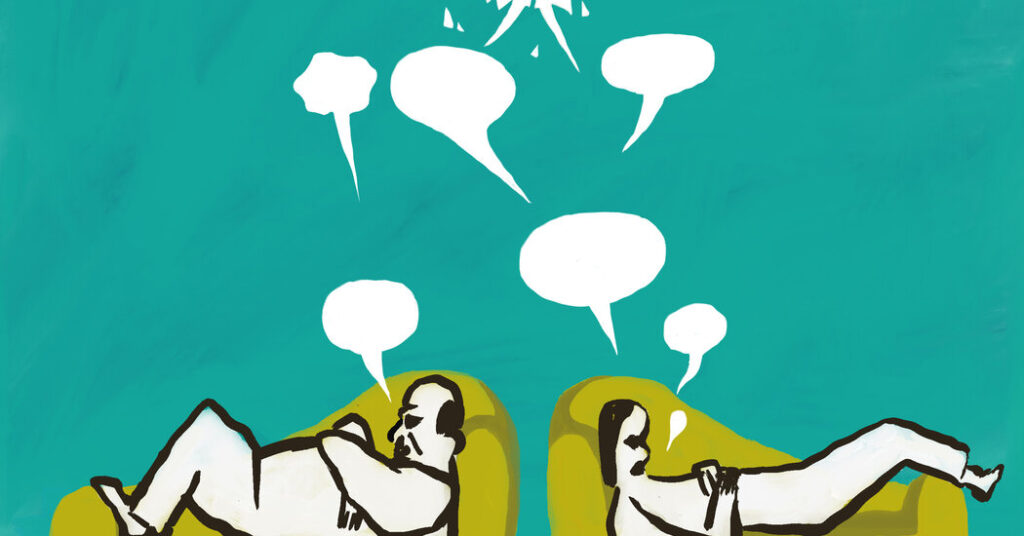
For my friends, this political disagreement was one more reason to go no contact. Instead, we went to therapy together.
My father was the one who suggested it. He said he’d pay and that he’d drive from our family’s home in Philadelphia to Washington, where I live, as often as I was willing to sit in a chair beside him, in front of a therapist he refers to as “the referee.” I did not immediately take him up on the offer. I was afraid. My fear, I knew, was both justified and cowardly. I worried therapy might offer an arena in which he would remind me through implication that my life was “an abomination,” which is what the Bible calls gay sex. (He insists it describes only male gay sex that way, which gives me no comfort.)
My life has been shaped by my father’s influence. As our therapist is constantly reminding us, we are very similar people. The home I want to build with my wife is enriched by the religious traditions that he taught me to love, and that my wife and I share. There is no way for me to approach that tradition, or the parts of me that were molded by it, without encountering my father’s fingerprints. I did not want to give my fiancée an impoverished version of me. I had to resolve my relationship with my father, and with my family, before I could start a family of my own. At least, I had to try.
Progress has been difficult. At the height of our fight in 2024, my father yelled that I did not have a shred of loyalty for the Jewish people. Disloyalty is a cardinal sin in our family, and this accusation cut to the marrow. I could not bear to continue our argument, and chose instead to move away from him entirely, a brief foray into the no-contact universe. In therapy, he repeated that accusation. I told my father that I had been raped shortly before writing about the ordeal publicly — in therapy he theorized that my lesbianism was a trauma response to my own rape. He also wondered if I had sought out cruel men in earlier years because of mistakes that he had made. These things were not easy to hear, and I made several accusations that were similarly wounding about his limitations and biases. Yet every hurtful thing we said in that room gestured us toward a deeper understanding of ourselves and each other.
Both my father and I have softened through this process, but neither of us has transformed our worldviews. We are learning how to stop fearing our differences and instead embrace an approach to family that does not insist on a shared worldview. That may be the key difference between those who choose no contact and those who choose to stay and argue and work toward a decent love. It is vastly more important that we love and respect each other than that we agree even on essential issues. In fact, being capable of loving an ideological adversary is a virtue.
One Sunday in May, my father officiated my wedding in the backyard of the home where he and my mother raised me and my siblings. In his welcoming remarks, he told the guests that my wife and I had been married in a civil ceremony three months earlier and that this wedding was our Jewish one: the one to which we had chosen to invite our friends and family, the one we chose to celebrate publicly as a symbol of our commitment to our tradition and to each other.
He also told them that my wife and I were entering into a union to alleviate the existential loneliness that God warns against in Genesis, where it is written, “It is not good for a human being to be alone.” This is the passage in the Bible that explains God’s choice to fashion Eve as a partner for Adam. By comparing our love to theirs, my father honored my and my wife’s love by placing it in the same category as the original romance, the one designed by God.
I would have gladly spent far longer in therapy with my father, for all the bruises inflicted and endured, to be able to hear him utter those sentences — and know he meant them. Getting to that point was not easy. Coming to a proper understanding of the ways in which you need the people you love the most is not easy. If you are lucky enough to love and be loved by a person who is willing to exert that effort, honor that blessing. Work to sustain it.
Celeste Marcus is the executive editor of Liberties and the author of “Chaim Soutine: Genius, Obsession, and a Dramatic Life in Art.”
The Times is committed to publishing a diversity of letters to the editor. We’d like to hear what you think about this or any of our articles. Here are some tips. And here’s our email: [email protected].
Follow the New York Times Opinion section on Facebook, Instagram, TikTok, Bluesky, WhatsApp and Threads.
The post Friends Wanted Me to Cut Off My Father. They Were Wrong. appeared first on New York Times.