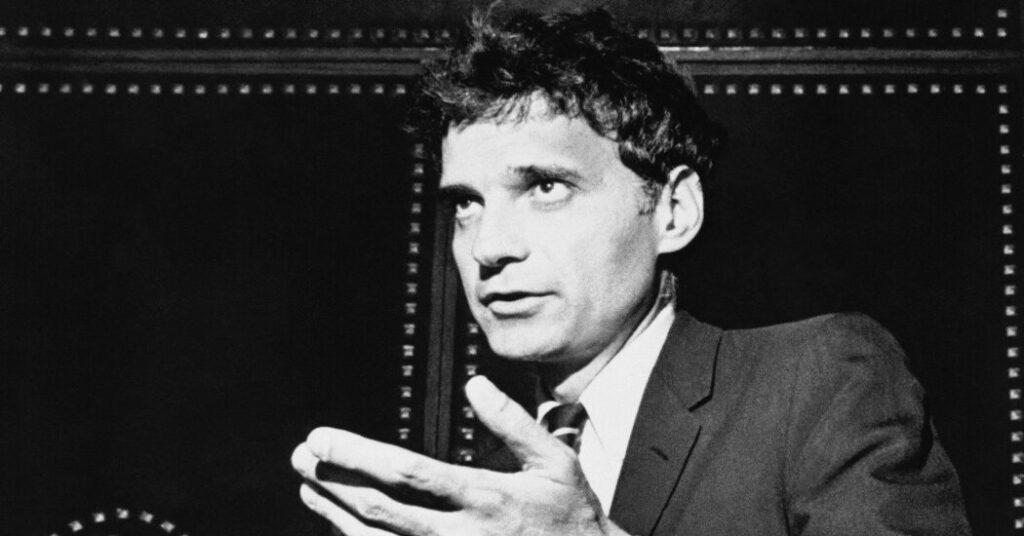
Each day, nearly without fail, Ralph Nader inhales several prominent periodicals, breathing new life into his perpetual state of outrage at the political environment du jour.
He will inevitably call Shine-Erkh Picon, his assistant, with a list of reporters, academics and elected officials he wants to contact. He will inevitably bristle when his missives are not received with the enthusiasm (or responses) they so richly deserve.
This was one of those instances.
For several years, Mr. Nader, 92, has been trying to get anyone — reporters, state lawmakers, Mayor Zohran Mamdani of New York City — to take up the fight to bring back a stock transfer tax that existed in New York State for about 80 years until 1981, when Gov. Hugh L. Carey ushered through a 100 percent rebate.
Even in a moment when taxing the rich is all the rage, a bill to repeal the rebate has gone nowhere in Albany. In many ways, the quest for a stock transfer tax encapsulates what it means to be Ralph Nader, as he pushes an arcane issue only to be driven crazy when he is ignored.
He’s tried Mr. Mamdani. He’s berated legislators and journalists. And he’s tried to get union officials on his side, all with little to no luck.
“Who wouldn’t be frustrated? The worst thing anybody can experience as a citizen advocate is not getting through,” he said in a phone interview.
Communicating with Mr. Nader typically means talking to him via his landline. He does not own a cellphone, a computer or even a credit card.
For a man so firmly enmeshed in the affairs of the day, Mr. Nader has turned into a bit of a recluse. He declined to be photographed for this story or to be interviewed in person.
He lives an almost hermetically sealed life in Washington, where he shares a home with his 98-year-old sister, Claire. Fearful of contracting Covid-19 or some other malady that might imperil his sibling or him, Mr. Nader rarely leaves the house except for walks around the neighborhood. He and Claire cook meals together, often from a recipe book that their mother wrote.
They spend most of their time working and discussing current events, said Laura Nader, Mr. Nader’s 95-year-old sister, who lives in Berkeley, Calif., and only retired from teaching at University of California, Berkeley roughly five years ago.
“Our parents thought that they were living in a free country, and we ought to participate in what’s going on. That why we are this way,” Ms. Nader said, adding that she had spoken to her brother this week about Israel’s actions in Gaza and how she believes they constitute a genocide.
Tall, lanky and perpetually slumped in the shoulders, Mr. Nader has spent decades battling large corporations, pushing for laws requiring seatbelts in cars and running and losing for president four times. Even at his age, he remains as relentless — and some would say — as dyspeptic as ever.
His sustained outrage inspired a generations of acolytes, and in New York it inspired the creation of several good government groups, including the New York Public Interest Group. In the 1980s, he successfully pushed Gov. Mario M. Cuomo to create a Citizens Utility Board to support consumers when utilities set rate. That board was later disbanded by Mr. Cuomo’s successor, Gov. George E. Pataki.
After the publication of his seminal book about the dangers of automobiles, “Unsafe at Any Speed,” Mr. Nader turned his attention to the Federal Trade Commission. With the help of seven law students, who became known as “Nader’s Raiders,” they uncovered profound weaknesses in the agency, which was later reformed by President Richard Nixon.
One of these “Nader’s Raiders,” Edward F. Cox, who graduated from Princeton University roughly a decade after Mr. Nader had, recalled driving through the streets of Washington at 4 a.m. in 1969 with Mr. Nader in a Volkswagen. There would be a news conference that day and Mr. Nader wanted to distribute their thick report to journalists so they had time to study the findings in advance, Mr. Cox said.
A few years later Mr. Cox, the current leader of New York’s Republican Party, invited Mr. Nader to his wedding to Mr. Nixon’s daughter, Tricia. Despite political differences that would emerge in later years, Mr. Nader attended the White House Rose Garden ceremony, and he gave the couple a Hitchcock chair from the famed Connecticut chairmaker near to where he grew up.
Their kinship made sense, Mr. Cox said, in part because as the Vietnam War turned many against government, Mr. Nader was working within the system to improve it rather than trying to burn it all down.
“In that era of radicals, we were conservative in coats and ties,” Mr. Cox said. “We were not S.D.S.,” he added, referring to Students for a Democratic Society, a more anti-establishment protest group of the era.
“We were impressed by his conservative way of doing things — making things work for the consumer.”
Fights on the behalf of ratepayers or against the automotive industry consumed decades of Mr. Nader’s life, leading to significant wins on issues as varied as federal pay, insurance and automobile safety.
Trying to bring back New York’s stock transfer tax has become his latest crusade. Before the rebate was instituted, the tax had raised 1.25 cents a share on stocks sold at less than $5 and rises up to 5 cents a share on a stocks costing $20 per or more.
State officials have said they have little reliable data about how much a repeal of this rebate would bring into its coffers. Estimates range, but one economist who has studied the issue calculated that it could bring in between $15 billion and $20 billion to the state.
This has not been enough to change minds, let alone move a bill to pass. Mr. Nader is characteristically undaunted.
State Capitol veterans in New York recall how, 40 years ago, Mr. Nader walked up and down the stairs of the 11-floor Legislative Office building in Albany to badger elected officials and their aides.
He wore an eye patch, had a pronounced limp and was showing the effects of Bell’s palsy, a disorder that affects the facial nervous system.
At news conferences, he joked to reporters that the affliction was a benefit to them in one way: He said he could not talk out of both sides of his mouth. In the end, Mr. Nader did not get every policy change he wanted but his and others’ advocacy resulted in the first comprehensive study of the quality of care in New York hospitals at the time.
“He was completely relentless,” said Blair Horner, a longtime doyen of the New York Public Interest Group, an organization Mr. Nader helped found.
“I’m sure there was no doctor in the world that would have told him, ‘Yes, you should run down the stairs of the legislative office building,’” Mr. Horner recalled with a laugh. “I assumed they would all tell him that he should be resting, but because the issue was happening when it was, and because he is who he is, there we were.”
Fighting quixotic battles also guided his four presidential campaigns, something that Mr. Nader is proud of despite some backlash among liberals for drawing votes that may have helped Al Gore defeat President George Bush in the 2000 election.
Mr. Nader has no regrets, even if, in addition to his advanced age, the campaigns left him at odds and on the outs with ideologically-aligned political allies.
Third-party candidates are important, he said, because they can infuse new ideas into the political mainstream. He recalled as a student at Princeton University asking Norman Thomas, the six-time Socialist Party candidate for president, his greatest accomplishment.
“He said, ‘The Democratic Party is stealing my agenda,’” Mr. Nader recalled.
Even now, with President Trump — whom Mr. Nader despises and calls a fascist — in power, Mr. Nader still supports third-party candidacies, even if they draw votes from a Democratic challenger.
“Nobody has a right to tell anybody not to run for office,” he said. “That’s like telling people shut up and don’t use your free-speech rights. So you’ll never hear me say about anybody, don’t run for office. I’ll oppose you, but I’ll never tell you not to run.”
Those who know Mr. Nader, well or casually, know of another truism about him.
“You can vote Trump out of your life, but you can’t vote Ralph out of your life so long as he says ‘No way’,” said Mark Green, a former public advocate of New York City, who has known Mr. Nader for almost 60 years.
“If you say, ‘Wow Aaron Judge last year hit 53 home runs,’ Ralph would say, ‘Yeah but it wasn’t 62,’” Mr. Green added. (Mr. Nader’s favorite player of all time is Lou Gehrig, the Yankee known for his record, since broken, of never sitting out a game.)
This persnicketiness and persistence is a standing feature in his frequent missives to reporters, which The Washington Post described adroitly as “complimentary but lightly scolding; a useful pitch, wrapped in a critique.” They come in flurries by phone and often by email from Ms. Picon, with the subject line: “From Ralph Nader.”
In one message to a reporter, Mr. Nader invoked his boss’ boss’ boss’ boss’ — the publisher of The New York Times — in hope of eliciting a response. In another, Mr. Nader notes that he had been trying to get ahold of the reporter since he was a student at Harvard working on The Crimson, the student newspaper, and only gotten through to him twice.
And in a voice mail message left in June with this reporter, Mr. Nader observed that the State Legislature had wrapped up its work on New York’s budget. So now was time to write about this stock transfer tax. Mr. Nader then listed several of this reporter’s colleagues who had gone dark on him before concluding with a line from Greek philosophy.
“Remember Aristotle, courage is the fundamental virtue that makes all other virtues possible,” he concluded. “He said it a long time ago and it’s still true. Thank you. Hope you’re well.”
The post Ralph Nader, Unsurprisingly, Still Wants You to Pay Attention appeared first on New York Times.