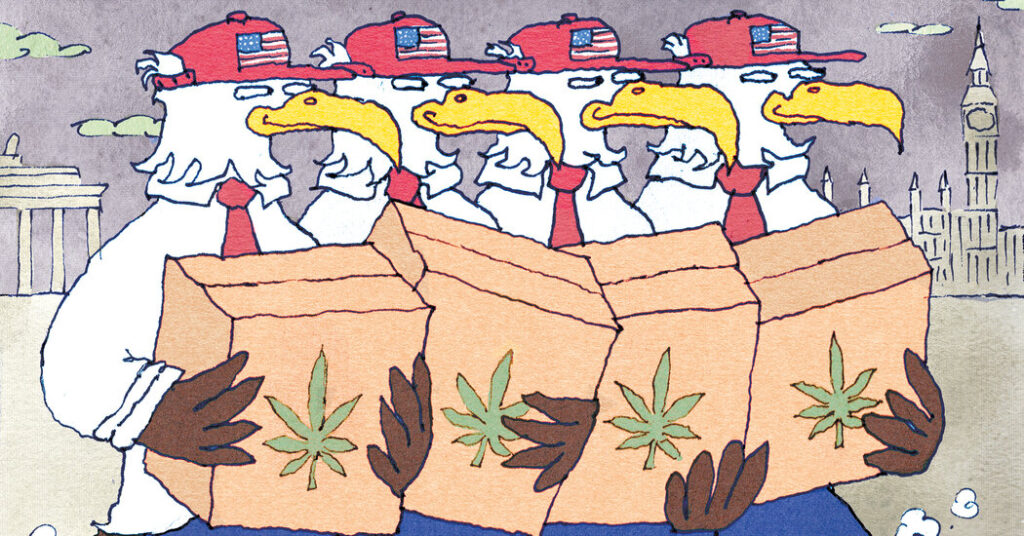
The 20th century was defined by American brands — McDonald’s and Coca-Cola, Microsoft and Starbucks — going global. In the 21st century, it’s artificial intelligence companies that are preparing to cannibalize the world economy. But the race to go global is on for another product: marijuana.
In America it has been a bumpy ride. The country long tried to effectively wipe weed off the face of the earth. But over the past decade or so, the pendulum swung: 24 states legalized recreational cannabis, and 41 states have legal medical markets. For a few years, venture capitalists poured their dollars into every hip-sounding weed company they could find, giving rise to the so-called green rush — a cannabis industry across the United States and Canada worth $30 billion at its peak.
But things were never steady. A patchwork of state laws, high taxes and overspeculation led to a cycle of boom and bust. Companies told their financial backers that federal legislation favoring the industry was imminent, but when that failed to materialize, investors pulled their cash. Profits stalled and stock prices collapsed. To many, it looked as though the cannabis industry would remain stuck in purgatory.
Then, at the end of last year, an unlikely savior arrived: President Trump. His executive order in December to reclassify cannabis promised to take the drug out of the category that includes heroin and place it alongside prescribed pain medications like codeine. It would also, importantly, spare companies from the heavy taxes that were strangling profits. The industry perked back up. Now North American cannabis companies are taking their wares overseas. And Europe, the first stop on their campaign of global conquest, is not ready.
The process of expansion has begun. In February the Canadian cannabis company Organigram acquired Sanity Group, a German medical cannabis company, for around $285 million. In April, Tilray, one of America’s cannabis juggernauts, acquired Lyphe, a leading British medical cannabis provider, not long after picking up a popular craft beer company. Not to be outdone, the United States’ largest cannabis company, Curaleaf, soon followed suit by completing the buyout of Four 20 Pharma, a major German medical cannabis producer and distributor.
Those are just the mergers. American companies are also moving directly into the European market. This year Curaleaf rolled out a public advertisement campaign in Britain with ads on the London Underground and on television, rebranded its Polish subsidiary as Curaleaf Centrum Medyczne and became the first company to supply medical marijuana in Spain. Curaleaf isn’t alone in making inroads. A recent report found that Canadian cannabis exports to Britain grew by more than 560 percent in a single year.
These are early days for legal marijuana in Europe. So far, only Germany, Malta, Luxembourg and the Czech Republic have legalized recreational cannabis. None follow the heavily commercialized model of North America, although there are pilot programs for retailing cannabis in Switzerland and the Netherlands. Medical marijuana, however, is legal in many countries, including Italy, France and Britain. Europe’s medical cannabis market is already approaching $1.7 billion in value.
With this influx comes challenges. In America, legalization — despite some of its social equity ambitions — has tended to place profit over public health. For the most part, the cannabis industry has adopted many of the same aggressive marketing practices associated with the tobacco and alcohol industries, including lobbying for favorable regulation, increasing the potency of products and targeting a small number of frequent users. The cost is clear. A recent study found that this underregulated and overcommercialized approach gives rise to increased use disorders and psychic distress.
Already there are signs of these issues emerging in Europe. In March, Curaleaf found itself in trouble in Britain after prescribing medical cannabis to Oliver Robinson, a 34-year-old man with a history of mental health issues who then took his own life. The coroner who led the inquest into his death found that industry practices meant there was a real risk of more deaths. It’s not hard to see how. In Germany lax prescription through apps and teleclinics led to a rise in imports of 400 percent in the first half of 2025, prompting the government to restrict online sales.
There is still time for European countries to change course and design a different type of market for legal cannabis. That might involve the mainstreaming of cannabis social clubs, where members learn how to grow, consume and manage the plant as part of a community — something that has taken place in Barcelona, Spain, for decades. It could also include license caps to stop multinational corporations from buying up large chunks of the market or giving licenses only to small local producers and cooperatives. Cannabis does not have to lead to either mass criminalization or mass commercialization.
The war on drugs, pursued across the 20th century, achieved little beyond targeting the poor, vulnerable and marginalized. Yet it succeeded in turning cannabis from the relatively normal intoxicant it had been for 5,000 years into the feared devil’s lettuce of popular imagination. As it gets recommercialized in the 21st century, accompanied by targeted Instagram ads, celebrity endorsements and delivery on demand, there is a danger of overhyping the drug again. But this time, it’s in the opposite direction: overselling the benefits while minimizing the risks.
Kojo Koram is a professor of law and political economy at Loughborough University in England and the author of “The Next Fix: The Winners and Losers in the Future of Drugs.”
The Times is committed to publishing a diversity of letters to the editor. We’d like to hear what you think about this or any of our articles. Here are some tips. And here’s our email: [email protected].
Follow the New York Times Opinion section on Facebook, Instagram, TikTok, Bluesky, WhatsApp and Threads.
The post American Weed Is Going Global. Europe Is Not Ready. appeared first on New York Times.