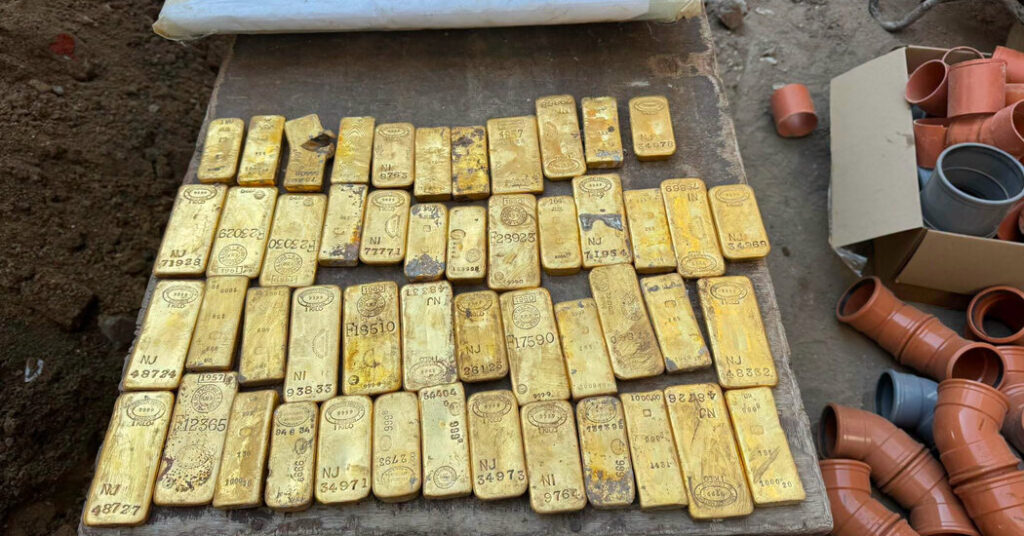
When the police chief learned what workers had found, sealed inside a small brick cellar as they drilled below a defunct brewery, he was sure someone had interrupted his Tuesday meeting with a prank.
”I thought it was a joke,” said the chief, Patrick Feys, “because things like that normally don’t happen in real life.”
But the workers had plenty of proof: 49 gold bars and more than 4,000 gleaming coins, a cache worth an estimated $10 million, its origin and fate unknown.
Construction workers in the Belgian city of Dendermonde had been drilling this week beneath what used to be the foundation of a brewery built in the 1890s. The site was undergoing renovations for a project to create transitional housing for homeless people. At first, the workers thought they had only found one-euro coins, and kept boring through the cellar’s brick walls, Chief Feys said.
Instead, they started finding gold bars — leaving dents and scratches on a few with their tools.
After the discovery, Chief Feys’s mounting excitement merged with anxiety, he said. The police hurried the trove to the station for inventory, where four people counted each piece under a surveillance camera to ensure nothing was lost or stolen.
“An amount like this, it’s always a risk,” Chief Feys said, adding that he did not relax that day until the stash was in federal custody.
Geert Hillaert, the director of the social services nonprofit that owns the property where the gold was found, said in an interview that two questions sprang to mind when he heard about the buried treasure: “How does this happen?” and “How do we get it safe?”
But after police took custody of the gold, a third question arose: Who will get to keep it?
Local prosecutors will investigate whether the gold has been stolen or involved in any crime, Mr. Hillaert said. If not, Belgian law gives family members or other heirs five years to claim the bounty, he and the police said.
But there do not appear to be any direct, living heirs of the brewery’s original owner, whom former mayor Piet Buyse has identified as a man named Théophile van Assche. In an interview with the Dutch-language Belgian outlet HLN, Mr. Buyse said the brewery was built in the late 19th century, and Mr. van Assche’s three children ran the business until it shuttered in 1970.
None of the children married or left heirs, Mr. Buyse said, and there are few ready clues as to the origin of the gold. The authorities said a stamp on one of the gold bars dated it to the 1960s.
In 1982, the property was left to a local Benedictine monastery, which used it as transitional housing for formerly incarcerated people, Mr. Hillaert said. Last year, the monks gave the property to CAW Oost-Vlaanderen, the nonprofit that Mr. Hillaert directs. (The monastery did not respond to a request for comment.)
If the gold eventually goes to his nonprofit, Mr. Hillaert said he hoped to use the money to build more housing for families without homes. His government-funded nonprofit also provides services for victims of abuse, young people, immigrants and formerly incarcerated people.
Chief Feys said at least three people had already come to the police saying they had ties to the unearthed family fortune. While investigators worked to ensure the gold was not connected to any crime, Chief Feys said he recommended the people claiming the riches find legal help.
Mr. Hillaert said he would consult with the nonprofit’s lawyers, but that he did not think the group would contest a legal claim if a family member or other legitimate recipient came forward.
“We are not that sort of an organization,” he said.
The post $10 Million in Gold Found Buried Under Former Brewery in Belgium appeared first on New York Times.