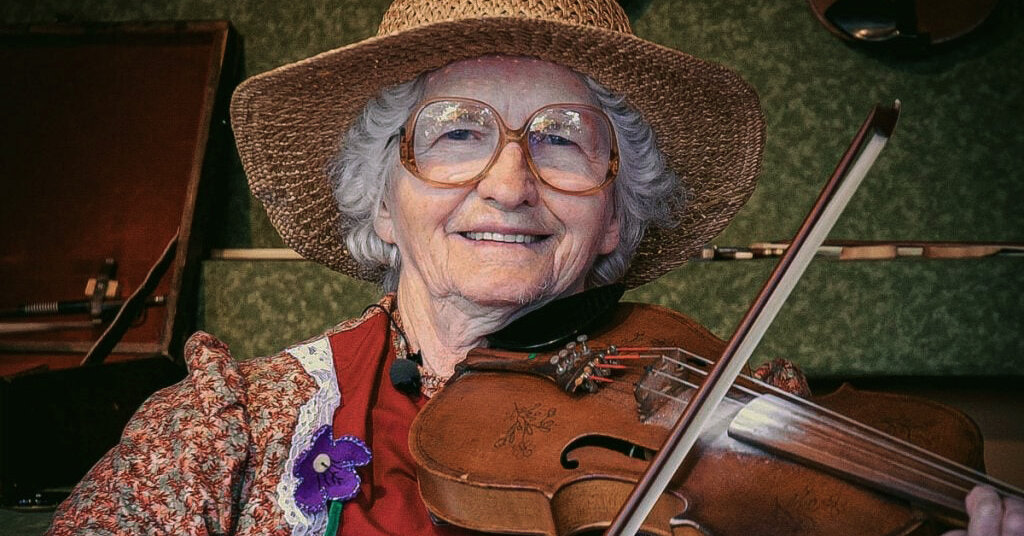
Violet Hensley, who grew up in Arkansas learning from her father how to carve and play a fiddle, and whose nearly 60-year performing career reached its peak at age 99, when she debuted at the Grand Ole Opry, died on Aug. 7 at her home in Yellville, Ark., in the Ozarks. She was 109.
Her daughter Sandra Flagg, a guitarist, confirmed the death.
Ms. Hensley made a clear distinction between a fiddle and a violin, even though they are essentially the same instrument. “If you can read music, you play the violin,” she told The Tulsa World in 1982. “I can’t read music, so I just play the fiddle.”
By the time she turned 99, Ms. Hensley had performed old-time mountain music — not bluegrass, which she deemed too fancy — at the Silver Dollar City theme park in Branson, Mo., for more than 50 years; played on radio stations and at schools; recorded at least two albums, one of them, with family members, called “Old-Time Hoedowns”; and appeared on TV programs like “Captain Kangaroo,” “The Beverly Hillbillies” and “Live! With Regis and Kathie Lee.”
She also handcrafted 73 fiddles — she played No. 4, which she made in the 1930s — thus acquiring nicknames like “The Whittlin’ Fiddler” and “Stradivarius of the Ozarks.” She could have built more fiddles if not for time spent gardening, canning, sewing and cutting her neighbors’ hair, she told CBS News when she was 90. To make ends meet, she was a cleaning lady at a hospital for many years.
One wish lingered: to play at the Grand Ole Opry, the citadel of country music, in Nashville. When another fiddler, Tim Crouch, read about that desire in Ms. Hensley’s autobiography, “Whittlin’ and Fiddlin’ My Own Way” (written with Randall Franks and published in 2014), he called the banjo player Mike Snider, who brought her onstage at the Opry on Aug. 6, 2016.
“This little lady was born in 1916,” he said as he introduced her, to cheers. She played “Angeline the Baker” and “Black Eye Susie” with Mr. Snider, Mr. Crouch and other fiddle players, and received three standing ovations, Ms. Flagg, her daughter, said.
“Man, she just tore it up,” Mr. Crouch said in an interview. “And afterward, she was the backstage star, everyone wanting her autograph and their picture made with her.” He added that her fiddle “didn’t look great, but it would shock you how good it sounded.”
Ms. Hensley told The Springfield News-Leader, a Missouri newspaper, “I was just me. Yes, I was pleased. But it’s still just me. You don’t want to try to be somebody you’re not.”
She performed twice more at the Opry, in 2017 and in 2018, the year she was inducted into the National Fiddler Hall of Fame in Tulsa, Okla.
Mary Violet Brumley was born on Oct. 21, 1916, in Alamo, Ark., near Mount Ida, in the central-western part of the state. Her father, George Washington Brumley, was a farmer, and her mother, Nora (Springer) Brumley, who ran the home, died when Violet was 11.
She observed her father making fiddles and, at 15, began to build her own, splitting, planing and shaping wood that she found nearby. She had begun playing at 12.
“I wanted to play the fiddle just because we didn’t have anything else to do,” she told KCPT, the public television station in Kansas City, Mo. “We didn’t have television or radio, and Dad played, and I guess it struck me that I wanted to play.”
After she married Adren Hensley in 1935 and began to raise their nine children, she stopped whittling and performing (she also sang and clogged) for 27 years, until she re-emerged in the 1960s, winning second place in the Turkey Trot Talent Show in Yellville.
In 1967, she began her long association with Silver Dollar City, where she fiddled onstage and demonstrated her fiddle-making skills at a crafts booth.
“She wasn’t simply one of America’s most respected fiddle makers and musicians,” the theme park said in a statement. “She was at the heart of an Ozarks tradition that connected generations to this special place.”
While performing at Silver Dollar City around 1999 with her son-in-law, Tim Nelson, a banjo player and guitarist, she met another fiddler, Betse Ellis, whose band was also playing at the park. Ms. Hensley’s invitation to Ms. Ellis to perform together at the park started a long friendship.
“She was a one-in-a-million fiddler who made an impact on everyone who got to hear her,” Ms. Ellis said in an interview.
On trips to see Ms. Hensley in Yellville, Ms. Ellis added, “She taught what I was getting wrong, and I paid more attention to how to play like her.”
Before a concert around 2010 at the Rock House Center for the Arts in Reeds Spring, Mo., that was to have two 45-minute segments with an intermission, Ms. Hensley confided to Mr. Ellis that she was tired.
“But she sat down to play, and we didn’t stop for three hours,” Ms. Ellis said.
In addition to Ms. Flagg, Ms. Hensley is survived by two other daughters, Beatrice Porter and Lewonna Nelson; three sons, Marvin, R.G. and Eddie Hensley; Wilma Flagg, a family friend who came to live with her as a teenager; 32 grandchildren; 85 great-grandchildren; 29 great-great-grandchildren; and two great-great-great-grandchildren. Her husband died in 1997. Four of their sons — Calvin, Russell and Gary Hensley and Larry Hensley, who was stillborn — predeceased her.
Making fiddles was one of many skills Ms. Hensley developed over her lifetime. She also made lye soap, tanned leather, broke horses and tended crops.
“I always say,” she told The Tulsa World, “making a fiddle is a lot easier than plowing a field with a team of mules.”
The post Violet Hensley Dies at 109; Ozarks Fiddler Made Opry Debut at 99 appeared first on New York Times.