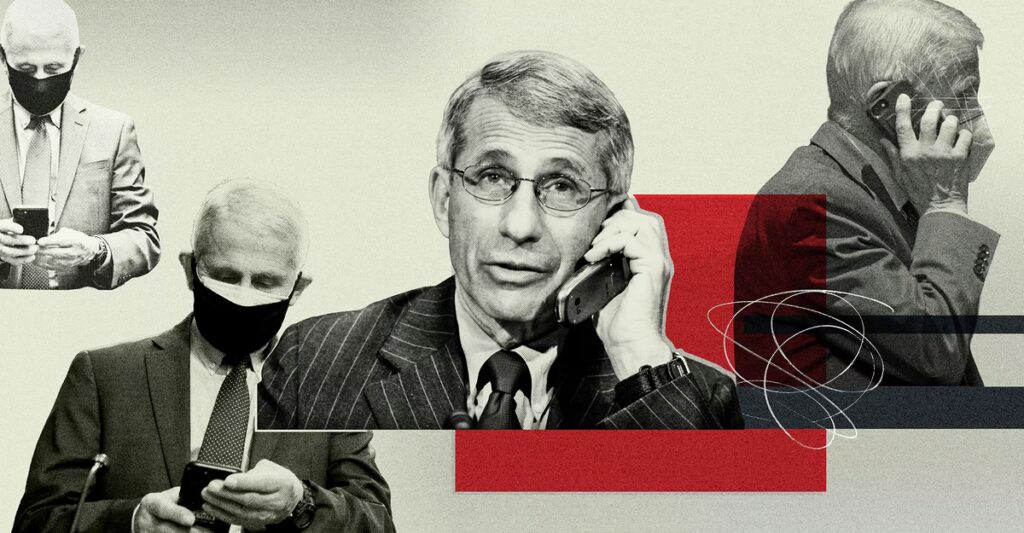
Did Anthony Fauci really get a text from Joan Baez, as his private diary suggests, wishing him a “happy fucking birthday” in the midst of the pandemic? Until now, the answer to that question has remained blessedly unclear. But soon we may have access to the former National Institutes of Health official’s phone. Senator Ron Johnson announced this week that he’d retrieved tens of thousands of messages and hundreds of voicemails from Fauci’s government-issued device and made them fully searchable. In the meantime, though, Johnson has shared just a single set of texts: a Fauci group chat that he considered so explosive in its implications that it had to be released forthwith. “This is a blockbuster revelation,” the senator said on Tuesday. The public had to know.
The texts in question were from a short exchange that Fauci had with two other public-health officials—former U.S. Surgeon General Vivek Murthy and former CDC Director Rochelle Walensky—in January 2021. Murthy had asked whether either of them knew of “any data or theoretical reason” why an expectant mother might choose to vaccinate early versus late in pregnancy. Walensky answered no, that this was all “data free.”
Fauci agreed, but a couple of hours later, he followed up. After asking around, he’d heard about a theoretical concern: A second dose of the vaccine could lead to fever and cytokine storm—an overactivation of the immune system, also linked to COVID itself—which in turn might lead to early-term miscarriage. In an interview that Fauci gave just one week later, he alluded to the need for balanced thinking on vaccination during pregnancy, given the lack of clinical-trial data. But he noted that thousands of expectant mothers had already gotten shots by then, and no issues had arisen. “We’ve got to be careful,” he said, but “I would rather take my chances with a vaccine than getting infected while I’m pregnant.”
Fauci’s critics now assert that this was tantamount to murder. Fauci knew that COVID shots were killing babies, they argue—he said so in a private text—and then he went out and pretended that the shots were safe. Representative Anna Paulina Luna called this “a crime against humanity and the most evil thing that could’ve ever been done.” Meghan McCain demanded that the 85-year-old be handcuffed, perp-walked, and put in a jail cell for the rest of his life. (“This is not hyperbole,” she noted, rather unconvincingly.) Senator Roger Marshall called for the appointment of a special counsel to investigate the matter—either that, he said, or “a full 9/11-style commission.”
Even a cursory reading of the context at the time suggests that Fauci’s group chat doesn’t quite reach the level of a “crime against humanity.” In fact, the new material is unremarkable, unrevealing, and—worst of all—maddeningly irrelevant to the many, far more interesting questions that still surround one of our most important public-health leader’s behavior and decision making during the pandemic.
Despite this week’s operatic calls for justice, there wasn’t really any gap between what Fauci typed into his phone and what he said in public at the time. Indeed, according to the messages released this week, Fauci sent another text to the same two colleagues just one day after he’d voiced his “theoretical” concern about the risks of vaccination. In that message, he gave essentially the same assessment that he’d offer to the public shortly after. He even used similar language: “No red flags” had yet emerged from real-world use, but even so, in the absence of clinical-trial data, “one must weigh the potential risks against the benefits.” (Senator Johnson’s office told me that the records show that “Dr. Fauci withheld information from pregnant women that they had the right to know,” and in doing so he robbed them of informed consent. Fauci, Murthy, and Walensky did not respond to requests for comment.)
That logic still applies. The safety and efficacy of the COVID shot during pregnancy was never tested in a full-scale, randomized clinical trial. But observational data—of which we now possess a very large quantity, after many millions of vaccinations—have not identified any reason to believe that any risk of miscarriage, if present, is significant. If the mRNA shots really were abortions in a needle, as some of Fauci’s critics have alleged—if they really caused a loss of pregnancy in 82 percent of cases, as Senator Ted Cruz and many others claim—then this catastrophic harm would surely have caused at least a blip in U.S. birthrates in 2021, when more than 200 million Americans were fully vaccinated. (As it happens, the number of Americans born that year went up.)
More tempered critics acknowledge that the COVID shots never did turn out to be dramatically unsafe for pregnant women—but then, no one could be confident about the risk at the start of 2021. The text message shows that Fauci clearly was aware of the uncertainty, they argue, yet he buried it in public statements; his crime, in other words, was one of clinical duplicity in the first degree. “He essentially told the public that it was safe for pregnant women to take it when he didn’t know that,” NIH Director Jay Bhattacharya said this week.
But Fauci and the public-health establishment did signal their uncertainty. If anything, they were unusually direct about the known unknowns around this topic—at least compared with their messaging on COVID origins, the value of masking, and the importance of school closures, among other squirrelly, scientific questions. When it came to vaccination during pregnancy, no one hid the fact that the most conclusive safety data were lacking. Fauci made this point both in public and in private; he also said repeatedly, both in public and in private, that the systems used to track vaccines’ adverse events had not yet picked up on any reasons for concern—an assessment that more formal analyses would later confirm. In the meantime, the CDC had already found that getting COVID was itself a major threat to pregnant women’s health, associated with a tripled likelihood of going to the ICU and a 70 percent higher risk of death.
What was this, if not transparency? Vaccines had been made available; the CDC’s official advice was that expectant mothers should discuss the matter with their doctors and reach their own conclusions. In the face of all this cautious, careful guidance, many women did decide to skip the shots: By the end of July 2021, less than one-quarter of all the pregnant women in the country had been vaccinated, according to CDC data from the time. That lack of uptake may well have had a grave human cost all its own, given that maternal mortality rates doubled in that year.
In other words, this week’s attacks on Fauci haven’t just inflated the importance of his text message; they’ve reversed its meaning altogether, transfiguring a moment of humility into one of arrogance and self-contradiction. The resulting tangle of misinformation has done little more than bring disgrace to the actual work of determining whether, and how, Fauci and other public-health officials might really have misused their power.
The case against Fauci has always been diverse; its most aggressive prosecutors are a big-tent assemblage of anti-vaxxers, libertarians, and lab-leak truthers. Some believe that he lied about the safety of the COVID shots; others say that he was the capo of immoral lockdown measures, or that he played a role in paying for (and then concealing) the research that started the pandemic. So far, the entire spectacle of this investigation—the email dumps, the diary, and now the texts, as well as the Senate hearing where Fauci refused to answer any questions—has only cast a scattered, insufficient light across a range of matters large and small. To choose just one: Do Fauci’s emails really show, as Senator Josh Hawley and others have asserted, that Fauci cajoled his institute’s grantees for help in winning large cash prizes for himself? The documentary evidence doesn’t indicate that he violated any ethics laws, but it is at least suggestive of self-dealing—and it does at least invite further questions about his use of public office. (When pressed on this during his Senate testimony, Fauci responded as he did to every question, by pleading the Fifth.)
And what about the mystery of COVID’s origins? Released emails and private chats do seem to show that virologists in Fauci’s circle took seriously, over many months, the possibility of a lab’s involvement—yet this idea was rarely given credence in the public sphere. Did Fauci help coordinate some sort of message discipline? How much did he really know about the coronavirus work in China that his institute had funded, and what does he think about that sort of research now? The information we have is inconclusive on these points and many others too.
Fauci remains, in the eyes of many experts, a public-health hero whose work on treating and preventing AIDS and other infectious diseases has saved millions of lives. But there are real uncertainties in his pandemic record and questions as to how he and others led the government’s response to COVID—and these points are only getting lost amid the rampant lust for retribution and the wild overreading of his private records. Fauci’s critics say he papered over gaps in knowledge and in doing so misled the public. Now they’re doing just the same.
The post Anthony Fauci’s Group Chat Is Making People Lose Their Minds appeared first on The Atlantic.