To the Editor:
Re “Nolan’s Trojan Horse,” by Ezra Klein (column, Aug. 5):
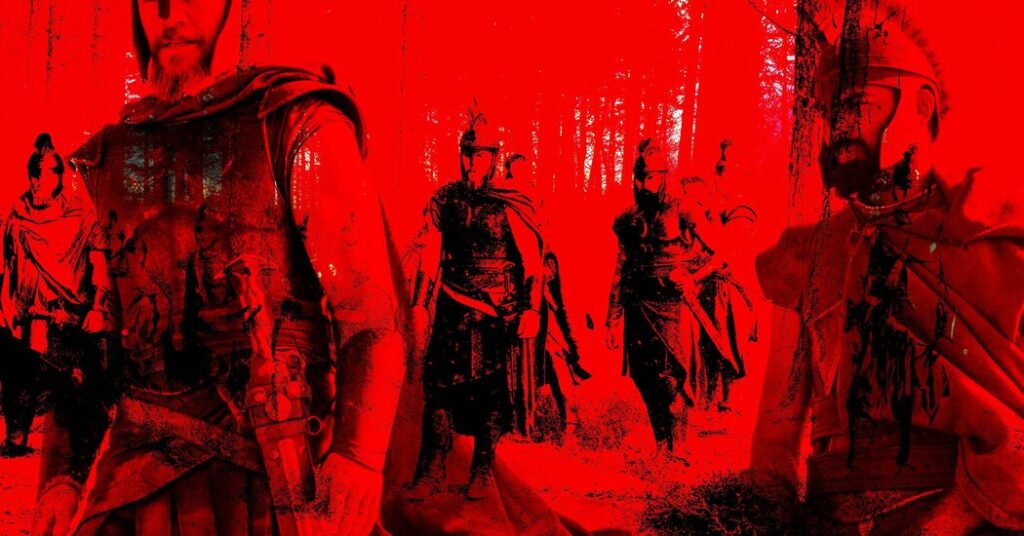
In his analysis of Christopher Nolan’s film “The Odyssey,” Mr. Klein brilliantly extracts the director’s message for today’s audience from Homer’s ancient poem. Mr. Nolan’s “finest trick,” he writes, is “to make one of our oldest moral rules sound new again” by turning “the best of Judeo-Christianity into the law of Zeus, so we can see why it might matter and what it might still have to say to us.”
Mr. Klein is right to say that Mr. Nolan “smuggled” the message in without most viewers even noticing. Most of the film’s audience, including Elon Musk and even the renowned “Odyssey” translator Emily Wilson, who reviewed the film harshly in The London Review of Books, misses what Mr. Klein sees: “Odysseus and his men were not fighting the barbarians; they were the barbarians.”
By observing both the film and the world order (and American democracy) crumbling around us, Mr. Klein reminds us that we cannot make Western civilization (or America) great again by betraying its own fundamental values. Strength, rules and order are necessary, but without compassion and empathy, we risk becoming the very thing we abhor.
Adam Michels San Francisco
To the Editor:
Bravo to Ezra Klein for taking a stand. How ironic that it took Christopher Nolan’s “Odyssey” to bring forth this crystal-clear statement of Judeo-Christian values.
We are living in an age of debased tricksterism. Could one imagine an ancient saga in which an utterly corrupt ruler seeks to create a fund through which the wicked suitors who stormed the palace of democracy would be rewarded, while he and his sons are allowed to go free despite all their many crimes? Homer couldn’t have depicted it better.
But Mr. Nolan sees through this tricksterism and brings his knight in shining armor, none other than Matt Damon, to call its bluff.
Mr. Klein invokes the Torah, Rabbi Hillel and the New Testament to make the point. The Golden Rule of human decency, treating others as you would be treated, is a beacon that can carry you all the way home and even make America once again a promised land.
(Rabbi) Arthur Green Newton, Mass. The writer was the founding dean of the Hebrew College Rabbinical School.
To the Editor:
Ezra Klein credits the director Christopher Nolan with smuggling Judeo-Christian ethics into his film version of “The Odyssey” in the guise of Zeus’ law. But Mr. Nolan has said otherwise.
In a recent interview with the Chinese podcaster Zhong Shu, he traces the film’s moral core to xenia, the Homeric hospitality ethic, and denies any deliberate Christianizing. He is right to do so.
Zeus Xenios, an aspect of Zeus that demands hospitality to strangers, is not a Christian add-on. It existed long before Christianity existed. And the reciprocity principle Mr. Klein credits to Judeo-Christian sources — like the Old Testament book of Leviticus, the New Testament Gospel of Matthew and the first-century B.C.E. Rabbi Hillel — turns up in the work of Confucius five centuries earlier, and again in Buddhist, Hindu and Islamic texts.
Mr. Klein isn’t wrong that the Golden Rule matters, or that the modern right has discarded it. But crediting Mr. Nolan with “smuggling” it in from Judeo-Christian tradition is its own sleight of hand, enlisting a director’s film for an argument the director says he never made.
David Phillips Amsterdam
To the Editor:
Whenever I teach “The Odyssey” in my world literature class, my college students often begin nodding as I explain the requirements of xenia. The protocol of inviting strangers in and feeding them is common back home, they say — meaning back in Egypt or Iran or India or Nepal.
I experienced this rule of guest friendship myself as a young Canadian teacher in Bhutan in the 1990s. I’d stumble into a village, lost on my way home, and a family would bring me in, sit me in their best room, cook me a meal and give me a gift as I was leaving. So I don’t think that Christopher Nolan’s take on xenia in his film is particularly Christian.
The belief that a guest might be a god in disguise was just one reason to treat strangers with kindness. Xenia was, in fact, reciprocal. The guest’s duty, upon leaving, was to offer the same hospitality to the host, as well as to other strangers in the future.
There’s a scene in “The Iliad” in which a Greek and a Trojan refuse to fight each other when they realize their grandfathers had been bound by the law of guest friendship; they exchange armor instead.
Xenia could not stop the war once it had started, but this tiny instance reminds us of how it might have been averted.
Jamie Zeppa Toronto
To the Editor:
As the author of “Trickster Makes This World,” I was pleased that Ezra Klein found it useful in his recent essay. Behind Mr. Klein’s essay lies a question I’m often asked: Is Donald Trump a trickster?
Indeed, the mythological tricksters are amoral opportunists, shameless thieves and liars, so there’s a case to be made. But I have reservations.
First, trickster tales are funny, and Mr. Trump has no sense of humor. He can’t take a joke. His wit is dehumanizing, fueled by insult and mockery. A trickster’s wit, by contrast, is all too human. It tells us not to be so self-important.
Take the classic tale in which the day-old baby Hermes steals the cattle of Apollo but, when Apollo insists that Zeus punish the thief, the little god’s denials are so witty, Zeus begins to laugh, and by the end of the story the antagonists are friends.
Second, there’s the issue of who’s in charge. In none of the old tales is a trickster the chief or king. He’s too mischievous, strewing feces around the palace or stealing fruit from the royal gardens. He’s a sneak, an outsider, never the boss.
Hermes is one of the last born of the Greek gods. He must be. Only after the cosmos has been put in order can he show up to bend or break its rules. He’s a parasite on structure, not its author.
Any kingdom foolish enough to put a trickster on the throne is in serious danger.
Lewis Hyde Cambridge, Mass.
To the Editor:
There is another aspect to add to Ezra Klein’s column in relation to trickster figures. While tricksters gleefully throw shade and cast dirt over societies that have become lopsided or gone awry, they also unwittingly pose an important question: How do we actually deal with our own dirt?
We are now seeing how President Trump’s chaotic and cruel culture deals with its dirt — not at all. If we want the past 10 years to be an interregnum and not a permanent disaster — for the horror and grief to become compost for something new — we need to find new and creative ways to deal with the dirt that has enabled the trickster dynamic to come alive again. Doing that, as the writer Lewis Hyde concluded, is how “trickster makes this world.”
Sherry Salman Clinton Corners, N.Y. The writer is the founding president of the Jungian Psychoanalytic Association.
The post The Moral Message of the New ‘Odyssey’ appeared first on New York Times.