All across Europe, shipwrecks and skeletons are rising from the deep.
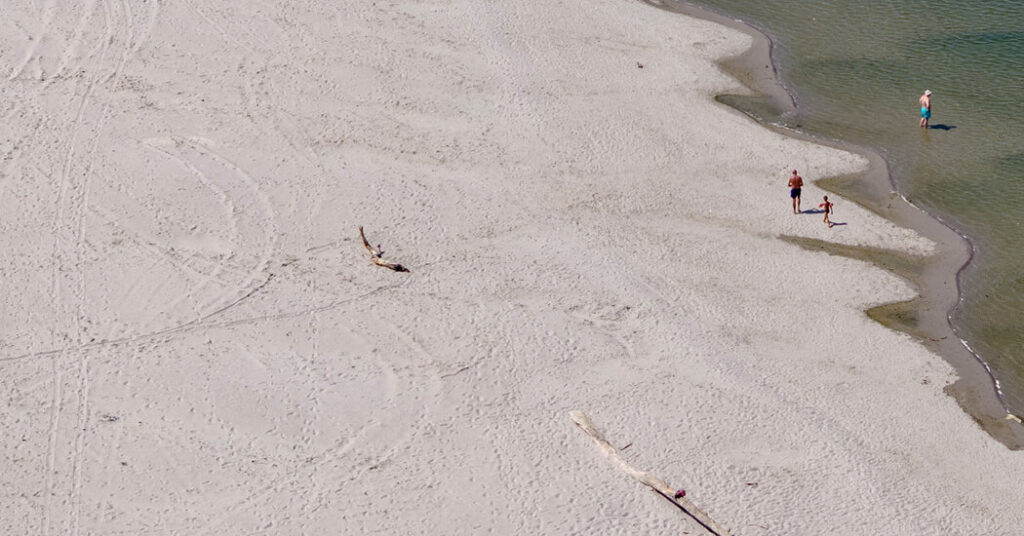
Near Prahovo, Serbia, Nazi ships scuttled in 1944 now lie broken-backed on sandbanks. In Croatia, a 1930s cargo ship protruded from the water. On the newly exposed riverbed of the Danube in Bulgaria, what local experts say is most likely part of the skeleton of an ancient mammoth was found scattered across the sand, like discarded bones after a giant’s picnic.
Much of Europe is in the middle of a severe drought, and major rivers have been reduced to a fraction of their usual size. Europe’s second-longest river, the Danube, is now facing record lows, recently measuring just 9 inches deep in Budapest. Part of Italy’s mighty Po River is also at a record summertime low. And the Rhine, a major outlet for trade flowing from the Alps to the North Sea, is now shallower than at any time since records began.
This summer, the transport of chemicals, oil products and other goods on the Rhine and the Danube ground almost to a halt in places. Romania shut down a nuclear plant cooled by the Danube, and Hungary narrowly avoided doing so. The carmakers Dacia and Ford agreed to temporarily cease production in their Romanian factories to save power.
For some in Europe, climate change seemed like a problem that mainly afflicted faraway places. In recent years, wildfires on the continent, together with heat waves and the drying of the rivers, have brought it home, where it’s beginning to alter the old map of Europe’s power and wealth. If the Rhine and Danube run even drier, the map will have to be redrawn.
Over the past 80 years or so, these rivers have served as the crucibles of the continent’s industrial power and the outlets for its trade. German industry, which powered the country’s famous postwar growth, was heavily concentrated around the confluence of the Rhine and Ruhr. The port at the Rhine’s mouth in the Netherlands rose to become the busiest in Europe.
The continent’s rivers also provide power for millions, and the Danube serves as a critical export route for Ukraine’s crops and a supply route for its military.
Against this backdrop, the drying of the rivers presents not only an ecological hazard but also a major strategic challenge for Europe, at a time when fresh problems are as welcome as old bombs revealed on a riverbed.
Europe is already struggling to deal with a once-in-a-generation economic transformation: the rise of Chinese high-tech manufacturing and electric vehicles in particular, which threaten European automotive icons such as Volkswagen and Porsche.
Simultaneously, it is wrestling with a major energy transformation as it seeks to curb its addiction to Russian gas while pivoting to renewables, including wind and solar.
In the face of President Trump’s nationalism and the aggression of President Vladimir Putin of Russia, Europe is cutting its reliance on U.S. defense assets in favor of greater self-reliance. Conflict in the Middle East and the closing of the Strait of Hormuz have revealed weaknesses in supply chains.
In conversations about how to respond, the buzzwords most overused in the European Union’s headquarters in Brussels are “strategic autonomy” — the idea that Europe will reduce reliance on foreign goods and military protection, meet the challenge of a rising China and a menacing Russia and deploy new technology to deliver a future that is greener, wealthier and healthier.
On paper, these are worthy goals.
The problem is that the continent’s leaders seem to assume that Europe’s physical geography will remain unchanged and that the huge advantages afforded by rivers such as the Rhine and the Danube can be taken for granted. Those advantages include the ability to transport goods across the continent at low cost, easy access to the ports at places such as Hamburg and Rotterdam, and unlimited access to fresh water for manufacturing, hydropower and cooling nuclear power plants
Now, it is rapidly becoming clear that the terrain on which Europeans live, work and travel is changing before our eyes.
Rivers can no longer be relied on to provide an inexpensive, reliable, relatively low-carbon alternative to road and air freight. Rivers cannot form the industrial backbone of the European Union’s push for autonomy from Chinese and American supply chains if they run dry. Nor can they provide reliable energy independence or guarantee food security.
Responding to these changes will not be easy. Just as the war in Iran is forcing some Middle Eastern countries to develop new supply lines and export routes, Europe needs to think seriously about how to develop alternative transport and energy networks that reduce its reliance on rivers. That could take decades and require huge investment in new infrastructure. Some places that grew rich through waterborne trade, such as the German Rhineland or Rotterdam, may lose out. And rivers may no longer bind together European neighbors in ways that made it easier to avoid relying on the outside world.
Take away Europe’s blue highways, and all the grand talk about building new industries, finding new trading partners and generating clean energy begins to look rather hollow.
One Dutch satirical outlet recently suggested using firefighting helicopters to refill the Rhine. That may be unlikely, but it’s clear Europe needs to begin thinking about its rivers more radically and more seriously — as a strategic asset rather than just an environmental sob story.
Ben Coates is a columnist for the Dutch newspaper Algemeen Dagblad and is the author of books including “The Rhine: Following Europe’s Greatest River from Amsterdam to the Alps” and “The Invention of Amsterdam.”
The Times is committed to publishing a diversity of letters to the editor. We’d like to hear what you think about this or any of our articles. Here are some tips. And here’s our email: [email protected].
Follow the New York Times Opinion section on Facebook, Instagram, TikTok, Bluesky, WhatsApp and Threads.
The post Europe’s Great Rivers Are Dying. The Continent Is In for a Shock. appeared first on New York Times.