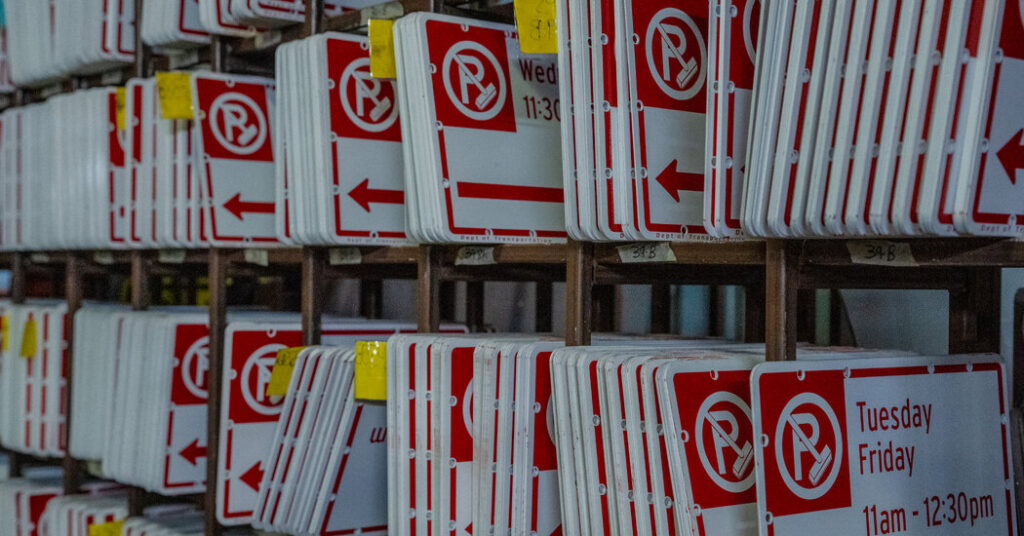
Sturdy sheets of aluminum are stacked to nearly the ceiling inside this industrial shop where almost every New York City street sign is born.
Even in a digital age, the Maspeth Central Shop in Queens is still cutting, printing and assembling more than 70,000 municipal signs a year, from the street-cleaning signs found in every neighborhood to the big green signs directing traffic on major highways.
The sign shop, which is part of the New York City Department of Transportation, has a staff of 46 workers, including seven letterers who lay out signs by hand and a blacksmith who makes custom brackets to securely attach signs to traffic poles.
These workers are responsible for maintaining more than one million street signs across the five boroughs. When a stop sign is damaged, they swoop in to replace it before anyone can get hurt. When a street is renamed or a parking rule is changed, they update the signs to make it official.
And when the Knicks won the N.B.A. championship in June, they whipped up 30 blue and orange “Champions Way” street signs to post all along Broadway for the ticker-tape parade. Even Mayor Zohran Mamdani showed up at the shop to help with the Knicks signs.
“This is the start of it all,” said Mike Fratianni, 49, the deputy chief of Maspeth operations. “This is the beginning of every sign in the city.”
Inside the red brick warehouse, every sign starts from a 12-foot-by-4-foot aluminum sheet. A thicker version is used for highway signs, which are installed on gantries above traffic and have to safely withstand heavy winds and rain.
It takes two workers to carry a single sheet, weighing up to 80 pounds, into the machine shop. There, the sheet is slid through a metal shear, which acts like a pair of giant scissors to cut it into smaller pieces.
“That’s our life here — cutting metal and making it look pretty,” said Ryan Medrano, 38, the deputy director of interior operations at the sign shop.
Each sign comes with a detailed work order, which lays out its shape and exact measurements as well as what letters and symbols will go on it. For highway signs, the aluminum sheets are joined together to make larger sizes.
On a recent morning, Marlon Sealy, 60, a traffic device maintainer, pushed buttons on the control panel for the metal shear. Wearing gloves, he fed an aluminum sheet into the front of the humming machine. Minutes later, it was spit out in three pieces from the back.
Mr. Sealy said that he liked making signs that helped people move around the city. “I’m indirectly providing a service to everyone,” he said. “Me too, when I’m lost.”
Once cut down to size, the aluminum plates are sent to another machine in the room that rounds their sharp corners and punches holes in them for mounting on traffic poles and posts.
From there, the plates take two routes. Those that will carry rules for parking and street-cleaning go to the screening room down the hall. They are hung on hooks on an overhead carousel and carried to a large gray machine that applies a hard enamel finish.
Workers put each plate on a screening table with a folding cover, which holds the silk-screen frame for the sign they are making. The frames for the most common signs, like “No Parking Anytime,” are numbered and kept nearby on shelves.
The workers step on a foot pedal to close the cover over the plate and activate a flood bar that spreads a solvent-based ink to print the sign. Afterward, the sign is placed on a rack to dry before being flipped over to print the other side.
Plates destined to become highway, traffic and street signs go to the art room instead of the screening room. They are covered with a vinyl material that is highly reflective — embedded with microscopic flecks of glass — so they can be seen more easily by drivers.
Workers attach a sheet with pre-cut or printed vinyl stickers of letters and numbers onto the vinyl-coated plates with a roller press. The extra material is peeled off, or trimmed with a box cutter.
It is precise, exacting work. Kate Griffin, 38, a letterer, has accidentally brushed her hand against the vinyl’s sharp edges. “It’s kind of like the worst paper cut you can get,” she said.
It typically takes from 20 minutes to several hours to make most signs, depending on the type and size, though the largest signs may take longer.
The sign shop has a storeroom where thousands of the most common street signs are kept on racks, ready to be dispatched. Nearby is a bin of signs that have already gone out, but came back after being run over, bent, mangled or covered by graffiti.
One stop sign on the street was altered with white stickers to say: “I will Never STOP Loving You.” Now, that sign hangs in the storeroom.
Other signs that cannot be repaired will be recycled.
Since June 2024, the shop has made replicas of popular signs for online drops. Knicks fans recently snatched up 200 “Champions Way” signs, at $100 apiece, within minutes. Other popular signs were Cornelia Street, which is the name of a Taylor Swift song, and Christopher Street Stonewall Place, which is named after the Stonewall uprising of 1969.
The sign shop itself has become a repository of city history. One wall displays signs that were ordered under previous mayors to celebrate special occasions like Nelson Mandela’s visit in 1990 and the New York Yankees’ World Series Championship in 1998. Other signs salute the Grammys and the troops of Operation Desert Storm.
The latest signs, of course, celebrate the Knicks.
“The city really came together for the Knicks, and it was cool to be a little part of that,” said Ms. Griffin, who made the “Champions Way” signs. “I make the celebration signs. They did all the work.”
The post There Are Over 1 Million N.Y.C. Street Signs. Here’s How They Are Made. appeared first on New York Times.