Frustration with Washington is growing in the Persian Gulf region, where U.S. allies are increasingly concerned that President Donald Trump is unable to manage the diplomacy necessary to secure peace with Iran, Arab and Western officials say.
Trump in recent weeks has repeatedly issued threats against Iran, only to withdraw them, citing progress in talks. After months of conflict, and continuing missile and drone strikes by Iran and its proxies, three officials and a former U.S. diplomat told The Washington Post, the governments of Saudi Arabia, the United Arab Emirates, Qatar, Kuwait and Bahrain are now united in their aggravation with the administration. Some have begun to debate the utility of continuing to host large U.S. military installations on their territory.
“Trump started this war,” one Gulf official said, “and we are paying the price.” Like others in this article, he spoke on the condition of anonymity to discuss the sensitive subject. Anger with the United States, the official said, was at its highest point since the U.S. and Israel attacked Iran in February.
The Gulf states continue to rely on Washington as a close security partner and major arms supplier, and Qatar and Bahrain host large U.S. bases. But the frustration is leading some states to consider new arrangements. These dynamics are unlikely in the near term to significantly reorder the region, analysts say, but some countries have begun to explore their options.
A mutual defense agreement signed by Saudi Arabia, Turkey and Pakistan last week was “a signal to the U.S.,” a senior European official said.
The pact shows the three powerful Sunni Muslim states “are trying to diversify their security and defense partnerships,” said the official, who is in regular contact with Gulf leaders. “In their mind, the U.S. is not enough.”
A White House official said Trump “has extraordinary relationships with all of our Gulf partners.”
“The United States has been in regular contact with all of our regional allies since before Operation Epic Fury,” said the official, speaking on the condition of anonymity under rules set by the White House. “Iran is more isolated than ever before as a result of its terrorist actions.”
Representatives of the Saudi, Emirati, Qatari, Kuwaiti and Bahraini governments did not respond to requests for comment.
“There has been frustration from the get-go,” said Firas Maksad, director for the Middle East and North Africa practice at the Eurasia Group. U.S. allies in the Persian Gulf, he said, feel they were “unnecessarily entangled” in a war that Trump is now struggling to resolve.
Maksad, who has extensive contacts within Gulf leadership, said Trump’s Iran policy is often described in the region as “erratic” and “unpredictable.”
Anna Jacobs, a fellow with the Arab Gulf States Institute in Washington, said there has been “diminished trust” of the U.S. since the start of the war. U.S. allies think the country’s “conduct in the region is making them less safe, not more safe,” she said.
One Western diplomat in the region said these changes don’t amount to a significant shift in sentiment toward the United States. Even before the war with Iran, he said, U.S. forces in the region were not “enthusiastically” welcomed. “It was more something that was a necessary evil,” the diplomat said. “Now, the necessity of it is being put in question.”
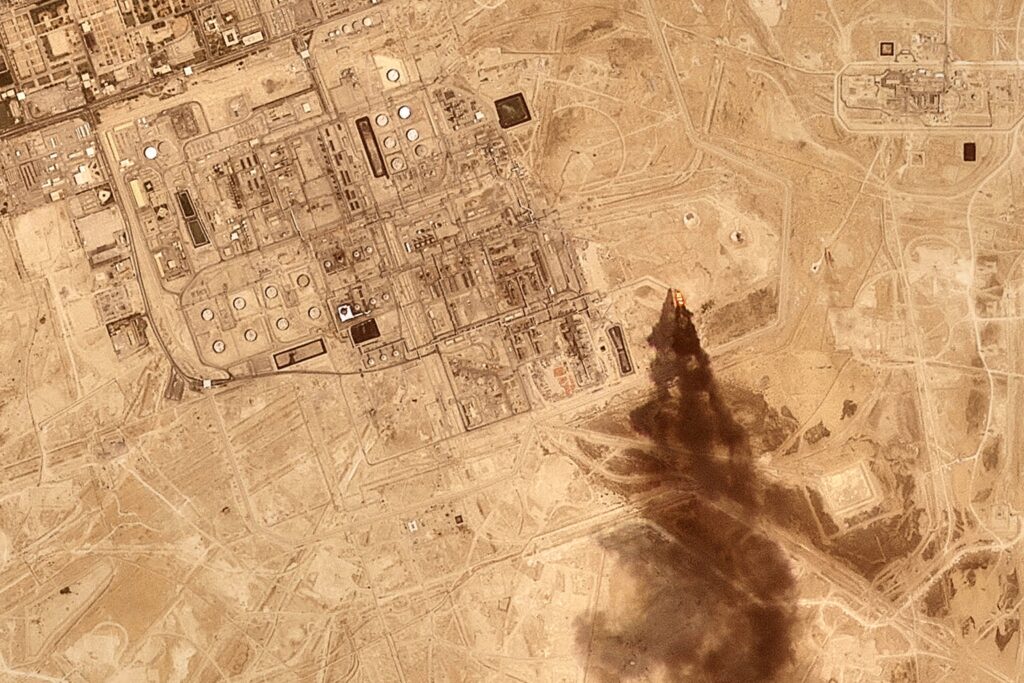
Saudi Arabia has come under particular pressure in recent weeks. In addition to attacks from Iran and Iran-backed groups in Iraq, the kingdom has been targeted by Iranian-aligned Houthis in Yemen.
Houthi forces have repeatedly struck Saudi energy infrastructure and are attempting to shut down the Bab al-Mandab strait at the mouth of the Red Sea. Since Iran closed the Strait of Hormuz in the early days of the war, Saudi Arabia has depended on its Red Sea ports to export its oil.
Attitudes toward the war among Gulf leaders have shifted. Oman has opposed the conflict from the outset, but Saudi Arabia, the UAE and Bahrain have at times backed it.
Emirati forces have conducted “numerous” strikes on Iranian territory in recent months, according to the Western diplomat, and Saudi forces have struck back at Iranian-backed groups attacking from Iraq.
“At the beginning of the war, they were — I don’t want to say, supportive — but honestly, they were not totally against the war,” the senior European official said. The thinking in Abu Dhabi and Riyadh, he said, was that a quick, definitive victory could prove beneficial.
That began to shift in the lead-up to the first round of talks between Iran and the United States in April, the official said, when it became clear that not only would the Iranian regime not fall, but it would not reopen the Strait of Hormuz.
In the months since, Trump’s inconsistency has alarmed the Gulf, said Bader Al-Saif, an assistant professor of history at Kuwait University.
“Even before all this back and forth with Trump, there was no clear strategy,” said Al-Saif, a fellow of the Arab Gulf States Institute in Washington. He cited the Memorandum of Understanding between the United States and Iran in June.
“The MOU was a joke,” he said. The agreement didn’t address the Gulf states’ top concerns, including Iran’s ballistic missile arsenal or Tehran’s support for proxy forces.
“Those terms were not terms of our liking,” Al-Saif said, “and that’s why it died out sooner than later.”
Trump, the White House official said, “has always been clear that his preference is diplomacy.
“Unfortunately, Iran chose the path of violence by killing American troops, committing international acts of terrorism, and lashing out at its neighbors in the region — and the Commander-in-Chief ensured that they reaped the consequences of those decisions.”
The Gulf states lack an immediately viable alternative to their decades-long security partnerships with the United States. As the conflict continues, the Gulf official said, their only choice is to double down on their alliances with Washington.
“Whatever we do,” he said, “we cannot say no to the United States.”
Douglas Silliman, a U.S. ambassador to Kuwait and Iraq under President Barack Obama and Trump, said he heard frustration with Washington on a recent visit to the region. But in recent weeks, he said, he is also hearing growing anger at Tehran for its continued attacks on infrastructure and refusal to reopen the Strait of Hormuz.
Silliman, now the president of the Arab Gulf States Institute, described the feeling in the region as “kind of this odd contradiction of being mad at the United States for starting the war and being dependent upon the United States” for equipment, munitions and intelligence.
If the conflict continues, the economic pressure on the Gulf will grow. Even during peacetime, the region quiets over the summer, tourism slows and residents hole up indoors to escape 100-degree days.
But in autumn, temperatures fall and activity resumes. This year, the conferences, summits, festivals and Formula One races that pack the calendar from October through December are all in limbo.
Saudi Arabia’s 10th annual Future Investment Initiative Institute in late October, the “Davos in the Desert,” could be an early test of whether senior officials and top CEOs are willing to visit the region, the Western diplomat said.
“They may tweak the theme” to acknowledge continued insecurity in the region, he said. “To postpone would send the wrong message.”
Iran continues to launch drones and missiles against Kuwait, but in the capital, much of life has returned to normal, Al-Saif said. “We have been through worse,” he said, referring to the 1990 invasion by Iraq that triggered the Persian Gulf War. “We handled the occupation. We can handle this.”
The security lockdown from the war’s earlier stage has been largely lifted. Businesses are open, traffic has returned to city streets and Al-Saif has resumed teaching in person. But the conflict, he said, must not continue much longer.
“A quick end is obviously something we want,” he said. “The Gulf War was much more straightforward than today.”
The post Frustration with Trump grows among U.S.’s Persian Gulf allies, officials say appeared first on Washington Post.