It was the worst clash in years between China and the Philippines at a long-simmering flashpoint in the South China Sea.
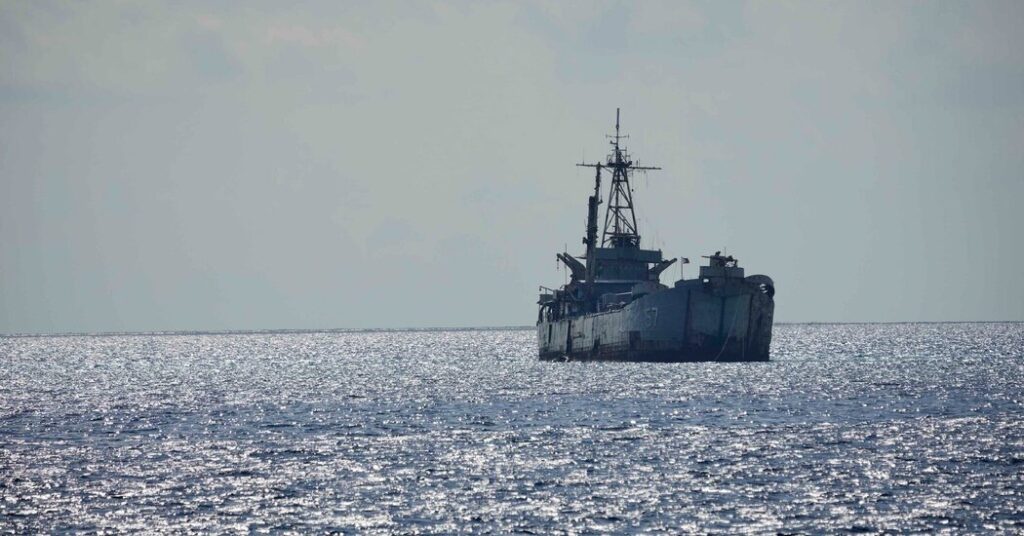
For decades, the Philippines has claimed a small reef in disputed waters and signaled its control of the territory by rotating troops to a World War II-era ship grounded there. An international tribunal ruling a decade ago supports the Philippines’ claim.
But last month, a Chinese Coast Guard vessel began circling the ship, which is named the Sierra Madre. It was the latest in a long series of encounters between the two governments at the site, which is called the Second Thomas Shoal.
At one point, the Chinese Coast Guard used small boats to move in on Filipino service members and beat one of the men with a wooden baton, inflicting head injuries, according to Philippine and U.S. officials. China blamed the Philippines for provoking the clash.
The American ambassador expressed outrage and declared that the United States stood with the Philippines, the oldest U.S. treaty ally in Southeast Asia.
Yet no one expects China to curb its expansionist activities in the region anytime soon. And there are growing doubts among Asian nations over what the United States would be willing to do to deter China, given the enormous distraction and resource drain of the U.S.-Israeli war against Iran.
The United States is running low on critical weapons, including air defense interceptors. Iran’s missile and drone attacks have forced U.S. troops to leave bases in the Middle East and destroyed the sites, an indication of what the Chinese military — which is much more powerful than Iran’s — could do in a conflict in Asia.
In early July, China conducted a rare test firing of a nuclear-capable intercontinental ballistic missile that carried a dummy warhead, sending it into the Pacific Ocean from a nuclear-powered submarine. It is one of the most powerful elements in its arsenal.
While China tests its might, President Trump’s State Department is closing consulates in Japan and Indonesia, according to congressional officials briefed on the decision.
Mr. Trump’s second term “has been a colossal failure for U.S. interests in the Asia region,” Representative Gregory W. Meeks of New York, the top Democrat on the House Foreign Affairs Committee, said in a statement.
“This strategy, if you can call it one, is a gift to China that is undermining U.S. credibility and harming our national security,” he added.
Trump appointees say the administration is not ceding ground in Asia. In a speech in Manila on Aug. 10, Elbridge Colby, the under secretary of defense for policy, said the Trump administration aimed to “maintain a posture of deterrence by denial along the first island chain” — meaning it was willing to commit military resources to dissuade China from invading or attacking islands that include Taiwan and ones in the Philippines and Japan.
But Mr. Colby also said allies needed to spend more on defense and should try to integrate their militaries with that of the United States — and “not vainly and futilely seek to exclude or supplant us.”
Mr. Trump’s global trade war, whose targets have included Southeast Asian nations, has also revealed to allies and partners that the United States can be a commercial antagonist.
The U.S. government has lacked an economic vision for Southeast Asia for years, as Democratic and Republican politicians retreated from a Pacific Rim trade pact that President Barack Obama promoted.
That has left countries in Southeast Asia wondering what happened to the U.S. drive to ensure that it remains a presence that balances against China.
While Southeast Asian countries do not want to be trapped in a great-power clash between the United States and China, “they still want to feel the United States is a healthy counterweight to the P.R.C.,” said Mira Rapp-Hooper, who served on the National Security Council during the Biden administration and is now a visiting fellow at the Brookings Institution. She was using the initials for the formal name for China, the People’s Republic of China.
“So the perception that the United States is drifting as an alternative has also left a real impression on many of these partners,” she added.
While Mr. Trump has talked about China as an economic rival, he also embraced the superpower after it successfully retaliated during his tariff war last year.
During a summit in Beijing in May, Mr. Trump expressed admiration for President Xi Jinping of China, and he is preparing to host Mr. Xi at a state visit in Washington in late September.
Mr. Trump’s move to build what he calls a “G2” — Group of Two — relationship with China has upended a growing bipartisan push in Washington in the last decade to confront China as a hostile rival.
As the Trump-Xi bonhomie grows, some Asian countries are feeling left out, yet are also opting to stay on China’s friendly side.
That is especially true when China remains the largest trading partner for many of the countries, and the United States is not working on presenting economic alternatives.
“We’re in a very difficult position because you know we want to have that maximal relationship with both sides,” said Richard Heydarian, a political scientist from the Philippines. “And then for countries like the Philippines, it’s even more impossible because the U.S. is a military ally. We need the U.S. when it comes to the China threat, but the U.S. is not giving us much love on anything beyond the military aspect.”
The Biden administration agreed to work with the Philippines on expanding a transportation network, called the Luzon Economic Corridor, to better integrate the country into global supply chains.
The Trump administration is trying to bring the Philippines into its so-called Pax Silica initiative, with the notion of having the country work on semiconductor manufacturing and building artificial intelligence in a way that would benefit the United States.
But those nascent steps pale next to U.S. efforts to keep up its military ties with the Philippines. The two counties have long had a close relationship, and they have tried to maintain military cooperation, though their ties have shifted at times.
The United State made the Philippines its first colonial foothold in Asia after taking it from Spain in the Spanish-American War. And the Philippines is the only Southeast Asian nation that has a formal alliance treaty with the United States — one that requires their militaries to help with the defense of the other nation.
Secretary of State Marco Rubio told reporters in Manila last month during an annual forum of Southeast Asian nations that the U.S. military was determined to push back against China’s expansionist efforts.
“We’re never going to accept that international waterways are somehow under the control of other countries,” he said. “We’ll continue to sail through international waterways and freedom of navigation efforts of that kind, and we’ll continue to live up to our commitments — for example, with the Philippines and other countries — in terms of the treaty commitments that we have.”
During the Biden administration, the U.S. government took a hands-on approach to forging partnerships in Asia. It brought Japan into a security coalition with the Philippines. And President Joseph R. Biden Jr. got the Philippines to grant American troops expanded access to nine bases on islands near Taiwan.
In November 2022, Vice President Kamala Harris flew to the island of Palawan, east of the South China Sea, and visited a Philippine Coast Guard site there to send a signal to China.
The military cooperation has continued under Mr. Trump, despite the resource drain of the Iran war. In May, the U.S. and Philippine militaries tested a Typhon missile launcher at one of the islands, a public show with a weapon that could be deployed against Chinese troops if they tried to invade Taiwan.
The Philippines invited Japan to take part in multination military exercises in June, the first time since World War II that Japanese troops had been active on Philippine soil.
The move is both a continuation of the coalition overseen by the Biden administration and a hedge by the Philippines to broaden its partnerships beyond the United States.
Eric Schmitt contributed reporting from Washington.
The post As China Pushes to Expand in Asia, Trump Focuses on Iran appeared first on New York Times.