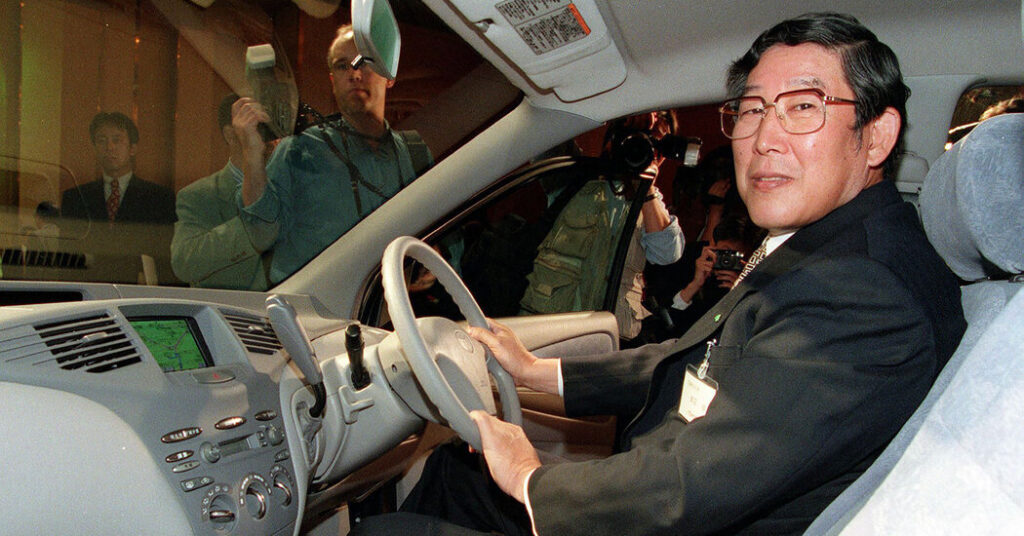
Hiroshi Okuda, a hard-charging Toyota executive who revived the floundering automobile maker in the 1990s by expanding production overseas, tightening decision-making at home and pushing through the introduction of the Prius, the world’s first hybrid car in regular production, died on Aug. 8. He was 93.
The Toyota Motor Corporation, where he had worked since 1955, confirmed the death, but did not provide a location.
When Mr. Okuda took over Toyota’s presidency in 1995, he was the first executive outside the founding Toyoda family to lead the company in almost three decades.
But he was an obvious choice: He had spent his entire career at the company, starting in the accounting department and rising to hold a variety of foreign posts that gave him deep insight into the financial and operational details of what was then the world’s third-largest car manufacturer.
Toyota was a behemoth, but it was slipping. Thanks in part to a strong yen, which hurt exports, and a conservative corporate culture, it had been steadily losing domestic and international market share. In 1995, for the first time in many years, it fell below 40 percent of car sales in Japan.
Mr. Okuda’s predecessor, Tatsuro Toyoda, the son of the company’s founder, Kiichiro Toyoda, seemed to embody the stagnation. Seriously ill and bedridden for months, he was said to be issuing orders to his brother, Shoichiro, through telepathy.
Mr. Okuda shook things up. An avid gambler and karaoke singer with a black belt in judo, he introduced what many observers described as an American executive approach. He made clear decisions quickly, empowered lower-level leaders and was unemotional about cutting dead weight.
Toyota had missed the sudden, explosive popularity of minivans and sport utility vehicles in Japan. Mr. Okuda pushed through the Sienna minivan, along with several other innovative vehicle designs, and retired dozens of older models that weren’t selling well.
He also brought the RAV4, which had debuted in 1994 in Japan, to the U.S. market, where it quickly became one of Toyota’s best-selling models.
And in 1997, he demanded that his engineers bring the Prius, a hybrid car, to market by the fall. It had been in development for years, and other companies were racing to be the first to introduce a hybrid.
Mr. Okuda’s team won the race, and the Prius became a milestone in automotive history.
“Most Japanese tend to keep silent, but I talk a lot,” he told The Associated Press in 1997. “And my decisions are quick, much quicker than those before me.”
He changed the way Toyota did business at home, creating a special branch of the company that focused on innovation and where promising young employees could gain experience — a novel approach in a country where age was often a strict determinant of corporate hierarchy.
To counter the effects of the strengthening yen, he opened or expanded more than a half-dozen overseas plants in the United States and Europe. Doing so cut costs, but it also helped with international relations at a time when fears of Japanese export dominance were a major factor in global trade politics.
Perhaps Mr. Okuda’s biggest shake-up came in 1999, when he handed the presidency to a lieutenant, Fujio Cho, so that Mr. Okuda could become chairman of the Toyota board of directors — taking many of the powers of the presidency with him.
“What I can say about Toyota is that before I became president, the company was considered to be very conservative, so I have tried to make us more aggressive,” he told The New York Times in 1998. “I think our example will be followed by other companies. Companies are being less conservative and that means even more competition, so the more conservative executives might not be around in the future.”
Hiroshi Okuda was born on Dec. 29, 1932, in Tsu, a city south of Nagoya. His father and paternal grandfather ran a securities firm. His family home, and much of the city, were destroyed by American bombs during World War II.
He studied business at Hitotsubashi University and went to work at Toyota immediately after graduating in 1955.
After spending 17 years as an accountant, he moved into the company’s overseas operations, working in the Philippines and Australia for several years before returning to Japan to join the executive leadership team.
Mr. Okuda stepped down as chairman in 2006, but remained a senior adviser until 2018.
His survivors include his son, Yotaro Okuda.
Among Mr. Okuda’s quirks was a love of driving fast. “Speed is like a drug,” he told Nikkei Business magazine in 1995. “I usually ride in a black executive car, but I get irritated when I ride in an executive car that drives slowly, and I even find it painful to drive slowly.”
The post Hiroshi Okuda, Disrupter Who Revived Toyota in the 1990s, Dies at 93 appeared first on New York Times.