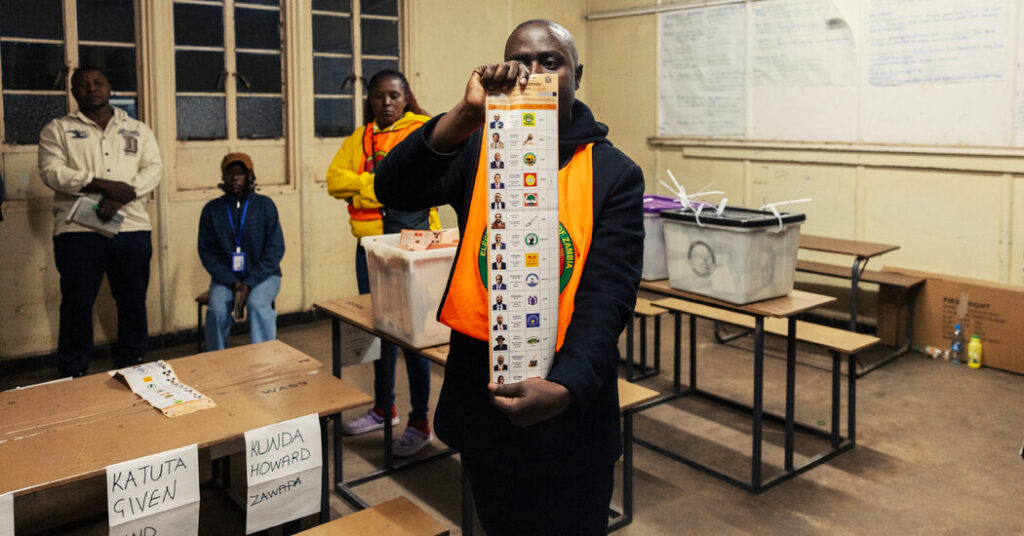
Zambian officials resumed vote counting in the presidential race on Friday after a brief suspension they said was caused by violence at polling stations and the theft of ballots in the southern African nation.
Just hours after halting the tallying, the Electoral Commission of Zambia announced that it had consulted with law enforcement agencies and contained the security threat. It said new measures were put in place to allow the counting to continue safely.
Mwangala Zalomouis, the commission’s chairwoman, said final election results would be released by Monday.
The move to suspend counting had drawn heavy criticism among opposition leaders, who said they feared election tampering. Both of the top candidates had claimed an advantage in early tallies.
President Hakainde Hichilema has been favored to win a second term, but economic hardship and concerns over growing repression have tightened the race.
Mr. Hichilema’s main opponent, Brian Mundubile, claimed victory in a statement on Friday, citing an unofficial vote count led by his party and early polling results. He said the suspension of vote counting by the Electoral Commission of Zambia raised “legitimate fears that this delay could create an opportunity for interference with, or manipulation of the results.”
Mulambo Haimbe, an official in Mr. Hichilema’s party, the United Party for National Development, said the concerns of election rigging were “purely speculative,” and accused Mr. Mundubile of “inciting the people to an uprising.”
He also said that early indications after Thursday’s vote were positive for Mr. Hichilema, adding that turnout had been high in his strongholds.
The party also saw positive results for Mr. Hichilema in places where the president underperformed in the last election, Mr. Haimbe said.
To win the presidential election in Zambia, a candidate must get more than 50 percent of the vote. If that does not happen in the first round of voting, the top two candidates compete in a runoff.
When Mr. Hichilema rose to power five years ago, he was seen as a bright spot for democracy in Africa. He had unsuccessfully vied for the office several times before and had been subjected to what analysts saw as a political imprisonment by the government he challenged.
The incumbent at the time, Edgar Lungu, was accused of suppressing the opposition and influencing the vote. Having overcome those challenges, Mr. Hichilema promised to renew Zambia’s democracy.
But during his five years in power, his government has passed measures that human rights groups say restrict press freedom and muzzle critics of his administration. In the lead up to this year’s election, Mr. Hichilema and his party were accused of violently cracking down on opposition rallies and thwarting political opponents from entering the race.
Mr. Hichilema, who has denied allegations of repression, had based his campaign on his success reviving Zambia’s stagnant economy. He helped the country climb out of crushing debt. He has attracted investors back to the country and pumped life into the vital mining sector, with Zambia being one of the world’s top copper producers.
But those high-level economic victories have not translated to a better life for many in Zambia, where many still face rising food and fuel prices and high unemployment.
The post Zambia Resumes Vote Counting in Presidential Race After Brief Suspension appeared first on New York Times.