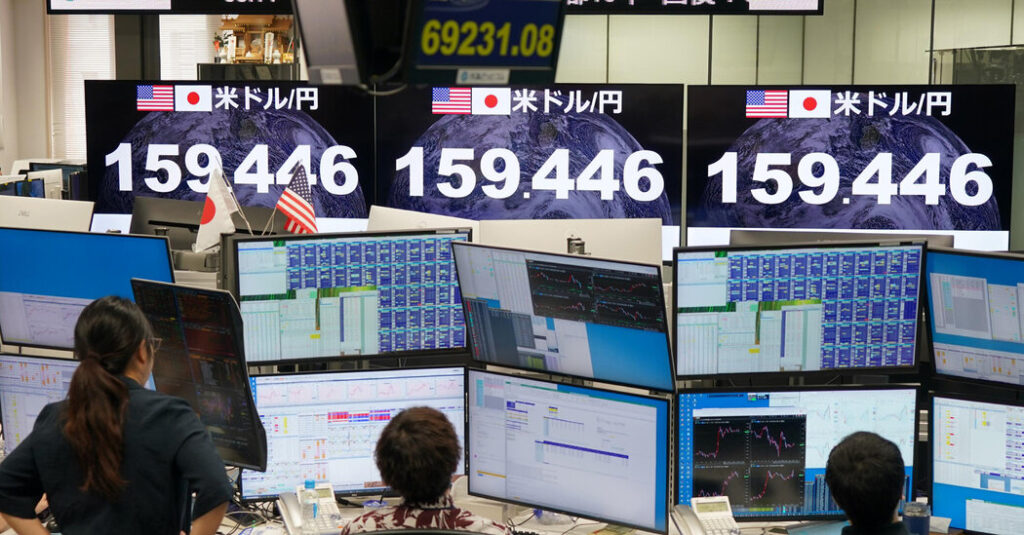
The Japanese yen has resumed its slide over the past two weeks, surrendering ground it gained after the United States and Japan spent tens of billions of dollars to prop up the currency languishing near four-decade lows.
The yen briefly strengthened to 155 per dollar intraday after the intervention in late July. But the rally quickly faded, and on Friday, the currency was trading at around 159 to the dollar. Its renewed slide is approaching the 160 yen level that could test the resolve of officials in Tokyo and Washington, who said they would not hesitate to intervene again if “disorderly yen movements” persisted.
The reversal underscores the limits of one-off currency interventions while investors remain uneasy about Japan’s enormous debt burden, Prime Minister Sanae Takaichi’s push for aggressive government spending and a perception that the Bank of Japan is raising interest rates too slowly.
“It’s no surprise that the yen has weakened again,” said Marcel Thieliant, head of Asia Pacific at Capital Economics, an economic research firm. “Without change to the underlying story, the underlying fundamentals, there’s no reason to think that this intervention would have a lasting impact.”
The yen’s long slide began in 2022, when the U.S. Federal Reserve rapidly raised interest rates to curb post-pandemic inflation while Japan’s central bank kept rates below zero. The widening gap made dollar-denominated assets more attractive, drawing money toward the United States and pushing down the yen. By mid-2023, U.S. interest rates were above 5 percent, while Japan kept its rates at -0.1 percent.
By 2024, the yen had weakened to about 150 per dollar, from around 110 in 2021. The Bank of Japan raised interest rates in 2024 for the first time in 17 years. Subsequent increases helped stabilize the currency, though at a historically weak level.
Then, in October 2025, Ms. Takaichi took office. From the outset, she championed low interest rates and aggressive government spending to spur investment and economic growth. Before her campaign, she had at one point called the prospect of the Bank of Japan raising interest rates “stupid.”
Her stance unsettled global investors already concerned about the sustainability of Japan’s public debt, which is more than twice the size of its economy.
In recent months, Ms. Takaichi has abolished a gasoline tax surcharge and reinstated subsidies for electricity and fuel. Shortly after the U.S.-Japan intervention in July, Ms. Takaichi’s government decided to cut the consumption tax rate on food to 1 percent, from 8 percent, for two years starting next spring.
Economists say the forces driving the yen have also changed. While the currency had been weakening for years, its movements under Ms. Takaichi appear to have become less closely tied to interest rate differentials. Even as the Bank of Japan has continued raising rates, those increases have done little to strengthen the yen.
Since 2024, the Bank of Japan has raised rates roughly once every six months, most recently in June. Expectations are growing that the central bank could act again at its next policy board meeting, in September.
U.S. Treasury Secretary Scott Bessent has repeatedly signaled support for higher rates in Japan, telling public broadcaster NHK earlier this month that he was confident the Bank of Japan would “do what is best” as a weak yen stoked inflation.
Further rate increases could narrow the gap between Japanese and U.S. interest rates and relieve some pressure on the yen. But at some point, they could also make Japanese bonds more attractive to domestic investors, drawing money out of U.S. Treasuries, depressing their prices and raising borrowing costs for the United States.
Highlighting the dilemma that policymakers face, concerns about blowback from a weak yen on U.S. interest rates are partly what motivated last month’s intervention. Japan is the largest foreign holder of U.S. Treasuries, and if the government was forced to sell more of its holdings to bolster the yen that could put upward pressure on U.S. rates.
Treasury yields are already hovering near their highest levels in decades. On Thursday, the United States sold 30-year bonds at the highest yield since 2001.
The latest retreat in the yen leaves Tokyo and Washington confronting difficult questions: how they can sustainably support the yen, and how badly they want to.
Analysts at Bank of America have suggested that, alongside steady interest-rate increases, Japan could adopt measures to bring more capital home, including shifting a greater share of public pension assets into domestic investments.
Others argue that the yen’s weakness could ease if fears of a fiscal crisis prove exaggerated and investors reassess the strength of Japan’s underlying finances. They note that the government’s investment income has been rising faster than debt service payments, and that Japan is among the few advanced economies where the ratio of debt to the size of the economy has been declining.
For now, however, uncertainty over how far Ms. Takaichi is prepared to push her spending ambitions continues to weigh on the yen. “There’s the underlying story still that people are worried about fiscal policy eventually becoming too loose, even if it’s not happening yet,” Mr. Thieliant said.
The post Why Japan Is Struggling to Stop the Yen’s Decline appeared first on New York Times.