It resembled in many ways a summer camp. Barbecues and beach volleyball games were on offer. A wellness spa was called “Relax and Have Fun.”
The men and women who attended the program at a resort complex in a remote part of Serbia also took part in more sinister activities, like learning to break through police cordons and set buildings on fire. They donned flak jackets and trained with assault rifles.
Their counselors, it turned out, were operatives with ties to Russia’s military intelligence service, known as the GRU. Their purpose, according to intelligence officials from three countries who described the activities, was to build a cadre of disciplined shock troops trained in election interference.
The target was tiny Moldova, a country of about three million people that carries outsize importance for President Vladimir V. Putin of Russia.
The Kremlin’s campaign included methods familiar elsewhere in the West, like hacking and disinformation. But in Moldova, its intervention went further than perhaps anywhere else outside Ukraine, and stands as one of the most extensive and audacious plots to date in Mr. Putin’s effort to destabilize the West, the three Western intelligence officials say.
Besides the camp in Serbia, Russian agents ran training programs in Bosnia and Moscow that were designed to turn pro-Russian Moldovans into foot soldiers. Moscow paid hundreds of Orthodox Moldovan priests to recruit voters and to push Russian narratives from the pulpit. And it spent hundreds of millions of dollars on a sophisticated vote-buying scheme financed by a Moldovan billionaire in exile and conceived and operated from Skolkovo, the Kremlin’s knockoff Silicon Valley outside Moscow.
Moscow’s campaign has not stopped. This spring, Russian missiles targeted energy infrastructure that provided service to Moldova, polluting waterways and disrupting electricity flows.
This article is based on interviews with activists who took part in the Russian effort; senior Moldovan law enforcement and security officials; and more than half a dozen European and American intelligence officials. The New York Times also reviewed thousands of documents related to Russia’s attempts to interfere in Moldova’s elections.
Many of those interviewed insisted on speaking anonymously, either to discuss sensitive security operations or because they feared retribution.
Details about Russian efforts in Moldova have emerged in court cases and local reporting, but the scope and extent of the campaign, including the vote-buying scheme and role of Russia’s intelligence services, has not been previously reported.
Publicly, Russian officials have denied interfering in Moldova’s affairs, and have dismissed accusations that Moscow is trying to undermine the West. Last December, Mr. Putin, in an address to military commanders, castigated European leaders for “stoking hysteria” over the threat from Russia.
Soon afterward, though, he gathered the leaders for a secret briefing to deliver the exact opposite message, according to officials from two countries with knowledge of the episode. Their goal for 2026, Mr. Putin told them, is “the collapse of NATO and the E.U. from within,” the people said.
Moldova is central to this effort. In the hierarchy of Kremlin priorities, the Western intelligence officials say, conquering Ukraine is first, and taking control in Moldova is second. Though it is not a member of the European Union or of NATO, it is strategically located, squeezed between NATO members and Ukraine.
Moldova would make an ideal beachhead for Russia for further aggression against either Ukraine or the West, the officials said, adding that Mr. Putin still hopes to conquer a swath of southern Ukraine to create a land bridge linking Russia to Moldova.
A map of planned Russian troop movements, publicly displayed by the president of Belarus early in the war, showed Russian forces sweeping into Transnistria, a separatist region in Moldova that hosts a contingent of Russian troops. Russia has not accomplished that goal.
Russia wants to use Moldova “as a springboard for hostile activities against Ukraine as well as its main defense and financial supporter, the E.U.,” said Stanislav Secrieru, the Moldovan president’s national security and defense adviser.
“For these reasons,” he said, “Russia allocated over the last few years unprecedented resources.”
Asked for comment on accusations of Russian interference in Moldova, Dmitri S. Peskov, the Kremlin’s spokesman, said: “These are all untrue assertions that have no basis whatsoever.”
The pro-Western government of President Maia Sandu has set E.U. membership as a priority, making it a Kremlin target. In every recent vote — including a presidential election and referendum on whether to apply to join the European bloc in 2024, and parliamentary elections last year — Moscow has poured in resources to dislodge Ms. Sandu and her party, PAS.
That was the objective last fall when Moldova held critical parliamentary elections to determine whether Ms. Sandu’s party would retain power, or cede it to a coalition backed by Moscow. The Kremlin had spent months preparing. Its cyberwarriors burrowed into the election commission; its vote-buying and propaganda campaigns were in full swing; its teams of recruits trained in Serbia were ready to sow chaos.
Sergiu Zama, a senior Moldovan prosecutor, who has been pursuing cases related to the election interference for more than a year, said just a handful of the recruits were needed to disrupt the voting. “The goal wasn’t to identify a thousand people to commit crimes,” he said. “Lighting the spark was enough.”
Malevolent Camp Activities
The Russians established their training camp at a resort in western Serbia in the summer of 2025, months before the parliamentary elections. The participants, mostly from Moldova, were paid $400 to attend a three- to four-day course, according to Mr. Zama — an enormous sum by Moldovan standards.
Videos from the camp, which Moldovan prosecutors and the country’s intelligence service said were taken from participants’ phones, show men dressed in camouflage and flak jackets training with assault rifles.
The Serbia camp was one of several established by Russian operatives. There was also a camp outside Moscow where more than 100 young Moldovans practiced “making and using incendiary items and homemade explosives” and handling drones “with special attachments for explosives or arson,” Moldovan prosecutors said in a statement. Two of the officials from Western intelligence services said the training was overseen by the GRU.
Iuri Vitneanski, a Moldovan political activist who attended the Moscow camp, denied that he had engaged in seditious activity. The purpose, he said in an interview, was to create “friendly, cooperative relationships” with young Russian politicians. He declined to say more than that.
He said he was unaware that the camp was overseen by the Russian intelligence. The Moldovan authorities acknowledged that not every person knew the camp’s true purpose.
Some attendees said they had refused to take part in training sessions. Maxim Rosca, who attended the training camp in Bosnia, later testified in court in Moldova that when he said he would not participate, a Russian trainer punched him in the face and knocked out a tooth.
In October 2024, three participants in the Bosnia camp were arrested crossing back into Moldova. They were carrying drone components, including attachments for dropping grenades, prosecutors said.
They also had a manual titled “Russian Cuisine: The ABCs of Homemade Terrorism,” prosecutors said.
Money for Votes
The protesters gathered in the hot sun. They waved brooms and posters with antigovernment slogans.
The protest in the provincial town of Taraclia in July 2025 appeared organic.
Mr. Vitneanski, the Moldovan political activist who attended the Moscow camp, was at the event. In an interview with local television he described it as “the initiative of local residents.”
In fact, it was organized some 780 miles away in Moscow by operatives working for Ilan Shor, an Israeli-Moldovan oligarch who lives in Russia.
Days before the protest, Mr. Shor’s associates, using Telegram, the online messaging service, had reached out to thousands of Moldovans, promising them cash payments, and instructing them to show up at the town’s district council building with brooms, as a symbolic prop to “sweep these types away.”
“Travel expenses and per diem will be reimbursed,” said the message.
The messages were part of a massive trove of documents from Mr. Shor’s Moscow-based financial services company, which helps Russian companies evade Western sanctions. The documents contained names, locations and contact information for activists enlisted by Mr. Shor’s operation, and show that more than 150,000 Moldovans were recruited.
The documents also included hundreds of pages of chat messages among operatives working for Mr. Shor, whose username was Travolta.
It all added up to a sprawling operation overseen by Mr. Shor intended to influence Moldovan politics far beyond a single protest, Western intelligence officials and Moldovan prosecutors said. In exchange for cash, recruits were instructed over social media to post material on the internet and take part in choreographed rallies, urging Moldovans to vote against Ms. Sandu, her party and European Union membership.
The records were stored in a cloud folder belonging to a software engineer working for Mr. Shor that was publicly accessible on the internet and reviewed by The Times. The Times verified the database by contacting people whose information appeared in it, reviewing social media posts linked in the data and tracing GPS coordinates included in the database back to its developer’s address near the Skolkovo Innovation Center outside of Moscow.
After The Times contacted the developer in Russia, it was taken down.
Additional documents from Mr. Shor’s operations that were leaked on the internet showed payments to 38,000 activists totaling nearly $20 million over the four months in 2024 leading to the referendum on joining the E.U. The Times contacted some of the activists by phone to confirm their identity; others are publicly known.
The existence of the leaked documents and the material they contained were first reported by Ziarul de Gardă (ZDG), Moldova’s leading investigative news outlet. The documents have since been removed from the internet, but were provided to The Times by a person who downloaded them before they were removed.
Mr. Shor was well known to the Moldovan authorities. He fled Moldova in 2019 when he was charged with defrauding banks of $1 billion. He has settled in Russia, where, according to the three Western intelligence officials, he answers to Sergei V. Kiriyenko, a senior member of Mr. Putin’s administration who has responsibility for countries like Moldova that the Kremlin sees as in its sphere of influence. Mr. Shor’s company was hit by sanctions in 2025 by the United States.
Mr. Shor did not respond to messages seeking comment.
Using Telegram, Mr. Shor’s developers created 240 different chatbots to enlist and coordinate recruits, the database shows.
There was a strict vetting process to weed out “infiltrators” and police informants. New recruits were known as “sympathizers.” Above them were 35,000 “activists” and then, in the top tier, 1,200 local managers.
The operation grew like a pyramid: Nearly 99,000 members were signed up by someone already involved in the operation.
Mr. Shor’s operatives tracked progress with spreadsheets, which show Moldovan recruits posting thousands of messages to social media, denouncing the European Union referendum and Ms. Sandu. The recruits also promoted Mr. Shor, who, speaking in Russian, promised to provide Moldovans with free gas.
Russia is almost never mentioned. But one advertisement shared widely warns that closer relations with the West would lead to “an exact repetition of the Ukrainian scenario.”
“The result?” the advertisement said. “War. Death. Tears.”
Last month, the European Union imposed sanctions on four Moldovans associated with Mr. Shor’s efforts to undermine the 2025 parliamentary elections. Among them, was Mr. Vitneanski, who the E.U. said receives a monthly paycheck from Mr. Shor and was involved in “attempting to destabilize and overthrow the constitutional order.” The hacked documents show that Mr. Vitneanski received payments of about $2,300 each.
Propaganda From the Pulpit
Priests were also enlisted in the Kremlin’s campaign. Hundreds of them traveled to Russia starting in the summer of 2024, visiting holy sites and senior church leaders.
Before they returned home, the priests each signed a contract for a debit card issued by a Russian bank, Promsvyazbank, which has ties to the country’s defense ministry and owns 49 percent of Mr. Shor’s financial services company. In the contract, a copy of which was reviewed by The Times, they declared themselves employees of Evrazia, a Kremlin-connected organization that Western intelligence officials said pushes pro-Russian policies in former Soviet states. Mr. Shor sits on the organization’s board.
In exchange for about $1,000, the priests were to urge their followers to reject the referendum on Moldova’s E.U. membership, as well as to campaign against pro-Western policies. Hundreds took the cash, Moldovan officials said.
The hacked documents described one priest, the Rev. Gheorghe Tursulet, as “a reliable asset,” and records a payment of about $1,000. A senior Moldovan official confirmed that he participated in the pilgrimages to Russia.
Another Moldovan priest, the Rev. Pavel Petrov, is affiliated with a group of pro-Russian priests but did not attend the pilgrimages, the senior official said. A few weeks before the 2024 election he delivered remarks from the pulpit denouncing the E.U.
“Democracy? What kind of democracy imposes on you all the filth they brought from Europe?” he asked, going on to decry schools with mix-gendered bathrooms.
“We, the people, what do we want? Sodom and Gomorrah? For God to burn us alive? He will burn us,” he said according to cellphone video of his sermon, which was later published by a local new outlet, NordNews, and verified by The Times.
Father Tursulet and Father Petrov did not respond to a request for comment.
The Rev. Iulian Rața, the archpriest of the town of Orhei, insisted in an interview that neither he nor the priests he oversees “conducted a direct campaign or supported anyone in elections.”
Even so, he is an unapologetic opponent of Ms. Sandu’s government, which he has accused of harassing priests like him who are loyal to the Russian Orthodox Church. He acknowledged participating in the pilgrimages to Moscow and said he would do it again. Politics, he said, would shift back in his favor.
“We’ll wait,” he said. “They have two years until the next elections.”
An Uncertain Path Forward
The Russians almost pulled it off.
On the day of parliamentary elections, Sept. 28, 2025, they brought together all of their efforts.
Operatives trained in Serbia prepared to cause chaos in Chisinau and elsewhere. They wore yellow and blue armbands to distinguish one another in the crowds, according to Mr. Zama, the prosecutor. Some carried incendiary devices, he said.
Russian hackers had penetrated Moldova’s Central Election Commission, and took over thousands of personal routers, the senior Moldovan official said.
The Moldovan authorities were prepared.
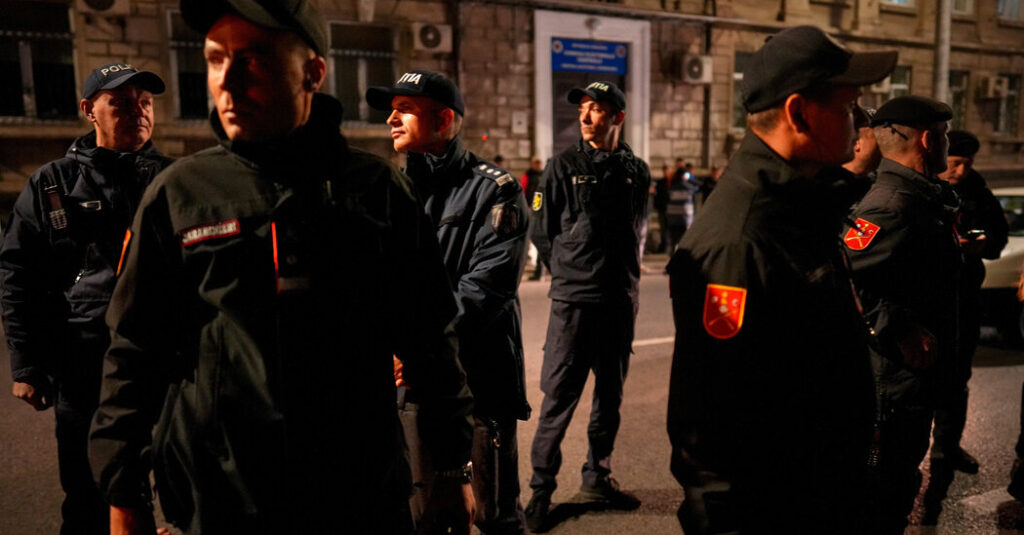
In the weeks before the vote, the Moldovan police conducted raids on hundreds of homes, arresting people who had attended the camps or had taken money as part of Mr. Shor’s scheme.
Moldova’s cyberexperts, aided by Western allies, stymied the hacking attacks. Protests broke out, but there was no serious violence.
When the police arrested several people suspected of plotting violence, those arrested claimed that incendiary devices in their possession were meant for a gender reveal party, Mr. Zama said.
Ms. Sandu’s party won with just over 50 percent of the vote, largely on the strength of the Moldovan diaspora abroad.
For the Kremlin, her victory was hardly a failure. The Moldovan government had to spend a small fortune and devote vast law enforcement resources to thwart the Russian interference. And the Kremlin’s allies have used the mass arrests of Ms. Sandu’s opponents for propaganda purposes, presenting it as proof of an authoritarian crackdown.
The Kremlin has since expanded its efforts.
In early March, a Russian attack on a Ukrainian hydroelectric plant near the border with Moldova contaminated the water supply for a swath of Ukraine and Moldova.
Then Russian drones hit a high voltage line in western Ukraine that provides up to 70 percent of Moldova’s electricity, leading to blackouts. When we visited some government buildings, including the presidential complex, the lights were often turned off to conserve power and workers traversed windowless hallways with flashlights.
Moscow, Moldovan officials said, is playing a long game.
“We won the battle,” said Mihai Lupascu, the director of Moldova’s Agency for Cybersecurity. “But we did not win the war.”
Julian E. Barnescontributed reporting from Washington, and Anna Moghilda from Chisinau, Moldova.
The post Why Moldova Is Central to Putin’s Goal of Wrecking NATO appeared first on New York Times.