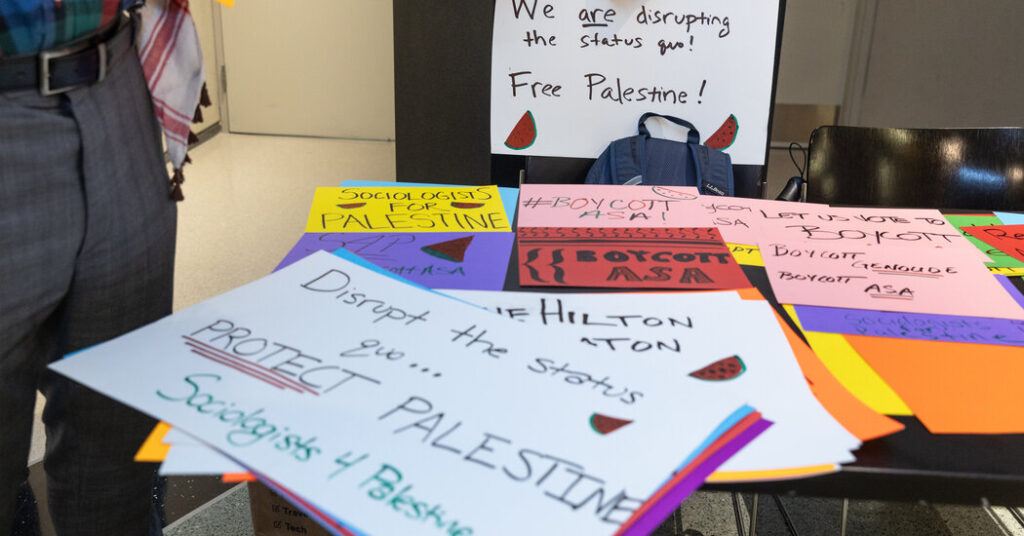
The president of the major sociology association, Shelley Correll, had just taken the stage at the discipline’s big annual conference in New York City on Sunday when a few dozen sociologists began chanting “Free Palestine” and unfurled a banner.
The short disruption was partly drowned out by turning up Dr. Correll’s entrance music, Dolly Parton’s “Big Dreams and Faded Jeans.”
Tuning out the broader cacophony around sociology is not so easy, however.
Republicans in some states have singled out sociology as a poster child of everything that is wrong with academia, saying that it has become a hotbed of leftist activism. And rifts have formed within the discipline over whether to take political stances on issues like the war in Gaza.
At the same time, fewer students are signing up for sociology classes, making the debates feel all the more urgent.
Sociologists study human society and behavior. The field has long included a mix of science and activism. But sociology’s difficulties are driving arguments about whether the discipline should rein in its advocacy wing to gain public confidence, or stand its ground against outside attack.
“We lost something through this pursuit of partisanship,” said Fabio Rojas, a professor at Indiana University who writes about schisms in sociology, adding, “There are a lot of people who are just like, ‘I want to go to work and not hear about Palestine.’”
Mixing research and justice
Sociology is sprawling. It includes ethnographers who conduct in-depth interviews, data-driven researchers and those who do both. Many sociologists study crime, demography, religion and other topics that do not generally irk conservatives. Sociology has also become a home for scholars who examine sexism, racism, policing, immigration and other politically charged topics.
The field emerged from the Enlightenment as a way to study human society and behavior amid rapid social change. Scrutinizing power was always a key part of the science, with early sociologists like W.E.B. Du Bois, Jane Addams and Harriet Martineau using scholarship to fight against racism, sexism and inequality.
Critics of the discipline say that it is now too hyper-focused on left-leaning concerns like inequality. That word appeared 186 times in the 165-page conference program.
Many sociologists argue that it’s impossible to study human society deeply without seeing inequality and discrimination. And those who support activism argue that it is not a big step to then use that knowledge to push for public policy changes.
The work of Anthony Abraham Jack, a Boston University sociologist, would be labeled activism by some. He wrote an impactful book called “The Privileged Poor,” about food insecurity among students at elite colleges. He then successfully pushed for schools to change their dining-hall policies.
Dr. Jack prefers the term “public scholarship.” He says that his work “is expanding the definition of what scholarship is, to not just publish articles and write books but also to be part of the dissemination of information.” He and other sociologists argue that economists, for instance, might advocate their preferred policy positions but aren’t thought of as “activists.”
But critics of the state of the discipline say sociologists who aim to change the conditions they study can no longer claim to be rigorous scientists. A report released over the weekend about the state of scholarly standards in the field said it had been compromised by politics that influenced the discipline’s values and priorities.
The report was produced by a commission led by Vanderbilt University and Washington University in St. Louis, where leaders have argued that higher education is in need of reforms. The commission found that scholarship in the humanities and social sciences was sometimes in the service of political goals.
“Some topics cannot be studied or cannot be studied in an honest way,” said Jukka Savolainen, a Wayne State University criminologist and sociologist who is not part of the commission.
For scholars studying incarceration, he said, “the only research that’s rewarded and allowed and encouraged is to find the umpteenth way in which incarceration is harmful.”
How sociology became a target
Other academic disciplines like history and anthropology face many of the same accusations of a left-wing bias. But conservatives in Florida singled out sociology in their push to excise what they said were left-leaning topics from the college curriculum.
Sociology courses are no longer allowed in the required general-education curriculum, a move that has sociology professors fearful that enrollments could plummet in the fall.
Ray Rodrigues, the head of the State University System of Florida, has said that the discipline is “now social and political advocacy dressed in the regalia of the academy.”
Scott Yenor, a conservative activist who briefly served on the board of the University of West Florida, said sociology had acquired a reputation as being left-wing for decades but that there were also strategic reasons it had been singled out by conservatives.
“History can be as bad,” said Dr. Yenor, a Boise State University political scientist, “but going after history makes you seem like you’re anti-intellectual. Conservatives like history.”
The sociology conference’s theme this year played to the scholar-activism wing: “Disrupting the Status Quo: Putting Sociology to Work for a More Equitable Society.” Republicans cited it as further evidence that the discipline was overrun with activism.
Dr. Correll, a Stanford sociologist, picked the theme and defended the scholar-activist model.
In an interview, Dr. Correll, who studies gender inequality in the workplace, said that many people became sociologists “to help make the world a better place.” She added that she had chosen the Dolly Parton song because it “offers a hopeful and compelling blueprint for social change.”
Doubling down to save itself
Student interest in sociology has dramatically dropped in recent decades. One analysis found that since 2013, completions of undergraduate sociology degrees fell by 25 percent.
Sociologists cite factors like a broader societal shift toward degrees that are perceived as prioritizing trade skills. The political attacks do not help.
While concerned sociologists worry that embracing activism could drive away new recruits to the discipline, some say that staying true to the discipline’s social justice roots will be what saves it.
The overall numbers mask that sociology is thriving in some liberal places, especially California. An analysis by Michel Estefan, a sociologist at the University of California, San Diego, found that two out of every five sociology bachelor’s degrees were earned in California.
The majority of them are students of color. Scholars like Dr. Estefan see a racial component in how quickly researchers are described and dismissed as “activists.” One person’s “activism” is another’s “policy recommendation,” he said.
At the New York conference, fissures over Gaza were the main point of division, not whether sociologists should dial down their activism more broadly.
Close to a thousand sociologists boycotted this year’s event because the group’s leadership did not allow a membership vote on whether to admonish and boycott Israel, according to the boycott’s organizers. More than 4,500 sociologists attended the main conference, officials said. Some attended a shadow conference down the street titled, “Resisting Authoritarianism: Global Solidarity and Democratic Futures.”
Dr. Correll said she did not see how boycotting Israel would make a difference in Gaza.
But Zachary Levenson, a sociologist at Florida International University who is a member of Sociologists for Palestine, said the scholars’ activism was part of a broader movement started by student protesters that had made a difference. It caused “a sea change in public opinion” against Israel that Dr. Levenson said he had never seen before.
Dr. Levenson rejected the notion that the Gaza activism was hurting the discipline’s public perception. It was Dr. Correll, he said, who had embraced “quite literally the politicization of the field” by embracing scholarly advocacy — except on the Gaza issue.
Dr. Correll said she wasn’t worried. She said the disagreement was a sign of pluralism, and that the discipline had overcome major challenges before.
“It’s really healthy for an academic discipline to not be grounded into just one way of being,” she said.
The post Conservatives Don’t Like Sociology. Many Sociologists Don’t Either. appeared first on New York Times.