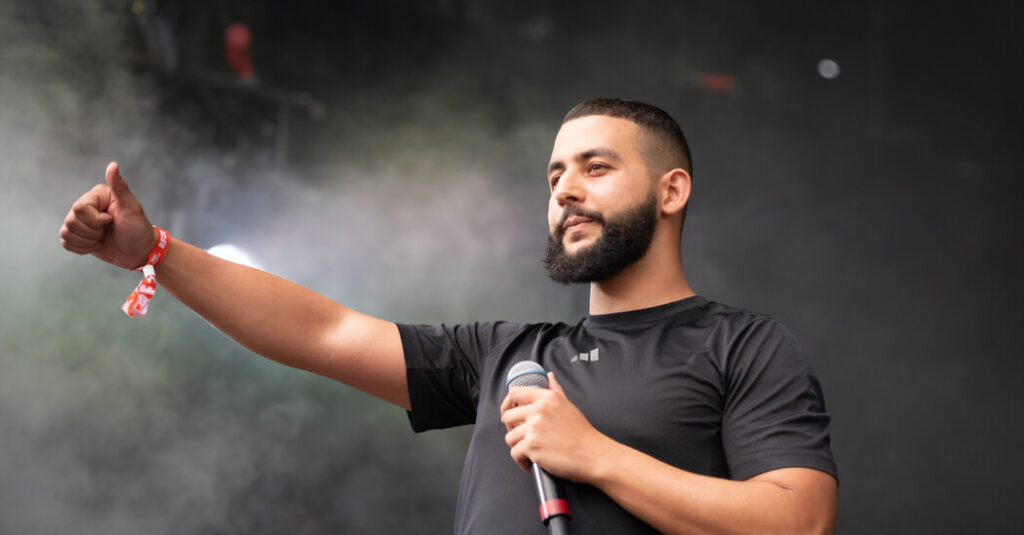
The Palestinian rapper Shabjdeed usually makes gritty, defiant music about the struggles of living under Israeli occupation in the West Bank.
But in his latest song, “SLV,” he’s turned his ire on a fellow Palestinian artist, a rising global pop star named Saint Levant. Born in Jerusalem, partly raised in Gaza, Saint Levant now lives in Los Angeles and is more likely to sing about his lovers than his homeland.
That appears to be Shabjdeed’s main gripe.
“Mixing Palestine with all kinds of bullshit and European pretentiousness, acting all chill,” Shabjdeed rapped to Saint Levant. “I’ll slap a watermelon right on your thigh — just so you know how much I love my country,” he added, a reference to the red, green and black fruit that shares the colors of the Palestinian flag.
The song, attacking Saint Levant’s persona and music as inauthentic, has drawn comparison with a similar, long-running feud between the rappers Kendrick Lamar and Drake. It has also struck a chord with many Palestinians, raising questions about their identity and representation, especially in the arts.
Palestinians have a long history of displacement, with no independent state or centralized political leadership. Who speaks for them — and how — has become a charged debate, and especially so since the Gaza war and rising Israeli settler violence in the West Bank.
Agents for Shabjdeed and Saint Levant, whose real names are Oday Abbas and Marwan Abdelhamid, did not respond to requests for comment. Both artists held competing concerts in Amman, Jordan, on Thursday night, with “SLV” included in Shabjdeed’s set.
Palestinian identity itself is complex. It has been shaped not only by a long history but also the forced expulsion and displacement of Palestinians by the creation of the state of Israel in 1948. The subsequent decades of Israeli occupation and further rounds of displacement have led to a fracturing of the Palestinian experience, with many forced to live far from their ancestral homes.
“Each of us carries a different piece of a puzzle that was shattered in 1948,” said Tamer Nafar, a rapper who is often considered the godfather of Palestinian hip-hop and co-founded the group DAM.
“The occupation dispersed us,” added Mr. Nafar, who lives in Lod, Israel. “It did not necessarily change our identity or our essence, but it certainly changed our perspective, our living conditions and the way each of us relates to Palestine.”
While the Ramallah-based Shabjdeed presents himself as the more authentically Palestinian voice, the pointed insults in “SLV” have led some to scrutinize his words and actions. Critics of the recent track accused him of not speaking out enough against the war in Gaza and noted that he continued to stage concerts during that time.
Saint Levant, 25, who often sings in Arabic as well as French and English, has made songs about Gaza and spoken out against the war during his concerts.
He has not responded to the dig from Shabjdeed, though another Palestinian rapper has.
Emsallam, a Jordanian-Palestinian musician whose real name is Msallam Hdaib, was the target of a Shabjdeed diss track in 2018. When Shabjdeed released “SLV,” Emsallam soon put out a lyrical response, urging him to rap about the war in Gaza, rather than going after other Palestinian artists.
“You don’t have any more honor — God, after this song I don’t want to hear your hisses,” Emsallam sang. “We haven’t heard your voice in three years amid all the massacres.”
Shabjdeed’s lyrics criticized Saint Levant’s focus on romance in his music, and his collaborations with Mia Khalifa, a former adult film star turned influencer and political activist, and the Lebanese pop star Haifa Wehbe.
Some Palestinians have pushed back on Shabjdeed’s criticisms, arguing in interviews and in discussions online that his lyrics feed into a long history of reducing the complexity and diversity of their lives to the political struggle.
“Palestinians are not a monolith, and we’re not all the same, and I don’t think anyone has a right to police who gets to be Palestinian,” said Tala Hammash, a fan of both artists, who runs a business in the United Arab Emirates importing pantry goods from the West Bank. “I think that’s one of the key pushbacks against the diss track against Saint Levant. So what if he talks about love and whatnot? Does that become less Palestinian?”
Ms. Hammash, who was born in Jordan and said she had not yet been able to visit her ancestral homes in Jenin and Jerusalem, added that art should grapple with every aspect of the Palestinian experience. After hearing the recent diss track, she posted a series of questions on Instagram.
“Is Shabjdeed a troll? Absolutely,” she wrote. “Are the criticisms of Marwan (SLV) valid? Yes.”
Those questions sparked discussion among her friends and followers online, and some said they felt Saint Levant performs for the tastes of Western audiences. Others said his success — from brand partnership deals to gracing the cover of fashion magazines — had come about in part because he is viewed as more Western than Arab, Ms. Hammash said.
Defenders of Saint Levant would characterize that as an unfair representation, arguing that he has put his Palestinian identity front and center. He regularly performs wearing the kaffiyeh, the black-and-white checkered scarf traditionally worn in parts of the Middle East, and waving the Palestinian flag. This summer, when he was named Prada’s new brand ambassador, he was pictured wearing a pendant depicting an outline of historical Palestine.
He has also said that his life’s goal “is to be the president of Palestine.” Saint Levant did not respond when asked, via his agent, about the criticism he had faced.
Mr. Nafar, one of the founders of Palestinian hip-hop, said that while he felt Saint Levant’s music was coming from a good place, his representation can feel simplistic, trendy and disconnected from the complex reality that Palestinians on the ground live every day.
Rather than shrink from the controversy, though, he encouraged Saint Levant to clap back and engage in a discourse that wrestles with questions of place, authenticity and who gets to tell which story, issues inherent to hip-hop, he said.
“As a rapper I say, ‘Yalla Saint,’” Mr. Nafar said, using the Arabic word for “let’s go.”
“Get your diss track back, and let the story go on,” he added.
Heedo Abu Laban contributed reporting.
The post A Rapper’s ‘Diss Track’ Has Palestinians Asking, Who Gets to Speak for Us? appeared first on New York Times.