Phoebe Bridgers’s marvelous, death-haunted third album, “Lost Weekend,” begins with one of the most devastating dad jokes you’ll ever hear. “Crying in a suit and tie, but you should see the other guy,” Bridgers sings, her voice eerily embalmed in a vocoder effect. Just before it sinks in that she’s talking about her father’s funeral, she sneaks in another poignant punchline: “One more time, for old times sake, I’ll watch him get carried away.”
Humor and pathos prove oddly compatible slow-dance partners throughout “Lost Weekend,” an emotional odyssey that finds 31-year-old Bridgers at a new peak of her songwriting powers, processing some major personal changes that have taken place in the six years since she released her breakout album “Punisher.”
In addition to losing her father, she fell in love, twice. (“I was supposed to be married, but I called it off,” she sings on the sparse title track.) She also saw her folk-rock supergroup boygenius, which features her peers Lucy Dacus and Julien Baker, ascend to a staggering level of success and visibility, thanks to the Grammy-winning, stadium-filling 2023 album “The Record.” Clearly, though, the anxiety-prone Bridgers does not always feel comfortable in the public eye. As she puts it on one of many (many) memorable and darkly funny couplets on “Lost Weekend,” referencing a headlining gig at a Manhattan music festival, “I was the belle of the governors ball / Hiding in the bathroom like Shelley Duvall.”
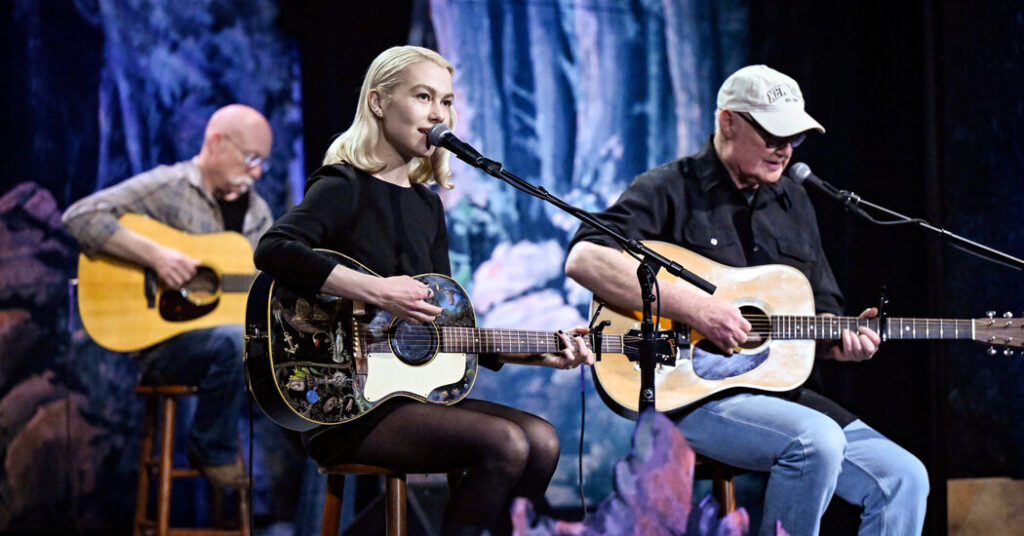
When Bridgers returned to the stage earlier this year, she seemed intent on stepping back into the limelight on her own terms, debuting new material at small clubs before announcing a benefit show at Madison Square Garden three days before it took place. (It quickly sold out.) To prevent leaks of new songs, attendees had to lock their digital devices in secure pouches, and even after the release of “Lost Weekend,” she will continue this no-phones mandate on her upcoming tour. That decision has suddenly made Bridgers a poster girl for analog concert-going and living in the moment — somewhat ironic, given that she was once known for her acerbic, terminally online Twitter musings (longtime display name: “Traitor Joe”) and that she sang on “Punisher,” wryly, “When I grow up, I’m gonna look up from my phone and see my life.”
Bridgers has indeed grown up, and on the celestially-minded “Lost Weekend” she has fixed her gaze as high as it will go. Caked in mud and stardust, the album sometimes feels like a 21st-century realization of what the country-rock outlaw Gram Parsons once called “cosmic American music,” steeped in folk tradition but unafraid of psychedelia’s mind-expanding drift. (Bridgers has been hosting prerelease listening sessions at planetariums.)
Banjos are layered atop synth beds; pedal steel mingles amicably with effects pedals. The stunning ballad “Kill Me” begins with little more than an acoustic guitar and Bridgers’s plaintive voice, but it gradually expands into a zero-gravity post-rock supernova, full of ghostly backing vocals and rocket ship riffs. The explosive, cathartic rocker “Bobby” gives way, in its final moment, to a sound collage featuring a recording of a scammy robot voice informing the listener that they have been selected to win “$18.5 million and a brand-new 2021 Mercedes-Benz in the color of your choice.” The detritus of the digital world hovers constantly above Bridgers’s existential musings. It’s like “Yankee Hotel Foxtrot” in the age of bot slop.
As a lyricist, Bridgers has never been sharper, whittling her observations on love and death down to lines as incisive as surgical tools. “You deserved better, you wanted me,” she sings on “The Governor’s Waltz,” a tour de force of economical storytelling anchored by a gorgeous, pirouetting chorus melody. It sounds like opening a music box only to find not a ballerina but an inner demon twirling in a tutu.
Intimate and singular as this album is, its credits read like the guest list at a house party. Bridgers’s boygenius compatriots sing backing vocals on the lovely bluegrass tune “Haunted” as well as the buoyant head-scratcher of a lead single “Lost Boys” — a decent song that is nonetheless unrepresentative of the rest of the album’s emotional gravity. Among the others invited are the folk singer-songwriter Christian Lee Hutson (who co-wrote 12 of the 16 tracks with Bridgers) and his new wife Maya Hawke; indie absurdist Alex G; and Bridgers’s romantic partner, the filmmaker and comedian Bo Burnham, who gets a co-writing credit on seven songs, including the ecstatic “Bobby,” which is totally about him.
An ace student of both ’70s singer-songwriters and turn-of-the-century emo, Bridgers sings in a voice that sounds at once anesthetized and alive with a quivering hurt. She is hardly the first musician to suffer the mixed blessing of sounding more compelling when she plumbs the darkness than when she steps into the light. Arresting images and candid admissions abound in “Still Standing,” the album’s stark, skin-prickling centerpiece, which overlays troubling memories of her father atop fresh grief. “Sometimes I want you back,” Bridgers sings to him. “But not today.” Comparatively, the mild optimism of “I Can’t Wait” rings a little hollow, contributing to an overall feeling that the album loses some of its steam toward the end.
But there’s one last highlight with the album’s final track, “Lost Weekend (Reprise),” a poetic inventory of the things she learned from her inevitably imperfect father and an acceptance of the ways in which she is more like him than she was previously willing to admit. The song also embraces the love of that recurring character Bobby, who has finally made her feel a little less alone in the cold, vast cosmos.
“You love me, and I won’t ever let you forget,” she sings to him. Peering into the big forever, she then hedges, only slightly: “Not yet.”
The post Phoebe Bridgers Finds Another Level on ‘Lost Weekend’ appeared first on New York Times.