MARTIGNY, Switzerland — Setting out for a hike one summer’s morning on Great St. Bernard Pass, the highest point along the Via Francigena route from England to Rome, I thought I was prepared. My trekking companions proved me wrong.
For starters, I should have worn gear that wicked sweat and slobber, and anticipated frequent breaks for kibble and belly rubs. I also should have known that my local guides, Swiss ambassadors named for the pass affiliated with St. Bernard of Montjoux, the patron saint of the Alps and hikers, would draw as much attention as Roger Federer swatting tennis balls in his home court.
“Mamma mia!” Chiara Manoli, a dog keeper with the Barry Foundation, exclaimed as she led a trio of Saint Bernards through a crowd gathering at the trailhead, their phone cameras held aloft like paparazzi.
Since 1887, Saint Bernards have been the jowly face of Switzerland, a national symbol as Swiss as Patek Philippe watches, army knives and neutrality. The XL dog breed originated at a way station for pilgrims crossing the perilous Great St. Bernard Pass in the Pennine Alps, which straddle Switzerland and Italy. (The travelers’ rest stop is officially called a hospice, a wholly different meaning than the traditional sense of the word.)
For three centuries, the Augustinian canons who established the refuge in 1050 bred Saint Bernards as watchdogs and to rescue travelers exposed to the harsh winter elements — blizzards, avalanches, hypothermic temperatures. Their most famous four-legged first-responder was Barry, who reportedly saved about 40 people in the early 1800s and now rests in perpetuity at the Natural History Museum in Bern.
In 1984, the Saint Bernards fully retired from this line of work, replaced by modern advancements in travel and rescue operations, including helicopters better suited for breeds that weigh a lot less than a full keg of beer. Instead of becoming dogs of leisure, however, the Valais branch of the Saint Bernard family switched careers.
From the mountains to their own museum
Nearly every morning, a white van with red trim pulls up to the back entrance of Barryland, the world’s only theme park dedicated to the Swiss dog breed. A side door slides open, unleashing a stampede of Saint Bernards.
Staff members, treat-filled fanny packs slung at their hips, herd the dogs into grassy yards connected to enclosures inside the museum in Martigny, about 85 miles east of Geneva. Some of the dogs gambol like bear cubs; others drag their paws, sniffing at every crack in the pavement. Occasionally, a Saint Bernard will go rogue.
“Athena! Athena!,” a dog keeper shouted while clapping her hands at the 7-year-old renegade who had entered through the visitors’ door. “She’s deaf,” the employee explained to a guest standing by an exhibit that explores a dog’s sense of smell, taste, sight and hearing.
The Barry Foundation’s roughly 30 dogs — the number fluctuates with the cycle of life — are direct descendants of the Saint Bernards that lived at the mountaintop hostel from the 1700s until the early aughts. In 2005, the nonprofit dedicated to preserving the Saint Bernard’s heritage and lineage became the primary custodians of the kennels, breeding program and dogs.
“You need a lot of space and money and a big car,” said Andrea Zollinger, the foundation’s head of corporate communications. “They aren’t Chihuahuas.”
As part of the arrangement, the canons requested about 10 dogs return to their ancestral home from June through September, the high season for trekkers, bikers, overnight guests and road-trippers. Barry Foundation enlists these pups for its high-demand summer hiking program.
The “in-town” dogs live in a private boarding facility about 25 corkscrew miles from the hospice and a mile from Barryland, where they rotate shifts at the attraction. Fall through spring, they live together as one pack, unless they are traveling for work as therapy dogs.
The foundation has run a museum since 2005, but in June 2025 it opened a more expansive and interactive paw-shaped venue built specifically for the Saint Bernards and the people who, when you say “Beethoven,” immediately think Swiss dog not German composer.
“We love Saint Bernards because of the sweet look they have on their face, the way they look at us with such love and protection,” said Alexandra Piatti, a dog keeper at Barryland. “They really give off big bear energy.”
Inside the world of Barryland
The Saint Bernards at Barryland are almost always on view, whether they are sunbathing in the outdoor runs or chilling inside the soundproof glass “boxes” that resemble a natural-history museum’s display cases but without the elaborate staging.
Staff members also cut through the upper gallery with the dogs, as they move between the pens and the live demonstration rooms or lead them on daily walks around the property. (To protect the animals, visitors must ask before petting and accept the answer.)
The dogs remain upstairs, above an entire ground floor of exhibits that cover their history, heroics and rise as models for Swiss chocolate and liquor companies.
Throughout the day, the staff holds live demonstrations with the Saint Bernards, such as enrichment activities, hydrotherapy sessions critical for a breed predisposed to hip dysplasia and a general “dog care” talk.
“Our goal is to maintain this breed,” Piatti said.
On a Friday afternoon in July, Piatti placed Edène on a raised platform, the 6-year-old standing as still as a 150-pound stuffed animal. Piatti brushed her silky coat, massaged her joints, checked her ears for the proper shade of pink, wiped her eye goop and groomed her neck scruff, which is susceptible to tangles from the slow drip of drool. Piatti also pulled back Edène’s lips and brushed her teeth with chicken-flavored toothpaste.
After the presentation and under Piatti’s watchful eye, Edène approached her audience and granted us the honor of rubbing her head.
Hiking with Saint Bernards
The foundation opens reservations for the Saint Bernard hikes in May. The outings, offered five days a week in July and August, sell out fast.
At Barryland, I met a mom and daughter visiting from Upstate New York who said they woke up at around 2 a.m. the day the treks went on sale, adjusting their clocks to Swiss time. Their preferred dates were booked, and the site was glitchy, but they persevered and reserved a slot in early July.
The New Yorker told me her husband did not understand why she would spend the money — $432 for up to eight people in the same party — for an experience similar to the one they had at home with their own Saint Bernard. She disagreed, explaining that hiking with the dogs on their turf, and in their place of origin, was a dream realized.
The two-hour adventures depart from the kennels at the Hospice Museum, where the 10 dogs spend their summer. I arrived during enrichment hour and cheered on Haïka as she played basketball, nailing her dunks in the toy hoop.
“Oui, bien! Super!” the dog keeper said, doling out congratulatory treats.
The dogs at Great St. Bernard Pass reside on the Swiss side of the divide but sometimes wander into Italy during their high-altitude hikes. The border is a few strides away, and the Italians embrace the Saint Bernards with the same gusto as the Swiss. The shops and kiosks overflow with Saint Bernard souvenirs, and visitors pose with a wood carving of a Saint Bernard set against the backdrop of Switzerland.
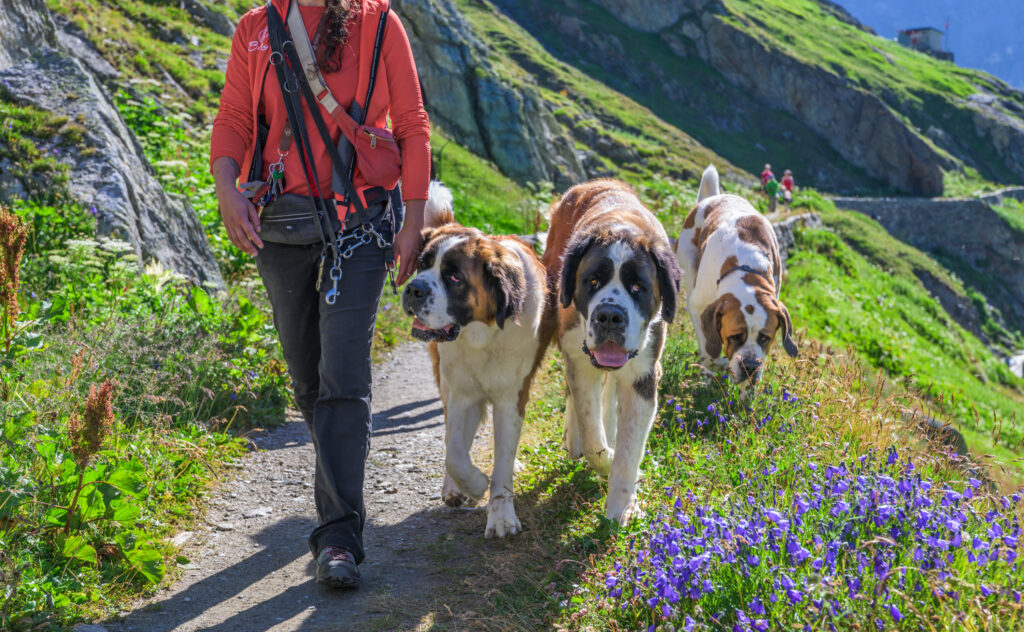
Though the hikes were sold out, Zellinger invited me on a morning stroll with Manoli, the dog wrangler, and Plume, Qualya and Roanne. Collectively, the dogs, which tipped the scale at 380 pounds, outweighed Manoli by several hundred pounds.
We followed a lakeside trail that could barely fit two humans side by side, but the leashed Saint Bernards walked nimbly along the narrow path. Manoli veered up into steep terrain that the dogs, now untethered, handled with the grace of mountain goats. Every so often, Plume would stand on a rock and gaze out at the sky, and Qualya would drop for a belly rub. We sipped water from flasks; the dogs lapped up water from a mountain stream.
In French, Manoli told the dogs to wait, wait, wait. Then, she gave the signal, and they barreled down the hill, their ears fluttering, and their jowls flapping.
On the return walk, we ran into a crowd that parted for our group. Even their dogs stepped to the side, making way for the great Saint Bernards.
The post At the high-altitude birthplace of Saint Bernards, huge dogs are a big draw appeared first on Washington Post.