When President Donald Trump backed a candidate for governor in South Carolina two months ago, her struggle to consolidate Republican support in a primary runoff proved to be a problem even a White House endorsement could not solve.
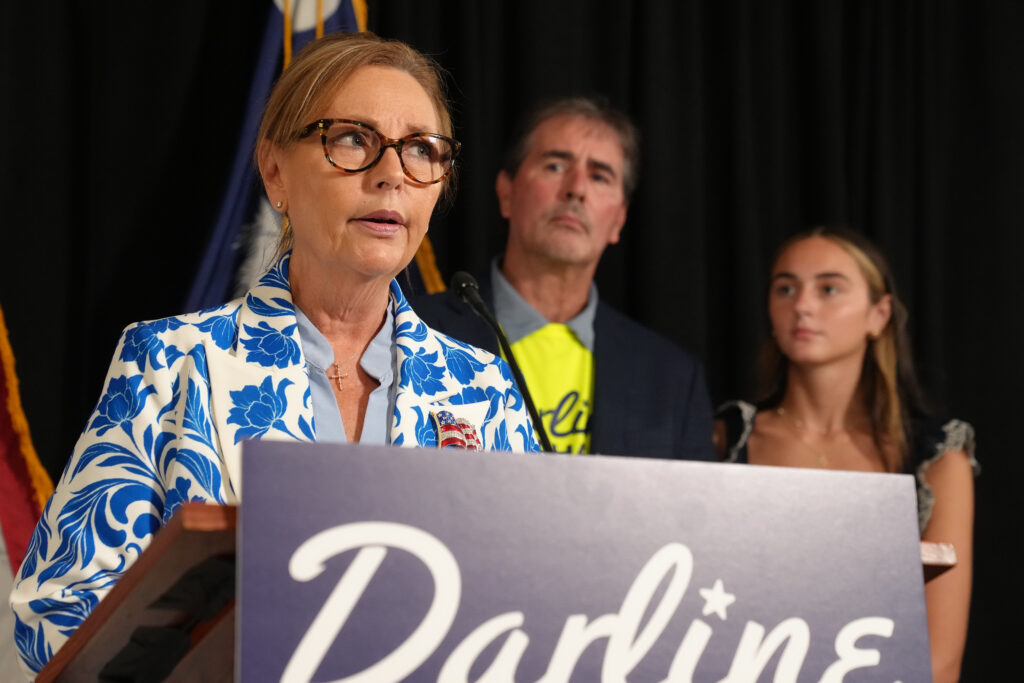
Now, after a number of his candidates have faced embarrassing primary defeats this year, Trump is mulling a different approach: fighting actively for his endorsed candidate in the state’s Senate runoff, Sen. Darline Graham, the sister of the late senator Lindsey Graham.
The fast-paced election — a two-week sprint to the Aug. 25 runoff — has the political newcomer facing Rep. Ralph Norman, a conservative stalwart and House Freedom Caucus member. The race has created the latest intra-MAGA fight and offers Trump a chance to reclaim the power of his imprimatur in the state, even as some of his most loyal supporters say they disagree with his endorsement of Graham.
Unlike in South Carolina’s gubernatorial primary in June, Trump has already taken steps to help his endorsed candidate survive the runoff.
On Tuesday night, fresh off the news that Graham had placed first in the primary race and would face Norman in the runoff, the president got to work trying to build bridges. He called Rep. Russell Fry, a Trump ally who came in third in the primary and whom he had considered endorsing for the seat.
He also phoned a relative political nemesis: Mark Sanford.
Trump had never before called Sanford, the state’s former governor and congressman who lost his House reelection primary in 2018 after becoming a vocal Trump critic. He also briefly ran against Trump for the GOP presidential nomination in 2020.
But the president was so determined on election night to try to halt consolidation around Norman that he rang Sanford and asked him to endorse Graham, according to three people with knowledge of the call, which has not previously been reported.
The brief conversation was cordial, and the president didn’t press the matter hard, according to the people aware of the call, who spoke on the condition of anonymity to discuss a private conversation.
Sanford did not make a guarantee one way or the other and still has not endorsed in the runoff. He told reporters that night that he did not intend to.
Fry, too, has not made an endorsement, leaving the White House and other allies of Graham and Norman on edge as they await word of his decision.
Trump’s team is considering holding a pre-runoff rally for Graham in the Myrtle Beach area, according to three people with knowledge of the plan, though the event has not been locked in.
Fry represents the area and is popular there. But he was the target of sustained attacks by Graham’s super PAC and trained his own fire in the primary back at Graham.
A Trump rally in the Myrtle Beach area would shore up support for Graham in Fry’s backyard. Norman, who hails from Rock Hill, near Charlotte, performed poorly in Fry’s northeastern district known as the Pee Dee, even as he locked up support in his Upstate area.
State Rep. Jordan Pace, a Republican who chairs the South Carolina Freedom Caucus and is backing Norman, said that if Fry intended to endorse Graham, his slow approach to do so in a two-week runoff is curious.
“Every minute that goes by that he hasn’t raises questions in my mind of if he will,” Pace said.
Asked about the congressman’s endorsement plans, a spokesperson for Fry pointed The Washington Post to his election night comments congratulating both Graham and Norman for advancing.
Whether Fry endorses and whether Trump, in fact, comes to rally for Graham in the runoff remain two of the biggest factors in the campaign, said Rob Godfrey, a longtime Republican strategist in the state who has remained neutral in the special Senate election.
“In a race where margins matter,” Godfrey said, “one or both of those could significantly benefit the senator, particularly given how well her opponent ran in the Upstate.”
Even without a visit, Trump has already done more for Graham than he did for Lt. Gov. Pamela Evette, the candidate he had initially endorsed in the Republican gubernatorial primary earlier this summer. She ultimately lost in the runoff after Trump issued a dual-endorsement of her and her opponent, Attorney General Alan Wilson.
The only major candidate in the primary so far to make an endorsement has been Mark Lynch, a right-wing contender who unsuccessfully challenged Lindsey Graham in the regular June primary. Lynch, who received 6 percent of the vote Tuesday, endorsed Norman, along with Duke Buckner, who earned half a percentage, or just 1,500 votes.
Lynch told The Post that he had not heard from Trump or the president’s political team asking him to endorse Darline Graham.
The White House did not respond to a request for comment.
Some Trump allies have floated the idea of a dual endorsement of Graham and Norman in the runoff. But the president has not signaled he is planning to do that, despite telling reporters Tuesday night that he liked Graham and her opponents, saying: “They’re all Trumpers.”
That hasn’t stopped chatter in South Carolina and D.C. about the prospect of Trump issuing another dual endorsement. On Thursday, some Republicans in the state received texts with a poll from the research company Dynata, which included a question about how a dual endorsement would affect their vote.
“If Donald Trump issued a second endorsement and endorsed BOTH Ralph Norman and Darlene Graham for U.S. Senate, for whom would you vote?” asked the survey, which was reviewed by The Post.
It is unclear who paid for the survey.
In addition to Trump, Graham has the backing of more traditional conservative senators like South Carolina’s Tim Scott, the head of the Senate GOP’s campaign arm, and Tom Cotton of Arkansas. Norman boasts support from Sens. Rick Scott of Florida and Mike Lee of Utah, outspoken firebrands in the chamber. He is also backed by several prominent conservative groups, including Turning Point Action and the Conservative Political Action Conference (CPAC) — as well as former South Carolina governor Nikki Haley, his longtime friend whom Norman endorsed against Trump in the 2024 presidential primary, a decision that has created tension in his relationship with the president.
Norman has sought to capture the support of grassroots conservatives in the state, many of whom have publicly said they know too little about Graham to vote for her for a six-year term in the Senate.
As has been the case in other Republican primaries in which prominent Trump loyalists have endorsed candidates other than Trump’s pick, those supporting Norman say their choice is not a knock on Trump — but rather, a belief that Norman is the more authentically conservative candidate. An official with Turning Point Action told The Post that the organization was already in the process of endorsing Norman before Trump backed Darline Graham, but that the group remains proud to back him.
Graham’s backers say, among other things, that she would be better positioned to accumulate seniority in the Senate.
State Rep. Lee Hewitt, a Republican who represents a county next to Fry’s home turf and had backed Fry ahead of Tuesday’s election, has since decided to support Graham in the runoff.
“With the knowledge that she has, what she’s learned from her brother, the contacts that she already has up there, I feel like she’ll be able to step in and has the best chance of somebody who could be there long term,” Hewitt said.
He added that he served in the state legislature with Norman and likes “his conservative message,” but questioned whether, at age 73, Norman should be elected to a six-year Senate term. Darline Graham is 62.
The post Amid intra-MAGA fight, Trump weighs going all in for Darline Graham appeared first on Washington Post.