At 72, I thought I was done with passion. “I’ve closed up shop,” I told my friends, and I meant it. I was talking about sex, but what I really meant was my heart.
My marriage had been lonely for years — no touching, no reaching, no sense of being wanted. My alcoholism had played a part but so had my husband’s impotence and relentless commitment to work. Just as I began to find my footing — going to meetings, getting help — my husband began to lose his.
First, he learned he had Alzheimer’s, then he lost his business, his ability to pay bills, to drive a car, even to turn on the television. I nursed him for five years. He no longer recognized me by the time he moved to long-term care.
I often sought respite at the home we had built together on Cape Cod. That’s where I met Charles. At first, it wasn’t romance. I simply loved listening to him. His words were steady, thoughtful, slyly funny.
“It takes a long time for the air to come out of the balloon,” he said about his struggle with humility. Sometimes he talked about himself in the third person: “Charles, have you set sail yet? Or are you still clearing the decks?”
I wondered that about myself, especially after my husband died.
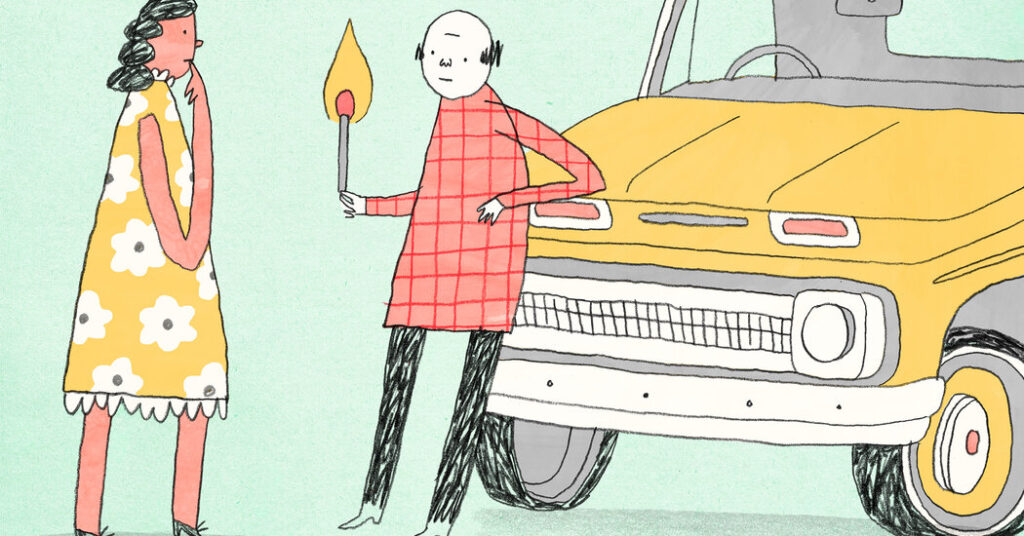
My husband used to say that a room can be dark for a thousand years, but a single match will light it. For me, Charles was that match.
It started quietly enough. One day, he invited me into his old pickup to go to a widow’s roadside stand to buy her homemade jam. When we got there, I thought of her as an old woman, though she was probably my age. Around Charles, however, I felt 16.
Soon we were meeting for coffee. And then he invited me for coffee at his house and insisted on driving me there.
“That way I get more time with you,” he said, “because I’ll have to bring you back.”
I was flattered. Also nervous. More than I wanted to admit.
At his house he offered me coffee, grapefruit juice, milk.
“Milk?” I said.
He shrugged. “I like milk.”
I declined the milk. Instead, I wandered around his living room. His shelves were crowded with books about language. I picked up a copy of Mrs. Byrne’s Dictionary of Unusual, Obscure, and Preposterous Words.
“I have this!” I said.
When I found a volume of Mark Strand’s poetry, Charles directed me to his favorite poem. When we were leaving, he said, “Can I ask you a question?”
“OK.”
“Can I kiss you?”
I panicked and bent double, laughing. Not because this was funny but because I was terrified. I hadn’t kissed anyone in more than 30 years. Not even my husband.
Charles looked stricken. We didn’t kiss.
A few days later, I invited him to my house. He told me about his prior relationships — his ex-wife, former girlfriends, even a few friends with benefits. I nearly laughed out loud. Charles was 79. He lived in a cluttered cottage and drove a battered truck. He proudly announced that he wore a dead man’s shoes and shopped at the dump. How did he manage to have so many women in his life?
For my part, I told him the truth. My marriage had been celibate for 25 years. (“I’m practically a virgin!” I said.) I might be a little feral. I don’t make friends easily. Most women would have presented a more polished version of themselves. Instead, I’d handed Charles the owner’s manual to all my character defects and watched to see if he would run.
He didn’t.
When I returned home to Connecticut, we talked on the phone every night for hours. Eventually he said, “Can I visit you?”
“Yes,” I said.
“I’m already packing my toothbrush,” he said.
“That’s a little too intimate,” I said.
“Fine. I’ve taken it out and replaced it with the Book of Common Prayer.”
I laughed.
He stayed for two nights. They were, I believe, the most erotic two nights of my life. Not because of what happened between us (yes, we kissed! boy, did we kiss!) but because of how he made me feel: seen, cherished, desired. He wanted me in a way I had wanted to be wanted for years.
Two weeks later, he returned for three more nights. We talked into the mornings, one confession to another. One night, he shared that when he got married, his wife was three months pregnant, and he’d warned her he would be gone within six months. He stayed, for a time. “I hadn’t had the goods,” he said, meaning the emotional capacity to sustain intimacy.
I thought, “This is not someone who hides who he is.”
A few days later, I shared with Charles that I had told my children about him. They’d been asking questions because I had effectively disappeared into this new life. He said he had told his children about me, too. He said he’d been a “lone wolf” for 40 years, and that I was “a comfort.”
Soon we were making plans together: a road trip to Prince Edward Island, a Thanksgiving for two at his place. I was more excited about these plans than I was about my upcoming Camino de Santiago pilgrimage with my two girlfriends, a walking trip I’d been planning for a year. All I wanted, really, was to be with Charles.
On the Camino, I thought about him constantly and called him every night. I texted photos from tiny Spanish villages: of my friends, the food we ate, the rooms we slept in. The Camino proved harder than I expected. Some nights before calling Charles, I would have to sit quietly and collect myself. I told Charles I felt oddly emotional all the time, untethered, raw and close to tears for reasons I couldn’t explain.
“It’s all right,” Charles would say softly. “It’s OK.”
On our last day on the Camino, Charles texted me five duck emojis. Cute enough but not requiring a response, I thought. When he texted to ask if I’d received them, I wrote “Yes.” I stared at the screen, not knowing what else to say.
That evening, he asked why I hadn’t responded. He said, “That was me at my most playful, most loving,” but that I had received them like “a wall of cement.” His voice was clipped, his tone cold.
I apologized repeatedly.
Finally, he said, “Let’s just move on.”
Which is what he did.
Two days after I returned home, Charles called. “We don’t connect,” he said.
I thought I’d misheard him. “What?”
“We don’t connect,” he said. He said I was an angry person. He commented about my dog.
“You don’t like my dog?” I asked.
“I didn’t say that. But you would choose your dog over me.”
“Well, yes,” I said.
When he called back, he said, “There’s no point in talking anymore. This has all gone south.”
Afterward, I texted him. Our relationship had brought me joy, I said, and I believed it had brought him joy, too. I told him I was grieving its loss.
He didn’t respond. A week later I asked if we could talk. “I’m not up for an inquisition, Kim,” he wrote.
That word lodged inside me like a splinter. I didn’t want an inquisition either. I wanted to understand what happened.
When I finally returned to the Cape a few weeks later, Charles agreed to meet. But he was cold. “I’m done,” he finally said, the unspoken words being “with you.” He called my texts a “barrage” of words.
When I watched him walk away, I felt something inside me vaporize, as if he’d erased what had happened between us: the fun, the tenderness, the love.
I had no appetite and lost 20 pounds. I talked to psychics, mediums, tarot readers and a therapist. I cried to my friends. I wanted someone to tell me that Charles was coming back.
Then, somehow, I realized that what broke my heart was not simply losing Charles. It was the possibility that I might never be touched like that again, never held, never told I was beautiful. With Charles, the lights had come back on for me, and I felt lit up like a Christmas tree. I felt hope.
For months, I thought Charles had taken my hope with him. I thought if I could only understand what had happened, I could finally put the story down. But I couldn’t. And I realized it wasn’t Charles I couldn’t let go of. It was what he had awakened in me.
At 72, I thought I had closed up shop, certain that part of my life was over. But I came to understand that the shop had never gone completely dark. Somehow, a light had stayed on.
It’s shining still.
Kimberly Blake, a writer in Fairfield, Conn., is working on a novel.
Modern Love can be reached at [email protected].
To find previous Modern Love essays, Tiny Love Stories and podcast episodes, visit our archive.
Want more Modern Love? Watch the TV series, sign up for the newsletter and listen to the podcast on iTunes or Spotify. We also have two books, “Modern Love: True Stories of Love, Loss, and Redemption” and “Tiny Love Stories: True Tales of Love in 100 Words or Less.”
The post My Light Was Out. He Turned It On. appeared first on New York Times.