This is an edition of Time-Travel Thursdays, a journey through The Atlantic’s archives to contextualize the present. Sign up here.
Historians are generally better off interpreting the past than predicting the future. By training, we’re meant to read sources, not tea leaves. In the fall of 1973, during the middle acts of Watergate’s Shakespearean drama, Arthur M. Schlesinger Jr. tried to do a little bit of both. In the cover story of The Atlantic’s November issue that year, “The Runaway Presidency,” Schlesinger cast President Richard Nixon’s abuses as the result of long-standing historical trends that had empowered the chief executive, and in the process offered a hopeful prognosis for what was to come. “Watergate,” Schlesinger wrote, “is potentially the best thing to have happened to the presidency in a long time. If the trails are followed to their end, many, many years will pass before another White House staff dares take the liberties with the Constitution and the laws the Nixon White House has taken.”
Nixon resigned 52 years ago this month, marking an end to the scandal, but bringing no such catharsis to our national life and no stop to the runaway presidency. Underscoring just how poorly Schlesinger’s optimism aged, J. D. Vance mused in June that “if Watergate happened tomorrow, it would be like a 12-hour news story. The idea that it would have taken down a presidency is crazy.” As my colleague David A. Graham noted at the time, the remark was a startling admission from a member of an administration that has taken liberties with the Constitution and the laws. It’s also entirely plausible: Scandals that would have previously brought the nation to a standstill barely register for more than a few days, in part because there are simply so many of them under Donald Trump. To understand how Schlesinger got it so wrong, first you have to understand what he got right.
In 1973, Schlesinger published a brick of a book titled The Imperial Presidency. He’d begun writing it as a pamphlet that March, but the project quickly swelled to 200,000 words as the spectacle of Watergate unfolded. The book tracked the aggregation of executive power from the founding onward, which accelerated during World War II and the Cold War. By the early ’70s, the office had grown so far beyond its constitutional bounds, Schlesinger wrote, that it posed “a revolutionary challenge to the separation of powers itself.”
Schlesinger’s Atlantic essay was preaching from his own text. In that account, Nixon’s abuses were symptoms that made visible a larger sickness. The expansion of the presidency, especially in the realm of war and foreign policy, was clear enough, but Nixon showed the dangers and “intoxications” that came with such power at home. Previous presidents may have possessed such authority but, Schlesinger argued, they had the character and restraint not to use it. Nixon was a different kind of case, demonstrating what would happen when a person “not open and modest,” but “from the start ambitious of power and contemptuous of law,” reached the nation’s highest office.
The president’s place at the center of the American political story exacerbated the problem. Congress should restrain the executive to reassert its place in the constitutional order, Schlesinger argued (he had advocated for Nixon’s impeachment as a starting point), but the American people also had a role to play: They must form “a new attitude” toward their presidents, becoming more skeptical and less reverent toward the office. Doing so would administer fewer “intoxications” to its occupant, Schlesinger wrote. But his prescriptions struck his critics as rich, to say the least. As he admitted in The Imperial Presidency, “historians and political scientists, this writer among them, contributed to the rise of the presidential mystique.” Contributed, indeed. Over the course of his career, Schlesinger had endowed Democratic presidents with just the stature he now feared. In 1965, he’d memorialized John F. Kennedy (to whom he served as special assistant) in a book so reverential that the writer Christopher Hitchens later called it “the founding breviary of the cult of JFK.”
Schlesinger may have only got religion because of the sins of the Republican Nixon administration, but he wasn’t exactly wrong. Many others in the moment hoped that Nixon’s transgressions would spark something of a democratic revival to check the dangerous tendencies that had made Watergate possible. And reforms did come: A slew of legislation from 1973 to 1978 attempted to address abuses exposed by Watergate and restrain presidential power on war, impoundment, elections, secrecy, and surveillance.
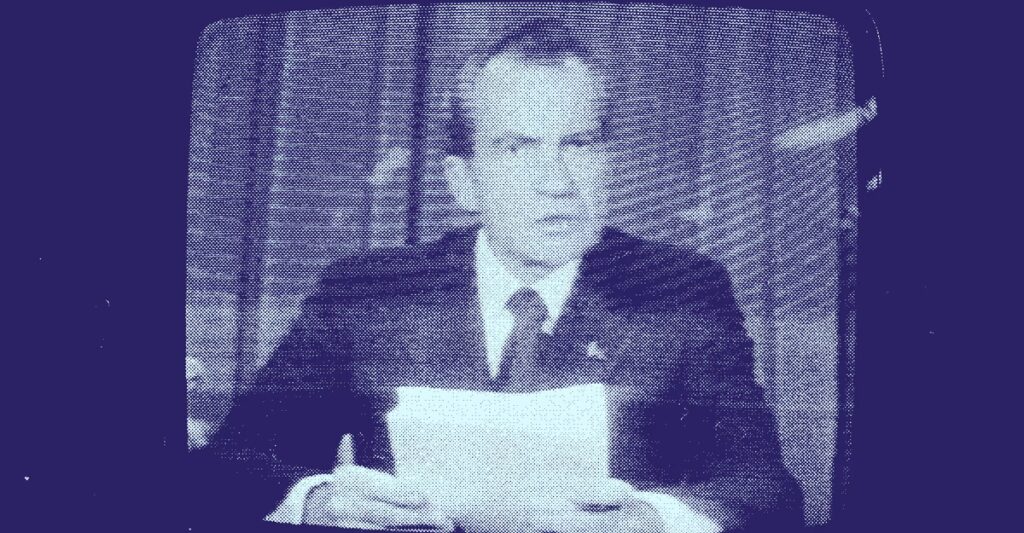
What Schlesinger failed to see was that although the dramas of Watergate may have pierced the mystique of the presidency, they also heightened the American fascination with it. Many people did lose their reverence for the office, but they didn’t turn their attention away. Perversely, it seemed that the spectacle of the presidency was enhanced rather than diminished by its subsequent scandals. Watergate supplied more than the inevitable suffix for all presidential crises to come—it also established the script. The crime and the cover-up; the drip of revelations; the question of what the president knew, and when he knew it; the obscure Washington characters thrust into the spotlight; the marathon hearings; the stern reports on the nightly news.
But presidential scandals, which once dominated the media cycle for weeks and months, now come and go at the speed of an attention economy that demands constant novelty. Meanwhile, the institutions that might have checked presidential power now enable it. Congress’s inaction and the Supreme Court’s expansive doctrine of executive authority have brought us closer to Nixon’s later assertion that “when the president does it, that means it is not illegal.” Watergate would be a 12-hour news story today, as Vance suggests, because there’s nothing to stop a new one from happening tomorrow. In an era of revelation without reckoning, we’re more transfixed than ever by the imperial presidency, whether we like it or not.
At the end of his 1973 Atlantic essay, Schlesinger suggested that corruption came to the White House in 50-year cycles, like monstrous cicadas. There is perhaps something to the idea. Start from the abuses of Nixon, in the early ’70s, and go back half a century to the abuses of Warren Harding, in the early 1920s. Do that again, and you would arrive at the scandals that plagued Ulysses S. Grant’s presidency, in the 1870s. Keep rewinding another 50 years—ignore John Quincy Adams’s reputation for probity and rectitude—and you’d land on the “Corrupt Bargain” that gave Adams the presidency in the election of 1824.
The cycle could be projected forward, too: Schlesinger closed with one more prediction, this one more right than wrong. “Around the year 2023,” he wrote, “the American people will be well advised to go on the alert and start nailing down everything in sight.” We can’t say we weren’t warned.
The post The Lesson Watergate Was Supposed to Teach appeared first on The Atlantic.