It’s been 10 years, but Paulo Gomes still vividly remembers the terror he felt that his wife, Lucirene, would never return from the hospital, that she would die instead of the dengue she contracted from a mosquito bite, her body racked with fever and excruciating pain.
She did come home, after 15 days, and recovered fully after several more months. But the experience forever changed how Mr. Gomes thought about mosquitoes.
Mr. Gomes, now 65, is an eager participant in an aggressive campaign by Belém, the northern Brazilian city where he lives on the edge of a rain forest, to reduce mosquitoes and the health dangers they bring.
Municipal workers have counseled him that mosquitoes breed in standing water and thrive in musty, moist spaces. He fills the swimming pool in the backyard every Friday for his grandchildren who live nearby, but drains it religiously every Sunday after they leave.
He and his wife keep their veranda scrupulously clean and uncluttered, just a tricycle in one corner, a hammock in another — and, since last summer, a plastic bucket that is a centerpiece in Belém’s multipronged strategy against mosquitoes.
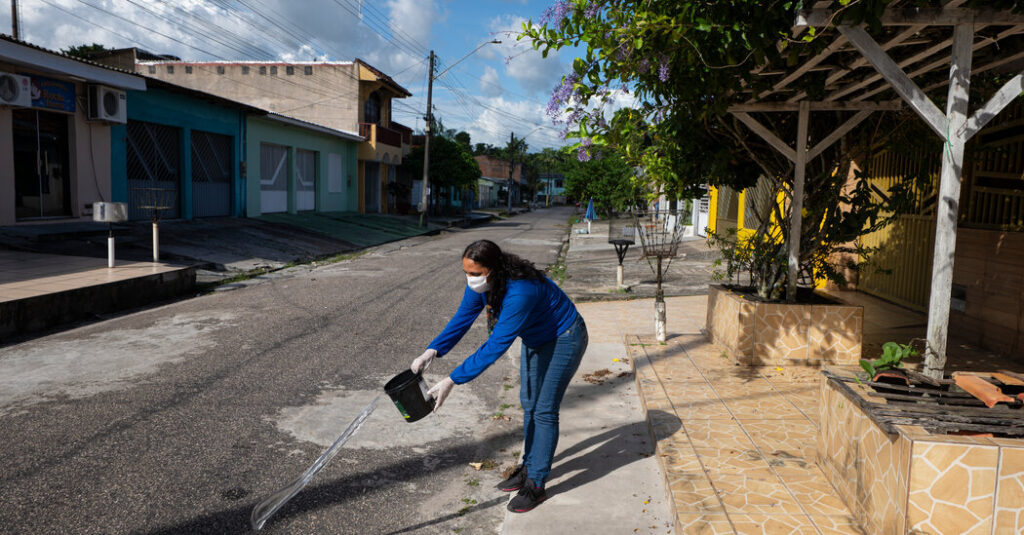
The size of a small trash can, it offers just the sort of dark, watery cavity a female mosquito might seek to lay eggs. But it contains larvicide, a chemical that kills young mosquitoes, and when she lands inside she becomes coated with it. When she flies away, she will spread it to other breeding sites, typically within a quarter-mile radius. Last year, Belém distributed 5,000 units in the parts of the city hit hardest by dengue.
At the moment, mosquitoes are a bigger menace in Belém and the rest of Brazil than in the United States or Europe, but the warming planet is expanding their range. Most cases of dengue, malaria and chikungunya in those places were contracted during travel abroad, but locally acquired cases are occurring more frequently. In 2024, the United States recorded nearly 3,800 cases of dengue, more than 100 of them locally acquired. About a third of the patients were hospitalized, and six died.
“The climate crisis is a public health crisis,” Dr. Alexandre Padilha, Brazil’s health minister, said in an interview.
“It’s not a coincidence” that during its Group of 20 presidency, Brazil championed new initiatives to combat climate-driven diseases like dengue, Dr. Padilha said. “We have a lot to learn and also to teach many regions in the U.S.A. about how to face the impact of climate change,” he said.
Forged by bitter experience, Brazil has embraced new techniques to combat mosquitoes. Most of them are environmentally friendly, including building the world’s largest “mosquito factory,” a facility that produces mosquitoes containing Wolbachia, a bacterium that blocks dengue and other viruses. The Wolbachia-carrying mosquitoes are then released in communities to breed and pass the bacteria to the next generation.
Tackling mosquitoes requires more than gee-whiz science. Municipal departments will need to beef up their vector control divisions and budgets, doctors must be trained to recognize and treat the diseases, and the general public will need education on protecting itself.
“It’s important for other countries to get ready for the possibility of having more and more cases happening, and train all the layers of the society,” said Luciano Moreira, the chief executive of Wolbito do Brasil, a joint venture between the nonprofit World Mosquito Program and the Brazilian government.
“It’s not just something like the government just goes there and sprays,” he said. “It’s part of a movement.”
A City Fights Back
Locals like to say Belém has only two seasons — one in which it rains every day, and one when it rains all day.
The city is a gateway to the mighty Amazon, and it is edged by lush, muddy rainforest. Mango trees and their fallen fruit line the streets, luring insects with their sweet sticky scent. Small puddles of water — on the sidewalks, in stacked tires and in trash cans — offer mosquitoes the perfect nurseries to grow millions more of themselves.
For decades, Belém residents have been under attack by Aedes aegypti, the type of mosquito that carries dengue, Zika and chikungunya — so much so that in 2018, a city park installed a large fiberglass statue of the insect. (Aedes aegypti is also found in many parts of the United States, including Florida, Texas and California.)
Climate change has allowed these mosquitoes to multiply faster, intensifying the threats they carry. In 2024, dengue infected more than 10 million people in Brazil and killed more than 6,000. There might have been even more deaths if doctors in Brazil did not know how to recognize and treat the disease promptly, said Moises Silva, a microbiologist at the Federal University of Pará in Belém.
Brazil’s toll that year was about four times the previous number, and in Belém, it was about seven times higher, flooding the city’s hospitals and forcing a reckoning. City officials adopted myriad methods in response, from increasing common-sense solutions like garbage disposal and treatment of sewage to collaborating with academic scientists like Dr. Silva.
It was Dr. Silva who petitioned the health minister to include Belém in the list of 10 cities that would try out the special larvicide dispensing buckets, and to fund training and equipment for city workers.
Dr. Silva and his colleagues looked at the distribution of dengue cases across the city. They also factored in data from the city’s entomology lab on mosquito larvae and egg traps to gauge the size of the population that season.
Based on those two streams of information, they identified the most vulnerable areas, down to the street level, many of them in low-income neighborhoods and favelas, that would benefit from the units.
Unlike mosquito traps that kill females, the larvicide units, which cost less than $2 each, use the females to spread the chemical to breeding spots that would be hard for humans to find, Dr. Silva said. “We’re using the mosquito against the mosquito,” he said. “That’s the smart thing about the trap.”
The city also trained the workers to educate residents in the low-income areas on ways to keep mosquitoes at bay, to recognize dengue symptoms and to head to the hospital at the signs of severe illness. High fever, headache and vomiting can be mistaken for signs of many other diseases. But dengue also produces intense muscle and joint pain, which earned the disease the moniker “breakbone fever,” and may progress to leaky blood vessels and death if left untreated.
“Back in the day, there was a lot of focus in the wealthier area, so the center of the town, and so we spread that out,” Igor Normando, Belém’s mayor, said in an interview.
Because of these efforts, he said, mosquito-borne diseases in the city dropped by 70 percent last season.
“The success of this program was a result of the fact that we didn’t just focus on one specific thing,” Mr. Normando said. “We didn’t only focus on education and only rubbish collection and only this or that.”
Door-to-Door Checks
A core part of Belém’s strategy is its community outreach. Of the city’s more than 1,000 workers in the health department, about a third are focused on limiting mosquito populations. (By contrast, Bay County, Fla., a coastal area of comparable size, has 15 full-time employees in its mosquito control division.)
Many of Belém’s so-called vector control agents go door to door, reminding residents about ways to keep their premises insect-free, keeping water containers covered and mopping up wet spots after the day’s inevitable rainfall. The houses that have the larvicide dissemination units get a monthly visit to replenish supplies and to ensure that the containers have not been refashioned to pot plants or to launder clothes.
On a sweltering day last month, workers on door-to-door rounds discovered that one homeowner’s grandson had thrown the container away when cleaning, not realizing its purpose. Another family hid the container behind two bicycles, to prevent their dogs from getting to it.
As a shirtless Mr. Gomes tried to stay cool in the unrelenting heat, Elizabete Reis, the city agent, inspected the bucket in his veranda for mosquito larvae — there were none — then dumped the water and refilled it. She then added a fresh mesh strip coated with the larvicide, which sticks to female mosquitoes as they land on the strip to lay eggs.
Mr. Gomes said he was “fascinated” to hear that Belém was ahead of many American cities in adopting this approach. “We imagine that this would be something that you would already have, and we always expect these solutions to be coming from the U.S., not for us to be exporting them,” he said.
Most cities in the United States still rely on aerial or truck spraying to control mosquitoes, dispatching the trucks after dusk and warning citizens to stay indoors. The pesticides can cause dizziness, nausea and skin irritation in some people, trigger seizures in some pets and wipe out beneficial insects like bees and butterflies. Brazil, too, initially relied heavily on spraying, but by the early 2000s, the mosquitoes had begun to show signs of resistance to the chemicals. Cities like Belém now resort to fogging — which produces a fine mist rather than the big droplets from sprays — only during outbreaks.
“We cannot just ban the use of insecticides, but we need to use them in a more rational way,” said Dr. Moreira of Wolbito do Brasil. Ideally, insecticides would become part of a larger strategy, to be used mainly during outbreaks, he said, “so that’s what Brazil is doing.”
In 2016, amid widespread insecticide resistance, Brazil’s health ministry convened experts to brainstorm new solutions, including breeding mosquitoes containing Wolbachia bacteria. Wolbachia is an environmentally harmless solution, naturally present in about half of all insects. The technological marvel here was in introducing the bacteria into Aedes aegypti.
The approach is now part of the country’s mosquito-control strategy in 16 cities, but the government plans to expand that number to nearly 80 by the end of next year, Dr. Moreira said.
Belém is not yet on the list to release Wolbachia mosquitoes; it may do so after reducing the numbers with other methods first. But for some residents, the city’s strategy of distributing larvicide units has already brought back unexpected magic.
Filipe Borges, 63, recalled that when Belém sent trucks to fumigate his neighborhood decades ago, the electric blue Amazonian butterflies of his childhood disappeared. But now, he said, there are noticeably fewer mosquitoes in his yard, and yet “the butterflies are back.”
The post A City Mobilizes Against a Stubborn Health Threat: Mosquitoes appeared first on New York Times.