I’ve noticed that whenever the Whitney Museum of American Art starts hanging the conceptual contrivances of its Biennial upstairs, a bunch of treasures from the golden age of lithography pop up a few floors down, as if to cushion the inevitable drop in the emotional thermometer.
Two years ago we got the shivering, animist domestic prints of Wanda Gág, the children’s book author and seer from Minnesota.
This year’s offer is another visionary New Yorker — via Ohio, Pennsylvania and San Francisco — one much blunter in spirit than Gág, more urban, and much nosier with the human animal, if the 20 small, beautifully tactile prints of social realist comedy in “Mabel Dwight: Cool Head, Warm Heart” are any indication. Along with the household Hindu chromolithographs at the Met, they are the most interesting lithographs in New York right now.
Though she is little known today, Dwight (1876-1955) was once a regular illustrator for Vanity Fair. At a time when the graphic and fine arts were not mortal opposites, Dwight was also a fixture in the rise of Gertrude Vanderbilt Whitney’s Studio Club in Manhattan, alongside Edward Hopper.
A life drawing scene from one of those studio get-togethers, it seems, hangs in this show, with scrunched-up, ogling faces worthy of Honoré Daumier. After the Club became a museum, in 1931, Dwight showed in the Whitney’s first Biennial. (Back then, prints and drawings showed in separate Biennials from the paintings, a segregation no longer enforced thanks to talent like hers.)
Dwight exhibited there for the rest of the decade, and about half of the present collection show comes from acquisitions made in the 1930s. Poor health slowed her in 1941. Which is a shame because the show leaves you craving her impressive realistic take on America after the war.
Her self-portrait from 1932 is almost photographic. Dwight sits at the drawing board, wearing a scoop-neck blouse that defies the “American Gothic” purse of her lips and owlish eyeglasses. A lamp throws a slice of light over her face, catching glints and double shadows in her cheekbones and graying hair.
But her heart isn’t with the camera. She is more interested in human judgment with all its foibles and irritations, which she channels in a gently exaggerated form of caricature: There’s the frumpy pout of a ferry rider as she eyes the nun beside her with a certain resentment, even envy. The guffaw of a strip-club patron. All the straphangers, window shoppers, bargain hunters, day laborers and sideshow freaks of New York after the Crash.
Despite its title, the hero of “The Ocean, Coney Island” (1928) is the father who tries, and fails, I think, to enjoy his meager little hot dog on this Sunday, hemmed cheek to jowl with hundreds of unwanted, half-naked strangers: the screaming boy up front who has just wet his diaper, the mother hoisting a new one on him, the grandmother grimacing against the sun.
Dwight’s hordes of bathers and barkers recede via increasingly light, satisfyingly tonal layers of crowd. For this she used five hardnesses of crayon or painted the limestone slab with tusche, an oily liquid she then planed down into grays with the flat edge of a razor blade.
To make a print once you’ve drawn all that, you treat the stone with chemicals that suck your oil marks into the pores of the stone, so that whatever you’ve drawn bonds with whatever ink you then apply. In that sense, lithography is additive. But the possibilities Dwight exploits so skillfully are the subtractive ones.
See “Derelicts” (1931). Times are trying indeed, and a line of men slump on the curb under what could be the Williamsburg Bridge. One man hoists up the drooping body of another. To help or to sock him, it’s unclear.
With the corner of her blade, Dwight carves the cheeks and noses of these desperate men out from her heavy curtains of black. Almost all the lines in this print are negatives: white patches of forehead, white facades of the buildings. Dwight seems to pull these men from the anonymous grime of the city and, with that gesture, to deem them worth regard. Ditto two fabulous, hilariously gendered movie theater scenes from 1928, where her blade does all the talking.
Dwight printed with George C. Miller, the master printer who opened this primarily commercial technology to Gág, George Bellows and other fine artists whom the Whitney acquired during the Depression.
It’s hard to say what kind of a person Dwight was. Dan Nadel, who is in charge of prints and drawings at the Whitney, and who curated the show, explains just enough for the work to land, and his focus is rightly on political orientation. Dwight was an angry socialist, born, she wrote in a 1936 essay, “with a hatred for the duality of poverty and riches.”
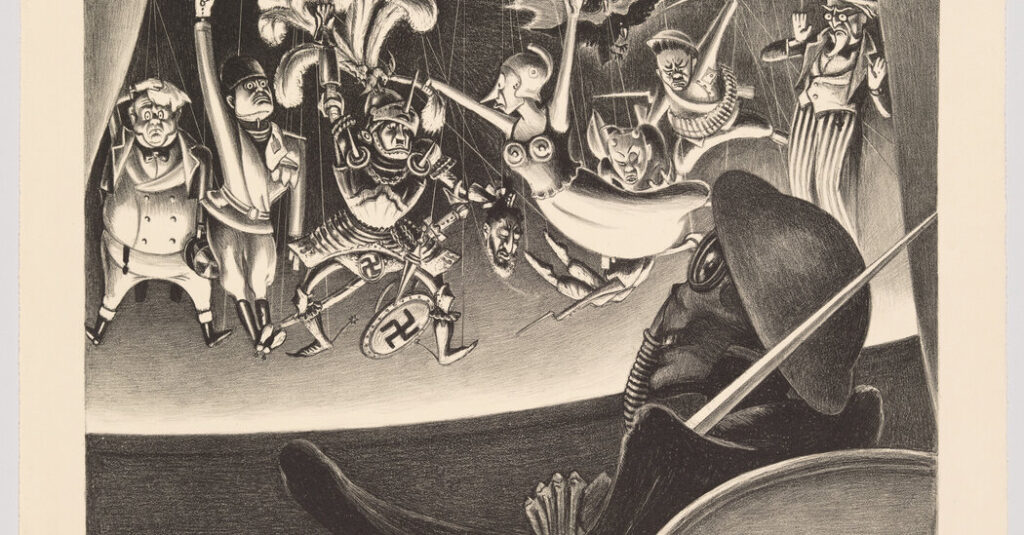
What better target than the America of the bread line? Dwight is meanest, and most memorable, in her geopolitical take on the “Danse Macabre,” from 1933, and in her “Merchants of Death” (1935), where Death leads a flock of tophat-wearing robber barons. They wear the jettest blacks in this show.
Dwight did some work for the Federal Artist Project, but she does not deify the workingman in the faultless way that her peers tended to do.
Her equal-opportunity ridicule — especially when her characters gawk at animals in aquariums or zoos — produces a defrocking effect upon the moneyed and a curiously elevating one on the low: a properly American middle-register that Joseph Mitchell was then discovering in prose. In mood and in medium Dwight seems almost too perfect a spokeswoman for the fact that printmaking is — or was — a gesture of democracy.
Mabel Dwight: Cool Head, Warm Heart
Through Aug. 30 at the Whitney Museum of American Art, 99 Gansevoort Street, Manhattan; 212-570-3600, whitney.org.
The post A Print Maestro With a Birdwatcher’s Eye and a Socialist Soul appeared first on New York Times.