A White House official called $4 billion in taxpayer funds being spent to address homelessness “God’s money — a move experts call an escalation of evangelical religious rhetoric coming from the Trump administration.
Dave Donaldson, special assistant to President Donald Trump in the White House Faith Office, spoke at a webinar inviting faith communities to apply for funds through the U.S. Department of Housing and Urban Development’s Continuum of Care program, the largest federal assistance initiative to combat homelessness that provides funding to states, American Indian tribes, nonprofits, and housing entities.
Organizations can apply through the end of August for a share of more than the $4 billion, with more than a quarter — a “historic” amount — available to new organizations, according to the webinar.
“I heard the other day, a faith leader said to me, ‘We shouldn’t touch that government money,’ but how many know ultimately it’s not the government’s money? It’s God’s money, and it’s your tax dollars,” Donaldson said.
“If we do not compete with this HUD Continuum of Care, these funds by default are going to go to perhaps organizations that have values that you do not share, and so I cannot urge you enough to do whatever it takes to compete.”
Ryan Burge, a professor at Washington University in St. Louis, who studies the impact of religion on American life and politics and hosts a popular Substack, “Graphs about Religion,” called the “God’s money” comment “very odd.”
The second Trump administration has embraced evangelical language, evoking religion more so than previous presidential administrations who tended to reference religion more “generically,” Burge said.
“Trump 2.0 is a decidedly more evangelical administration than even Trump 1.0. Guys like Pete Hegseth are a great example of that, of being very evangelical in their approach,” Burge said.
“It’s like ‘God owns everything. God’s providence is over all of us’. That kind of language is very evangelical.”
‘Combativeness is so much more evident’
Donaldson isn’t the only Trump administration leader who has recently pushed evangelical language.
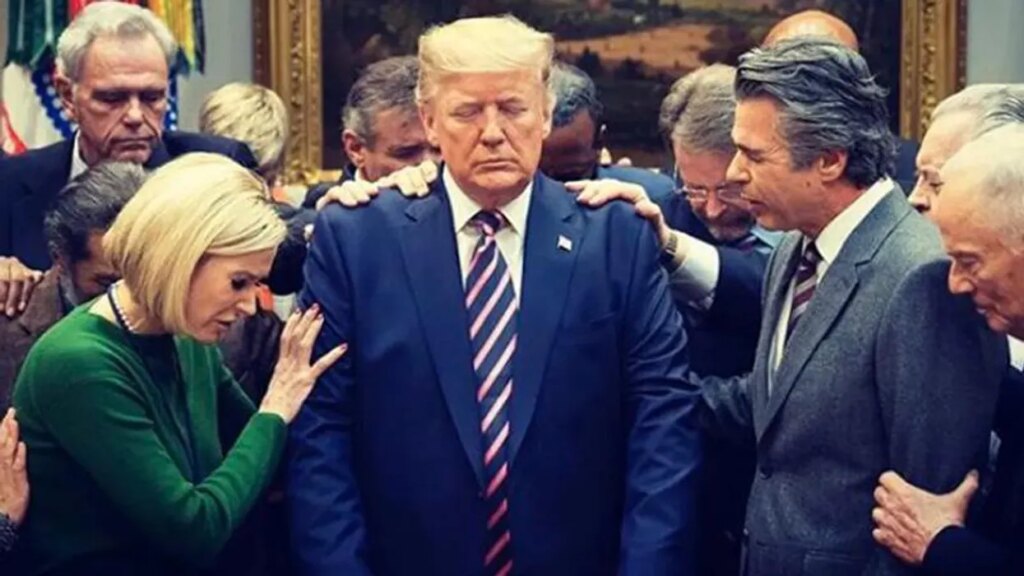
Paula White-Cain, a White House faith adviser, in a recent webinar for the National Faith Advisory Board, called on evangelical Christians as “the body of Christ, just the church” to register to vote to ensure “we would never have an election problem again.”
That type of language is “very old evangelical rhetoric,” Burge said.
“This is a constant in the Trump administration. They’re always fighting against the Deep State. ‘If we don’t take this money, then they’re going to take it and use it for priorities that we don’t like,’” Burge said.
“That combativeness is so much more evident in this administration than prior ones.”
In the webinar, White-Cain called the election of Zohran Mamdani, a Democratic Socialist and Muslim, as a mayor of New York City “a very scary time.”
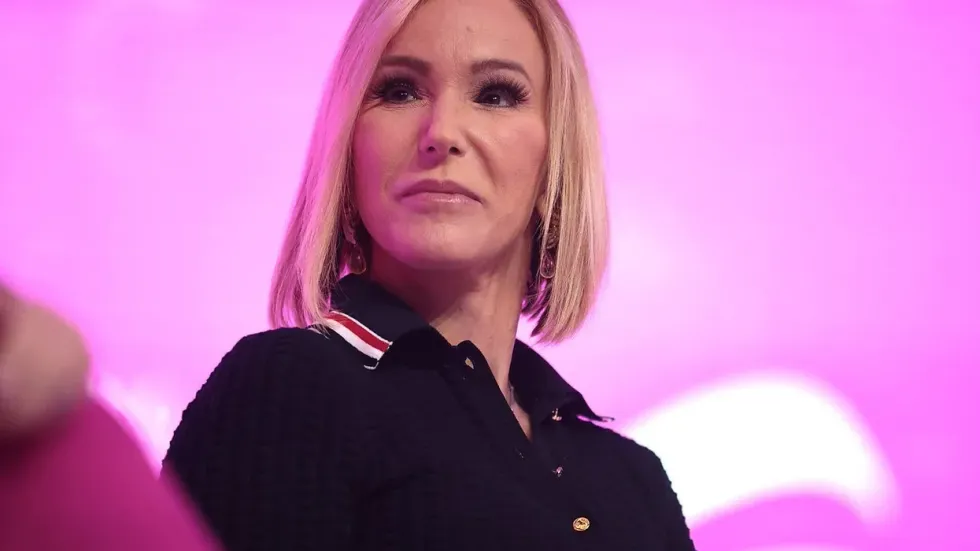 The Rev. Paula White in Grapevine, Texas on June 11, 2021 (Gage Skidmore) The Rev. Paula White in Grapevine, Texas on June 11, 2021 (Gage Skidmore)
“You’re not just talking Socialism … you are talking straight up Marxism, and if you don’t think that has consequences, most of your churches got shut down during COVID,” White-Cain said.
Burge called that language “couched anti-Muslim rhetoric,” promoting the idea that “Muslims are taking over America, and they’re the real threat facing the country.”
“It’s sort of an anti-Muslim in a way that I think is very unique today, that wasn’t true even three or five years ago, and it seems like almost like a return to the post-9/11 Islamophobia stuff is coming back,” Burge said.
The Religious Landscape Study from the Pew Research Center shows that 62 percent of Americans identify as Christian, 29 percent are religiously unaffiliated and 7 percent identify with other religions. Muslims make up 1 percent of Americans, according to the study.
While nearly 80 percent of Americans do not want churches involved in politics, Americans are more open to politicians using religious language, particularly related to Christianity, according to Pew reports.
Pew’s research shows that since Trump has taken office again, Americans perceive that religion is having a greater influence on society, and 55 percent of those surveyed view religion’s role in American life positively.
The number of Americans who think Christianity should be the U.S.’s official religion grew slightly to 17% in 2026, up from 13% in 2024.
“Even though people don’t really want to see partisan politics happening at the church level, there’s definitely a clear sense that religion, and particularly Christianity, is part of the fabric of American culture,” said Chip Rotolo, senior researcher at Pew.
“People would like to see Christian moral values promoted, and even if they don’t support things like Christian nationalism on the whole or the ending of church-state separation, something like the general presence of Christian values in society is pretty well supported.”
Evangelical Protestants are the largest group of Christians in the U.S., making up 23 percent, and are the group most likely to approve of Trump, according to Pew.
“We’ve seen support for Trump generally go down among all religious and non-religious groups, but it’s still worth noting that some of the more devout religious groups, groups like white evangelical Protestants, support for Trump overall is very high, and Trump acknowledges that sometimes,” Rotolo said.
“Sometimes you see this reciprocal thing when politicians use certain religious language these religious communities value that.”
The White House and National Faith Advisory Board did not respond to Raw Story’s request for comment. HUD acknowledged Raw Story’s questions but did not immediately respnd.
The post ‘God’s money’: White House enrages with vow that public cash belongs to evangelicals appeared first on Raw Story.