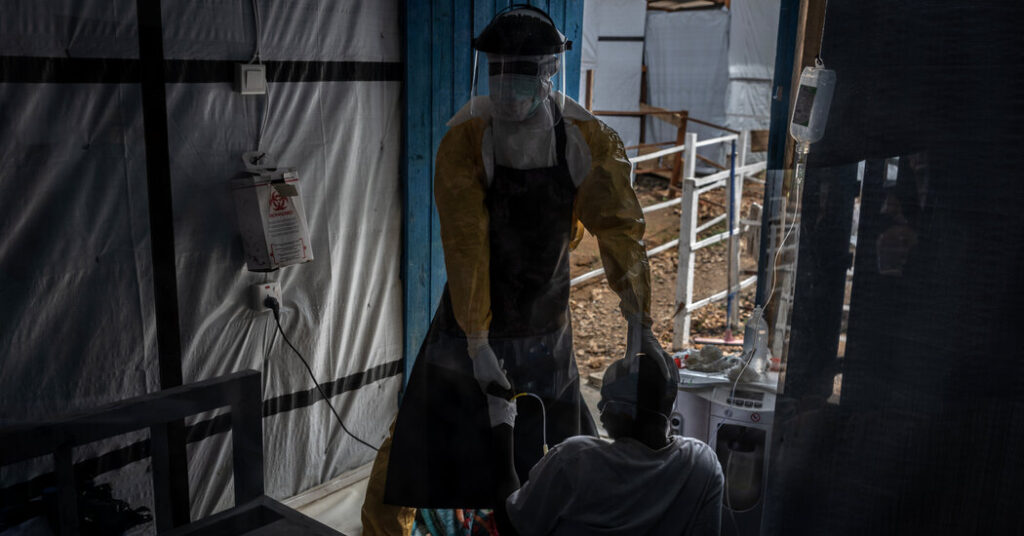
On one side of the Ebola ward, a woman visiting her ailing husband spoke to him through a plexiglass window. He had spent two days at the ward recovering from the virus and, after his first negative test, expected soon to be discharged.
A few yards away, Congolese doctors struggled to insert needles into the collapsed veins of Justin Bataga Mugarwa, a gold miner whose condition was rapidly deteriorating.
Mr. Mugarwa, 42, had been at the ward for nearly a week, and his sudden decline began with delirium, followed by convulsions so violent that doctors dragged his mattress and their patient onto the floor to prevent a fall.
“I’m not sure how long he can last like this,” said one doctor observing Mr. Mugarwa’s condition through the plastic window as fellow doctors dressed in full protective gear fought to save him.
The distance between life and death is razor thin at clinics like this one in Rwampara, just outside Bunia, the capital of Ituri province and the heart of the Ebola outbreak ravaging eastern Democratic Republic of Congo.
The recently built outdoor Ebola ward, run by the medical charity Alima, has treated 708 Ebola patients, 291 of whom have died from the virus as of this month.
The ward was hastily put together, made from temporary wood frame structures with corrugated metal roofs. Only infected patients and health workers in protective clothing are allowed to enter the “Red Zone,” where medicine and supplies are passed down a slide.
When exiting the Red Zone, medical staff are sprayed with chlorinated water as they remove their masks, yellow suits, gloves and hoods. They take care to avoid contact with any potentially contaminated surfaces. The disposable yellow suits and protective hoods are burned while gloves and boots are sterilized by a team of support workers.
Recovering patients share rooms while awaiting two negative tests within 48 hours before they can be discharged. Single isolation rooms are reserved for patients in critical condition, like Mr. Mugarwa.
On a recent afternoon, doctors spent hours attempting to administer intravenous fluids and medication to him. Mr. Mugarwa’s severe dehydration made inserting needles into his veins impossible.
He vomited blood. His internal organs failed. One of the doctors treating him slumped on the metal bed frame and stared down at Mr. Mugarwa as his breathing slowed.
Then it stopped. He was gone.
This outbreak has killed more than 2,000 people since May, according to the World Health Organization. The organization said Wednesday that the outbreak is on track to surpass the deadliest one in history, which killed more than 11,000 people over a decade ago. Local health officials fear the virus could be mutating.
Health workers in Rwampara had long struggled to treat Congolese facing violence, hunger, and preventable diseases. Then came Ebola. Mortality rates associated with this epidemic hover at nearly 46 percent.
Mr. Mugarwa’s niece, Rebecca, also died from Ebola at the ward that afternoon. His wife and one of his three sons, both of whom had been under observation, fled the clinic upon learning of his death.
“We are shocked because he has been here almost a week and we thought he was improving,” said one of Mr. Mugarwa’s seven brothers, Prospere Kondjedo, when the family arrived at the clinic the following day. “When we got here this morning, we went to where he had been, and all we saw were his clothes and his telephone. He is no longer there.”
Some 100 health workers have contracted the virus overall, and at least 36 have died, according to health officials. In mid-June, one of the doctors at the ward tested positive for Ebola after flying to Paris.
After the doctor fell ill, Congo’s government imposed a 21-day international travel ban for anyone leaving Ituri province, potentially impeding the response, aid organizations said, before the ban was eased.
In July, dozens of health workers and support staff in Rwampara went on strike, part of a wider strike in the province over unpaid wages. Ebola patients were left at the clinic without care for days until staff were assured by Congo’s health ministry that late salaries would be paid.
Mr. Mugarwa and his niece were buried at a cemetery across the road from the clinic the day after they died. Two body bags were carried from the morgue, placed into coffins and loaded onto a vehicle for transportation.
Mr. Kondjedo, the brother, and around a dozen other family members gathered as the coffins were lowered into graves. Earth was shoveled atop the caskets and mourners sang their farewells.
The post A Patient’s Final Breath in a Congolese Ebola Ward appeared first on New York Times.