Sports are supposed to be fun. Even in this contentious age, that isn’t a controversial notion, is it? I hope not. Sports exist for many reasons — to test the limits of human achievement; to give children a reason to run around for a while; to sell beer, hot dogs and pills for middle-aged men. But the primary justification is the simplest: The world is scary and confusing and stressful and exhausting, and sporting events provide an escape from all that.
I offer this reminder because, right now, I’m pretty sure no one involved with the WNBA is having any fun. Everyone is either miserable, angry or both.
Pick any exhausting cultural flash point, and you’ll find the WNBA at its center. Race? Last week, after a Black player fouled a White one, the Florida attorney general said, “The WNBA knows better than to play games down here in Florida, because I’ll be charging people with assault.” (There is no WNBA franchise in Florida.) Labor-management relations? An ugly, protracted contract battle nearly canceled the season and pushed players into a competing league. Transgender rights? Well, a team owner was suspended after reportedly calling two anti-trans activists “insane,” two (very opportunistic and attention-seeking) former NBA players are pushing to enter the league’s draft, and a Fox News pundit has declared interest in putting together a team of “men pretending to be women” called the “Nashville Balls” to enter the league. (I feel obliged to point out here that the WNBA has never had a transgender woman player.) Candace Buckner, an excellent columnist for The Athletic, wrote this week that “it feels like psychological warfare just to engage with the WNBA.” She might be underselling it.
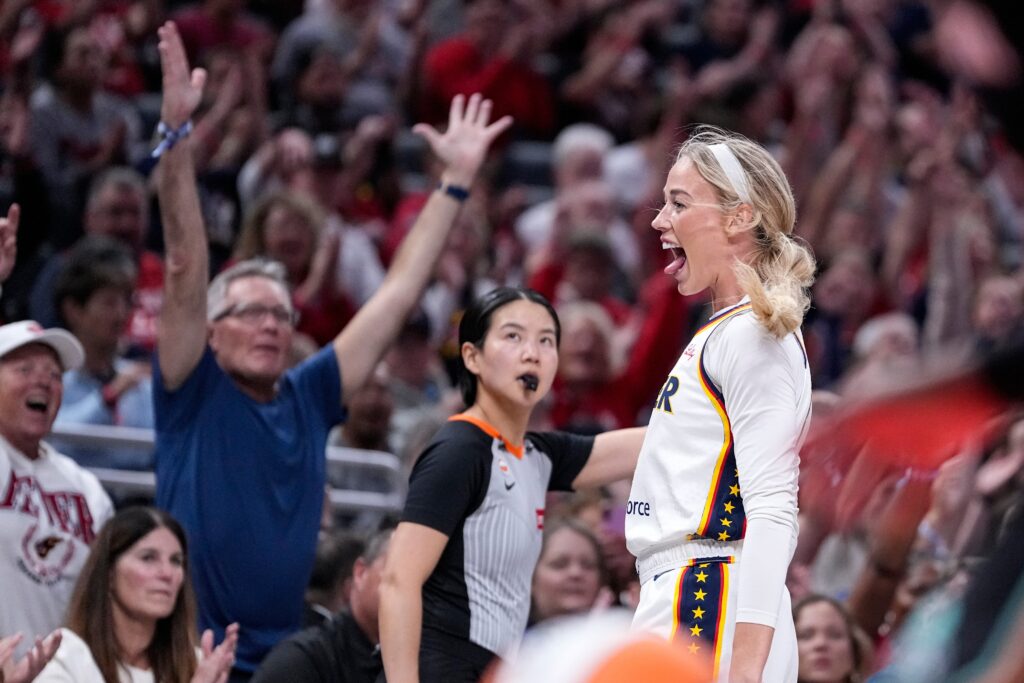
At the center of all this has been, predictably, a podcaster-influencer. For five years, Sophie Cunningham was a perfectly adequate three-point specialist and bench player for the Phoenix Mercury. Then she became Caitlin Clark’s teammate and apparently realized where real money could be made.
After Clark’s incredible college career made her one of the most popular athletes on the planet — and created a whole new subsection of WNBA fans when she was drafted by the Indiana Fever — she discovered, as every rookie in every league in the history of sports has discovered, that veteran players sometimes make things tough for a star rookie. They did this the way every league’s veterans do it: They roughed Clark up, knocked her around and made her work for everything she got. It happened to Michael Jordan, to Peyton Manning, to Wayne Gretzky, to all the greats: Going through that, in fact, was part of what made them great.
But the league’s new fans were taken aback — that didn’t happen to Clark in college! — and opportunistic pundits instantly leaped on their discomfort and confusion. Here was a terrific chance to use the league’s explosion, and Clark’s popularity, to exploit divisions around race and sexuality. Veteran players weren’t getting physical with Clark because that’s what veterans do; they were doing it because she’s a nice White girl.
To her credit, Clark has generally tried to stay out of these battles. But Cunningham — who hosts a podcast with exiled “Summer House” cast member West Wilson — had no such compunctions. Thus, she styled herself as Clark’s “enforcer,” leading to numerous on-court confrontations and Cunningham’s exaggerated, made-to-meme reactions to them. And then she began Talking About The Issues.
Specifically, trans rights, which just happened to align perfectly with the interests of the very pundits looking to make hay (and profit) through controversy. Cunningham said in an ESPN interview, “I want to protect young girls in a locker room, or young girls in sport who shouldn’t have to go against biological men.” That led the WNBA players union to release a statement saying it would not allow its players “to be used as political pawns,” protests at WNBA games, Clark being dragged into a situation she had been desperately trying to stay out of and, in another total coincidence, Cunningham’s follower counts exploding. Again: In a league that has no trans women players. As Buckner pointed out, it has all made merely watching a game impossible.
Here it should be said that this, in fact, is part of the growth pattern for any emergent sports league. Ask an NFL, NBA, MLB, NHL or college football fan what it feels like when a whole bunch of people who don’t actually care about their sport start to use its popularity as a cudgel. It’s no fun at all!
So perhaps a reset is in order.
Anyone who has been watching the WNBA for years knows that the quality of play is higher than it’s ever been. The product is magnificent. (Seriously, watch an actual game if you haven’t.) If that matters to you, then that’s all you have to care about. Just watch the games, and ignore the rest. And if you don’t like the WNBA — if you don’t watch it, or you’ve just tuned in and decided you don’t like it — you (and I hope you are sitting down) do not have to watch it. You can do something else! Read a book! Watch a movie! Watch ants race down the sidewalk!
These are the two types of people in the world: people who like the WNBA and people who don’t. The latter have taken over the conversation right now, but the former don’t have to let them. This, after all, is supposed to be fun. It is in fact the point. Let’s try to remember that.
The post The culture wars come for the WNBA appeared first on Washington Post.