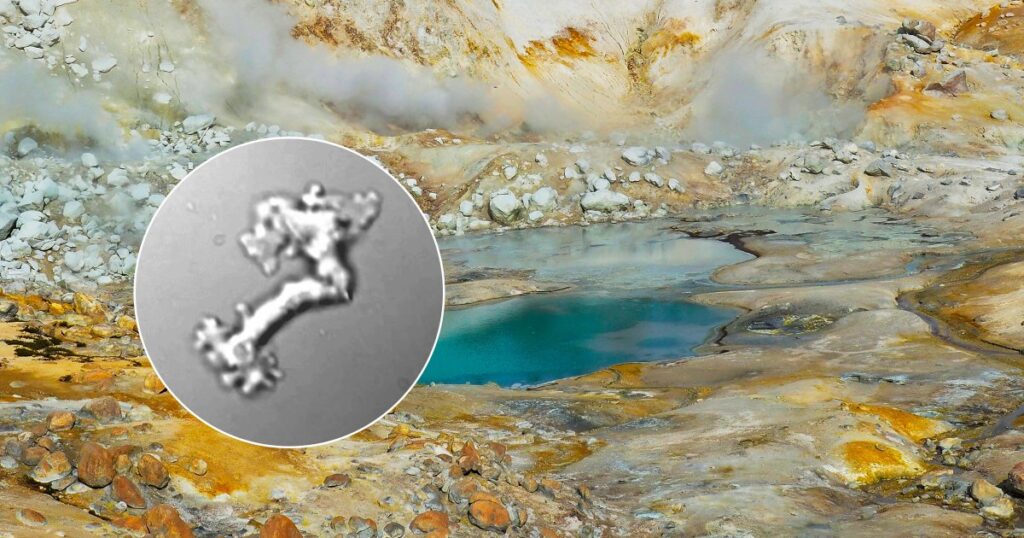
Parts of the Lassen Volcanic National Park in California’s Cascade Range resemble the gateway to a hellish underworld, with pools of boiling water and bubbling mud where almost nothing can live, due to scalding temperatures that can reach a blistering 464 degrees Fahrenheit.
That’s enough to kill a human, obviously, which rangers and ample signage helpfully point out to visitors throughout the park. And yet: a team of scientists in America and Europe have discovered one remarkable organism that can survive and even thrive in these hellish waters: a tiny single-cell “fire amoeba.”
This humble critter, a gooey-looking blobunder the microscope, has set a “new record for the upper temperature limit” for all complex organisms on Earth because it can divide at a burning-hot 145.4 degrees Fahrenheit, according to the scientists who laid out their findings in a yet-to-be-peer-reviewed study published last week.
In reporting by Nature, the researchers said the existence of the once-unknown amoeba — now called Incendiamoeba cascadensis, meaning “fire amoeba from the cascades” — also challenges the notion that certain organisms called prokaryotes, which includes all bacteria, are the only lifeforms on Earth that can survive extreme temperatures that kill almost everything else.
Prokaryotes, which have no distinct nucleus, are still the reigning champs of biological toughness, as they can persist in temps between 149 and 221 degrees Fahrenheit — and they can theoretically be viable up to 392 degrees, above which nucleotides and amino acids start to break down.
Prokaryotes, which also includes a domain of microbes called archaeans, can be found in steaming compost piles, and places with volcanic activity and hot springs such as Lassen. The highest known temperature shrugged off by a prokaryote, an archaean called Methanopyrus kandleri, is 251.6 degrees Farenheit, a record for all organisms, prokaryotes or not.
In contrast to prokaryotes, the fire amoeba is an eukaryote — complex organisms that include every animal, plant, fungi, and also unicellular tiny lifeforms called protists, encompassing algae and other amoebae — and is composed of cells, or one cell in the case of the fire amoeba, that have a distinct nucleus bound by a membrane and interior organelles.
Eukaryotes such as mammals and us humans have an upper temperature limit of 109.4 degrees Farenheit, above which we die. Until now, the upper temperature limit for more hardy eukaryotic organisms, such as fungi and red algae, was thought to be 131 to 140 degrees Fahrenheit, so this discovery of the fire amoeba is remarkable.
“We need to rethink what’s possible for a eukaryotic cell in a significant way,” Angela Oliverio, Syracuse University microbiologist and study co-author, told Nature.
The team found this tiny microorganism in a stream of hot spring water that was pH neutral, in contrast to the many acidic pools in Lassen.
“It’s the most uninteresting geothermal feature you’ll find in Lassen,” Syracuse microbiologist and study co-author Beryl Rappaport told Nature.
Studying the water from this stream yielded zero indication of life while under microscope, but something unexpected happened when the scientists added nutrients to the water and heated the samples to a temperature of 134.6 degrees Fahrenheit, the stream’s temp range; they noticed this then unknown amoeba moving and replicating.
When they slowly heated the samples up to 145.4 degrees, the hardly little amoeba again defied expectations and still kept on dividing and moving, according to the paper. At a degree higher, it was still active.
At 158 degrees, though, the amoeba went into dormancy in a process called encystment, in which it turns into a cyst-like ball; it develops a hard shell that protects it from harsh environmental conditions; cooler temperatures would allow for the amoeba to unwind form its cocoon to grow and reproduce again.
The team also decoded and analyzed the fire amoeba’s genome and “found an enrichment of genes related to proteostasis [process that regulates proteins], genome stability, and sensing the external environment,” the scientists wrote in the paper, showing the hidden mechanisms that allow the amoeba to survive.
The scientists said this discovery of the fire amoeba is exciting because it opens up the possibility of further research and discovery of new, undiscovered high-temperature loving eukaryotes; scientists have typically studied heat-loving prokaryotes called thermophiles.
“We looked in one stream,” Oliverio said. “Maybe we got extremely lucky and there’s nothing else out there, but we really don’t think that’s the case.”
Another exciting aspect of the discovery, according to the scientists, is that it could lead to better insight on how eukaryotes can survive such extreme temperatures while maintaining healthy cellular integrity and functionality. The proteins within the amoeba can also be a source for “thermostable proteins” that can find many applications in the biotechnology field, they said.
What’s also cool is that the discovery raises the possibility of life beyond Earth; researchers have speculated that microbes such as bacteria could lurk in the ancient riverbeds and lake shores of Mars or its ice caps.
Because like what actor Jeff Goldblum said in the first Jurassic Park movie: “Life finds a way.”
More on Microbes: We’re Totally OK With This 48,500 Year Old “Zombie” Virus Being Resurrected
The post Scientists Impressed by “Fire Amoeba” That Can Survive Incredible Temperatures appeared first on Futurism.