In January 1977, not two years before Reverend Jim Jones would orchestrate his followers’ deaths by the hundreds, a San Francisco church bestowed its Martin Luther King Jr. Humanitarian Award on him. Jones, the founder of the Peoples Temple of the Disciples of Christ, had managed to become a major player in the city’s politics. No one foresaw the horrific depths to which the combination of a charismatic leader, an all-encompassing belief system, and the human need for community and redemption would soon descend.
On November 18, 1978, at Jones’s eponymous farm commune deep in the jungles of northwest Guyana, 908 members of the Peoples Temple, which had become a Pentecostalist-inspired socialist personality cult, either ingested cyanide-laced punch or were shot for refusing to do so. Most of the victims were poor Black Americans; more than 300 were children. Multiple generations of families died at Jonestown—grandmothers administered the deadly concoction to their screaming grandchildren before swallowing it themselves. (Based on a recording and other evidence from the incident, no one can say how many died willingly; men with guns oversaw the operation.) Just hours before, at a nearby airstrip, gunmen acting on Jones’s orders had murdered three journalists, a temple defector, and Representative Leo Ryan, a Bay Area Democrat who had traveled to Jonestown on behalf of temple members’ concerned relatives. Jones himself died from a gunshot wound to the head.
Until 9/11, Jonestown had been the largest premeditated mass killing of American civilians in history. In his 1980 book, Journey to Nowhere: A New World Tragedy, the author Shiva Naipaul examines how ideologies related to the American counterculture helped bring about the massacre, and what he finds is deeply disturbing: Jonestown wasn’t just the work of only one man, Naipaul argues; it was also the product of a morally corrupted environment.
[James Kirchick: The DSA is a parasite]
The phrase drinking the Kool-Aid, a metaphor for unquestioningly holding a belief, was inspired by the fatal cocktail administered at Jonestown. But dark jokes about a nearly half-century-old massacre have a way of obscuring its continuing relevance. In recent years, totalizing ideologies such as communism, fascism, and Islamism have found dedicated audiences on social media, and the proliferation of demagogues manipulating people for malign ends is an ever-present worry.
Jones himself was a mentally unsound megalomaniac. But the people who followed him to South America were not—poor and vulnerable, yes; crazy, no.
During Naipaul’s too-brief career, he was overshadowed by his older brother, the Nobel laureate V. S. After the younger Naipaul died at 40, in 1985, his book about Jonestown languished in obscurity. Fortunately, Doubleday has reissued Journey to Nowhere as part of a new imprint called Outsider Editions, which aims to revive “extraordinary books” that “were overlooked or forgotten but still speak urgently to this moment.” The edition comes with a new introduction by the Pulitzer Prize–winning memoirist Hua Hsu, and it could not have arrived at a more opportune time.
Naipaul, Hsu writes, was skeptical of worldviews whose adherents had “no interest in solutions to political problems” and “wanted to feel as though they were being saved.” Naipaul first came to understand how “the language of religion could be transformed into the language of politics” in his native Trinidad, where he once saw supporters of a future prime minister holding placards that declared him the Messiah. Fascinated by the decolonization of what was then called the Third World—the poor nations unaligned with either Cold War superpower—Naipaul traveled to Jonestown two weeks after the massacre in search of answers as to why the commune, which Jones had touted as a collectivist utopia, had gone so tragically wrong.
In the second half of Journey to Nowhere, Naipaul takes us to what he sees as the real scene of the crime: Northern California, where Jones had built his flock and cultivated alliances with influential political figures. In the San Francisco of the early and mid-1970s, the Peoples Temple could blend in as just another piece of the city’s eccentric furniture.
Jones began his ministry in 1950s Indianapolis, where he founded an interracial church. Seeking a more liberal environment, he moved to Northern California in 1965. Many Black parishioners who joined the Peoples Temple attested to the church’s racial inclusiveness. This perception was central to the positive reputation that Jones built up among San Francisco’s political elite—an image that persisted even after revelations of misconduct began to surface. In 1972, the San Francisco Examiner published a four-partinvestigation into abuse and financial impropriety within the church, and five years later, New West magazine reported on the physical and psychological terror that Jones inflicted on his followers. But Jones’s proven get-out-the-vote operation apparently eclipsed local officials’ misgivings. Jones’s ever more abusive and erratic behavior was ignored or rationalized by people who should have looked harder.
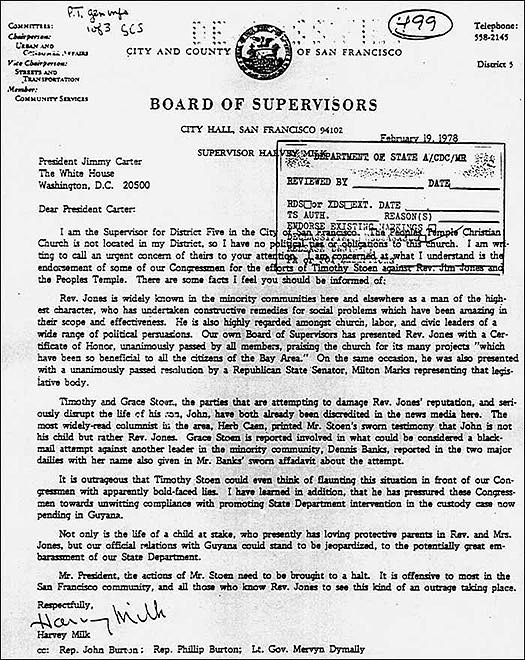
State Assemblyman and future Mayor Willie Brown once praised Jones as an “American Gandhi,” a combination of Martin Luther King Jr., Angela Davis, Albert Einstein, and Mao Zedong (he meant this as a compliment). California Governor Jerry Brown attended a testimonial dinner held in Jones’s honor, and in 1976 the Democratic vice-presidential candidate, Walter Mondale, invited him onto his campaign plane. Nine months before the massacre, the city supervisor Harvey Milk, one of America’s first openly gay politicians, lauded Jones as a “man of the highest character” in a letter to President Jimmy Carter.
These officials’ endorsements of Jones made him all the more dangerous to his followers, Naipaul argues. In his view, evildoers require passive and active enablers, whom he deems partly culpable for their deeds. “Those who ought to know better nourish our crazy dreams of resurrection and redemption; those safely beyond the borders of our madness underwrite our lunacies,” he writes; it’s the closest thing his book has to a thesis.
California, in Naipaul’s words, was a “state of mind.” So too was the ideology that Jones embraced. The term Third Worldism was devised in the early years of the Cold War to define a system of beliefs that Hsu, in his introduction, characterizes as “an awakening of the global underclass.” In practice, it has usually amounted to a blend of socialism, authoritarianism, and rhetoric pitting the global South against the West. An antipathy to American racism, imperialism, and capitalism was the reason that Jones and his followers decamped in the summer of 1977 to Guyana—then well more than a decade into Prime Minister Forbes Burnham’s experiment with “cooperative socialism.”
Oddly for a man of the cloth, Jones seemed to prioritize communism over religious belief. “Neither my colleagues nor I are any longer caught up in the opiate of religion,” he wrote, echoing Karl Marx’s denigration of divine faith. He referred to the Bible, its teachings so clearly at odds with his own mad project, as a “paper idol” and a “dead letter.” On the day of the mass culling, as his desperate followers pleaded for their lives, Jones screamed at them to “stop this hysterics. This is not the way for people who are socialists or communists to die.” (Jones’s term for the events of that terrible day, “revolutionary suicide,” is the title of the Black Panther Party co-founder Huey Newton’s 1973 autobiography.)
As temple members met their gruesome death, documents bequeathing some $7 million to the Communist Party of the Soviet Union were spirited out of Jonestown in a suitcase stuffed with cash. These statements and actions, some conservatives said at the time in a finger-wagging tone, demonstrated that mass suicide at the feet of a power-mad dictator was the predictable result of radical left-wing politics. Ruminating on the tragedy, the Catholic intellectual Michael Novak wrote that socialism “begins in mysticism and ends in terror.”
Yet Jones was driven by instincts more primal than politics. Yes, he had openly fantasized about relocating his church to the Soviet Union, producing what Naipaul describes as “a cruel fantasy of escape” that “led to the sad absurdity of eighty-year-old ‘senior citizens’ struggling to master an alien tongue and comprehend Lenin’s thoughts on Marx and Engels.” But Jones had also been on friendly terms with the San Francisco chapter of the John Birch Society, claimed to be saving taxpayer dollars by helping the poor, and donated money to the wives of slain police officers. He was a narcissist and an authoritarian before he was anything else.
In Jonestown, the racial brotherhood that Jones had spoken about in San Francisco transmogrified into racial paternalism—or worse. An undercurrent of white supremacy was undeniable at Jonestown, where Black people labored in the fields for 11 hours a day on meager rations while Jones preached to them over a loudspeaker from the comfort of an air-conditioned house with a well-stocked larder. “Jones stripped bare his following and left them naked and defenseless,” Naipaul writes. “He did not liberate: he assaulted and traumatized those who believed in him. One can sense at a certain level his raging hatred for the Blacks whose God he claimed to be; a hatred so deep-seated, so tormenting that, in its fury, it turned itself inside out and called itself Love.”
In spite of his conduct, Jones was skilled at speaking in a way that appealed to progressives and reinforced his left-wing bona fides. He cast the church’s critics as reactionaries hell-bent on destroying his radical ministry. To counter the media’s “vicious lies,” Jones enlisted Mark Lane, a dean of the President John F. Kennedy–assassination–conspiracy–theory industry, and Charles Garry, an attorney for the Black Panthers. After touring Jonestown in September 1978, Lane alleged that the settlement was being “cruelly assaulted by the intelligence organizations,” and Garry was convinced that, as Naipaul put it, “animals were better treated in Jonestown than human beings were in the United States.” Sycophants such as these, Naipaul writes, turned Jones into “a modern-day Moses,” such that when the preacher “did finally pull the trigger, he was able to pull it not only on himself but on nearly a thousand others.” To this day, conspiracy theories alleging that Jonestown was a CIA mind-control experiment gone awry find favor across the internet.
[Read: How much worse is this going to get?]
To some extent, Jones’s constant inveighing against fascism and genocide indicate his paranoia. But Naipaul reminds us about how ubiquitous premonitions of catastrophe and doom were in the 1970s. The optimism and idealism of the 1960s had curdled into what Tom Wolfe dubbed the “‘Me’ Decade.” Watergate, Vietnam, and stagflation sapped American confidence to a degree not seen since the Great Depression. During an 18-month period stretching from 1971 to 1972, the FBI recorded some 2,500 domestic-terror bombings. Fears about environmental devastation, overpopulation, energy depletion, and a nuclear holocaust were omnipresent, manifested in books such as The Population Bomb, the back-to-the-land movement, and the entire Hollywood disaster-movie genre. Owing more to Jones’s personality than to his politics, something like the horror in Guyana was inevitable, in Naipaul’s telling. But responsibility for it radiated widely, as “the ideological irresponsibilities of a promiscuous decade were coming home to roost in Jonestown.”
Journey to Nowhere deserves to be read alongside Joan Didion’s Slouching Towards Bethlehem as a pair of bookends to the American counterculture. The ideology of Third Worldism and the New Agey, anything-goes-style progressivism of the West Coast that Naipaul so keenly lacerates were necessary precursors to the mass death in Guyana. But the most important factor distinguishing Jonestown from the other left-wing movements of its time was a singularly evil leader. Today, Americans routinely describe their political opponents—whether in the MAGA movement or the Democratic Socialists of America—as members of a cult. But whatever you think of Donald Trump or New York City Mayor Zohran Mamdani, neither of them is Jim Jones.
Nearly half a century onward, Jonestown strikes many people as a bizarre aberration. Knowing everything that we now know about the Peoples Temple, we struggle to understand how anyone could have been taken in by Jones. That so many otherwise intelligent people missed the warning signs is a testament to the power of his message and the force of his charisma. The Washington Post correspondent Charles Krause didn’t realize the truth until he was dodging bullets at the nearby airstrip. “It seemed to me that the Peoples Temple had a legitimate purpose, a noble purpose, and was more or less succeeding,” he later wrote. The tragedy is not just that Jones deceived people. It’s also how willing they were to be deceived.
Naipaul’s scathing critique of radical left-wing politics may yet limit the audience for his ideas. One recent review of Journey to Nowhere assails Naipaul for the “racism” of his analysis of Third Worldism and denigrates the book as “one long sneer” at “vegetarians, environmentalism, hippies, feminists,” and other progressive interests. Some of Naipaul’s language comes across as dated, and the scorn he feels for certain postcolonial political actors and their Western sympathizers is palpable. But his unsettling conclusions still warrant attention. At a time when more and more people look to politics for salvation, we should heed Naipaul’s warnings about how we see what we want to see and ignore what we don’t.
The post The Jonestown Style of Politics appeared first on The Atlantic.