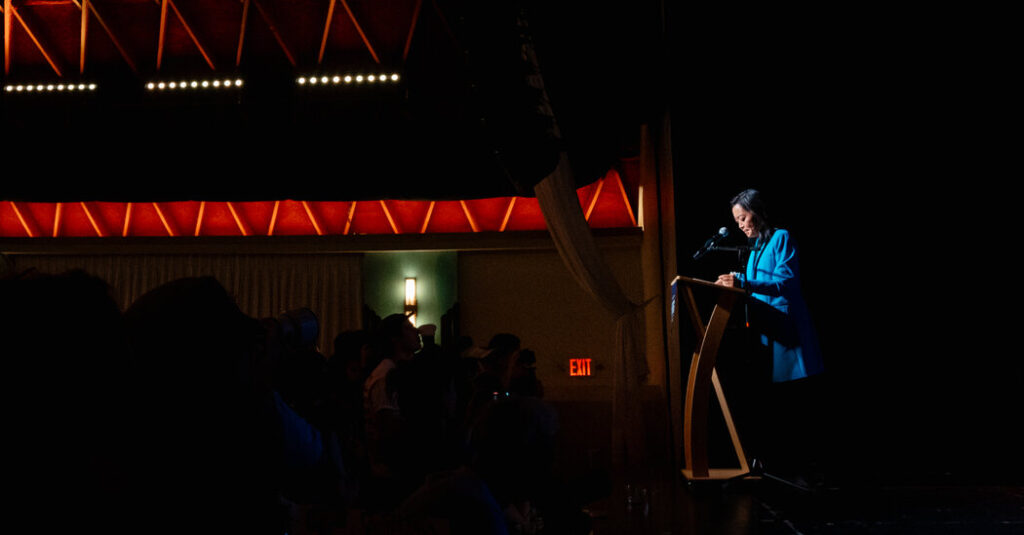
Francesca Hong was supposed to prove that a democratic socialist could win a statewide election.
Instead, her surprise loss in the primary election for governor of Wisconsin dealt a blow to the progressive movement and initiated a scramble among Democratic factions to define her narrow defeat either as an impressive harbinger of the movement’s future or an ominous sign of voter antipathy toward the far left.
Some prominent Democrats argued that the outcome was proof that the moderate wing of the party carried more electoral weight than the progressive one, which has dominated headlines this year as insurgent candidates have ousted incumbents in deep-blue cities.
Others, on the left, looked to celebrate the tight race — even though their candidate fell short — as evidence that progressives can compete in statewide contests.
“It’s a significant loss,” Robert Lasica, a spokesman for Madison’s Democratic Socialists of America chapter, said in an interview. But he argued the race was also “a big triumph of how far we can go with building the left infrastructure in Wisconsin that simply did not exist a year ago.”
David Crowley, who is the Milwaukee County executive and had briefly suspended his campaign just over a month ago, defeated Ms. Hong by a razor-thin margin. His victory defied months of polls that showed Ms. Hong far in the lead.
It was the second consecutive week with a Democratic primary in which a progressive candidate underperformed expectations. Last week in the Democratic Senate race in Michigan, Dr. Abdul El-Sayed defeated Representative Haley Stevens, but the contest was closer than expected and was not called until the next morning. Both narrow outcomes have kept the debate that has been raging all year between moderates and progressives vigorously alive.
Mr. El-Sayed is not a member of the Democratic Socialists of America, and the D.S.A. is not officially part of the Democratic Party. But both the D.S.A. and non-D.S.A. progressives have roiled the party in this year’s midterms by exciting the left flank of the party’s base.
Some in the party hoped to export aspects of Ms. Hong’s success to other campaigns, notably her ground game. The former chef and restaurateur spent more time than any other candidate campaigning in rural Wisconsin, and it appeared to pay off with strong margins in some of those counties. Progressives have won a string of races partly on the strength of their ground games. The question is whether the model can be replicated without the populist policy proposals, such as abolishing I.C.E., that are resonating with some voters but that many moderates eschew.
The fallout of Ms. Hong’s campaign carries extra weight as the party eyes 2028, with those in each wing already jockeying to elevate their own. On Wednesday, Democrats openly exploring presidential bids sought to wield the election results to make their cases.
Rahm Emanuel, the former Chicago mayor and former chief of staff to President Barack Obama, wrote on social media that Ms. Hong’s defeat showed “that the pragmatic wing isn’t a faction of this party. It’s the majority, it’s awake now, and it’s exerting itself.”
Representative Ro Khanna, a progressive congressman from California who had endorsed Ms. Hong and is also contemplating a run for president, sought to tamp down criticism of the far left.
“I appreciate that Democrats can have differences over single payer healthcare, free childcare, pausing data centers and other issues @FrancescaHongWI fought for,” he wrote on X. “But caricaturing and labeling candidates based on a few statements is not a politics I believe in.”
Democratic socialists had seen Wisconsin as a key opportunity to prove that their message could resonate in less liberal parts of the country. While they planned to study Ms. Hong’s loss to improve their electoral fortunes, several said they viewed Tuesday’s result as strong proof of the movement’s rise.
“Francesa won hundreds of thousands of votes — one of the highest vote totals of a democratic socialist candidate in any election in the United States,” said Katie Sims, a D.S.A. member in Ithaca, N.Y., who leads the group’s national electoral strategy. “Ultimately, it’s disappointing that she lost by such a small margin, but really heartening that it shows that these kinds of races are viable.”
D.S.A. members pointed to several areas for improvement. For one, the socialist infrastructure and campaign experience in Wisconsin was far less robust than in places such as New York City, which last fall elected Zohran Mamdani, a democratic socialist, to be mayor. There, socialists had been building for years toward that victory as well as additional successes in congressional campaigns in June.
“For some people on the campaign, they have not worked at this scale yet before under these pressures,” Mr. Lasica said. “Next time around, we’re going to be in a better position.”
Some progressives criticized some of the biggest national names in their movement, including Senator Bernie Sanders of Vermont and Representative Alexandria Ocasio-Cortez of New York, for sitting out the race.
Ms. Hong also struggled in the final days of her campaign to explain past online remarks that were unearthed in news reports — including one in which she suggested canceling Thanksgiving.
Those reports unfurled an examination on the left, too, of how positions and rhetoric of pandemic-era progressivism have not always aged well with the broader population. Ms. Ocasio-Cortez jumped into that debate on ABC’s “This Week” on Sunday, describing that era as “crazy” and “Woke 1.0” — a term that has become a political meme.
Asked about those comments on Wednesday and whether “Woke 1.0” was indeed crazy, Mr. Mamdani stressed that elected officials have a responsibility to own their evolving beliefs.
“I think that each person has a responsibility to tell New Yorkers, to tell Americans, when they’re running for office what they believe,” he said to reporters. “And sometimes what you believe can change, it can develop, it can grow.”
Dana Rubinstein and Tim Balk contributed reporting.
The post The Debate Over Democrats’ Future Rages On After Hong’s Defeat in Wisconsin appeared first on New York Times.