Benjamin Netanyahu is the longest-serving prime minister Israel has had, as well as its most disastrous for Jews and Palestinians alike.
Gaza has faded somewhat from global consciousness but remains in desperate shape with no clear path forward, while the West Bank endures brutal attacks by settlers that create a widening chasm between Israel and the rest of the world. All this is Netanyahu’s legacy.
Finally, polls suggest a chance that his malignant reign may come to an end with October’s election in Israel.
The question hanging over the region is whether, if he is ousted, what follows will be better. The answer I hear from experts is: Yes, maybe to a degree. Don’t expect a Palestinian state or a transformation. But the worst excesses and brutality might be reined in.
Gadi Eisenkot, a former army chief, seems the most likely to lead Israel if Netanyahu proves politically mortal, and Eisenkot is by no means a dove. He is well known for helping to formulate the Dahiya doctrine: Respond to attacks with overwhelming, disproportionate destruction to create deterrence. It is named after the Beirut suburb where Israel applied it two decades ago, and it’s sometimes seen as a forerunner of Netanyahu’s demolition of Gaza.
But Eisenkot also withdrew from Netanyahu’s war cabinet because of disagreements over the direction of the Gaza war (in which he lost a son, which has made him a particularly sympathetic figure in Israeli politics). His comments suggest that he would try to move Israel in a more moderate direction and control the violent settlers in the West Bank who have been committing terror attacks against Palestinians.
“Eisenkot would make a substantial difference in terms of calming the waters on the one hand and cracking down on lawlessness,” said Daniel Kurtzer, a former American ambassador to Israel who now teaches at Princeton.
Most settlers are not violent, and some live in settlements (which are generally regarded as illegal under international law) not for ideological reasons but because it is cheap. But it is also true that settler attacks causing damage or injury are at the highest level in two decades, with an average of five a day last year. That rose to six a day in the first half of this year, according to United Nations figures.
About 1,100 Palestinians have been killed in the West Bank by Israeli soldiers or settlers since the Oct. 7 Hamas terror attack on Israel, the United Nations says. The circumstances are often disputed, but the total includes at least 243 children.
Under Netanyahu, the Israeli Army increasingly takes the side of settlers, even when they are engaging in illegal or violent behavior, according to Palestinians, Israeli human rights groups, news accounts and others. “The army routinely accompanies settlers in attacks,” a U.N. commission reported.
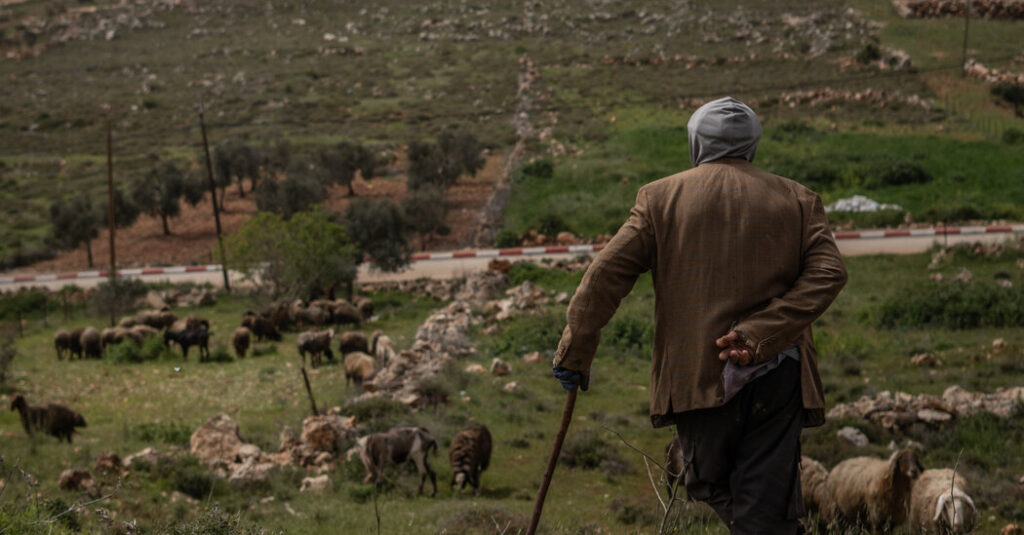
What all this means in practice is misery for people like Abdel-Majeed Hassan, a Palestinian farmer in his 70s whom I’ve visited periodically for many years. He is a soft-spoken shepherd in the village of Qusra, deeply proud that all 12 of his children attended university.
“My sheep sent my children to university,” he told me during an April visit as he herded his flock.
Over the years, settlers have shot Hassan in the leg, he said, partly burned his home (twice), stolen his sheep, invaded his home, blocked his access to his olive trees, tried to burn his sheep alive, prevented him from accessing the spring where he drew water for his animals, threatened his grandchildren, destroyed five of his vehicles and hurled rocks at him more times than he can count, according to accounts by him, fellow villagers and human rights monitors.
“It’s getting worse,” he told me. Before, the Israel Defense Forces would sometimes restrain the settlers, he said, but now they often protect them. As we spoke, one of his sons called to warn that 20 or more settlers were approaching. “They will start throwing stones, and if they see a car, they will burn it,” Hassan told me resignedly.
One development that makes a clampdown on extremist settlers more possible is that growing numbers of prominent Israelis are acknowledging the savagery of the attacks and demanding that the government crack down.
Two former prime ministers and other former senior figures signed a joint letter this summer calling on Netanyahu to “immediately take all measures necessary to terminate the Jewish terror that has been widespread” in the West Bank.
Tamir Pardo, a former head of the Mossad security agency, told Israeli television after touring West Bank villages: “My mother was a Holocaust survivor, and what I saw reminded me of the events that happened against Jews in the last century.”
Jonatan Shimshoni, a retired Israeli brigadier general, put it this way: “Israel is now using its power to start ridding the West Bank of Palestinians.” Even Israel’s president, Isaac Herzog, condemned settler attacks as “a wave of terrible violence that is being carried out by an anarchist mob.”
Terrorism is doing its job, instilling fear and leaving entire families wondering whether to flee.
“We think about leaving a lot,” Shifa Abuaram, 54, told me when I visited the remote Palestinian hamlet of Halawa, under regular attack by settlers. “I worry a lot about my children. I have young daughters, teenagers, and I fear the settlers might rape them.”
Settlers have invaded homes in Halawa, handcuffed and beaten the men, burned one home to the ground, cut water pipes, uprooted olive and pomegranate trees, destroyed solar panels and water tanks and pounded on latrines with women inside, multiple villagers told me. Sometimes the settlers are armed with American assault rifles, they said.
Perhaps scariest of all for parents, the settlers rammed the vehicle that takes children to their school, the parents and children told me.
“I got scared when they attacked our car,” one girl who was inside, Kawther, 9, told me.
When I was leaving Halawa, a group of settlers blocked our vehicle. I spoke to the settlers in English, asking to interview them for The New York Times; they declined and retreated.
The Trump administration is notably soft on this kind of terrorism, even when Palestinian Americans are injured or killed. That happened in February: Settlers killed a 19-year-old American citizen in the West Bank.
But in the United States, West Bank attacks by settlers are further draining Israel and Netanyahu of support. An Economist/YouGov survey last month found that Americans by a 22-percentage-point margin favor arresting Netanyahu for alleged war crimes in Gaza. And attitude shifts are evident not just among Democrats: An Emerson poll found that two-thirds of independent voters believe America gives too much aid to Israel.
The brutality of settler attacks should rouse American officials as well. Because of U.S. support for Israel’s security apparatus, we Americans are enabling some of this terrorism.
My colleague Thomas L. Friedman has aptly called Netanyahu not just the worst leader in Israel’s history but also “maybe in all of Jewish history.” And that’s a lot of history. What I know personally from my reporting on the ground in the West Bank and Gaza for many years is that countless lives have been destroyed to serve Netanyahu’s political career, and that at least until recently we Americans haven’t reflected adequately on our own complicity.
I’m hoping that Netanyahu’s political end is coming, and that someone like Eisenkot will dial back the repression. But even if that happens, let’s be honest: Gazans will still suffer unconscionably, and the West Bank will remain oppressed and unequal.
“Even if a new government wanted to rein in violent settlers, it would be difficult,” said Sari Bashi, the executive director of the Public Committee Against Torture in Israel. “Settlers have been given weapons and vehicles by the government, they’re emboldened, and the Israeli Zionist left and center has never rushed to use violence or other strong measures against Israeli Jews. This genie might not fit neatly back into its bottle.”
The Times is committed to publishing a diversity of letters to the editor. We’d like to hear what you think about this or any of our articles. Here are some tips. And here’s our email: [email protected].
Follow the New York Times Opinion section on Facebook, Instagram, TikTok, Bluesky, WhatsApp and Threads.
The post Israeli Settlers Are Out of Control. Could an Election Change That? appeared first on New York Times.