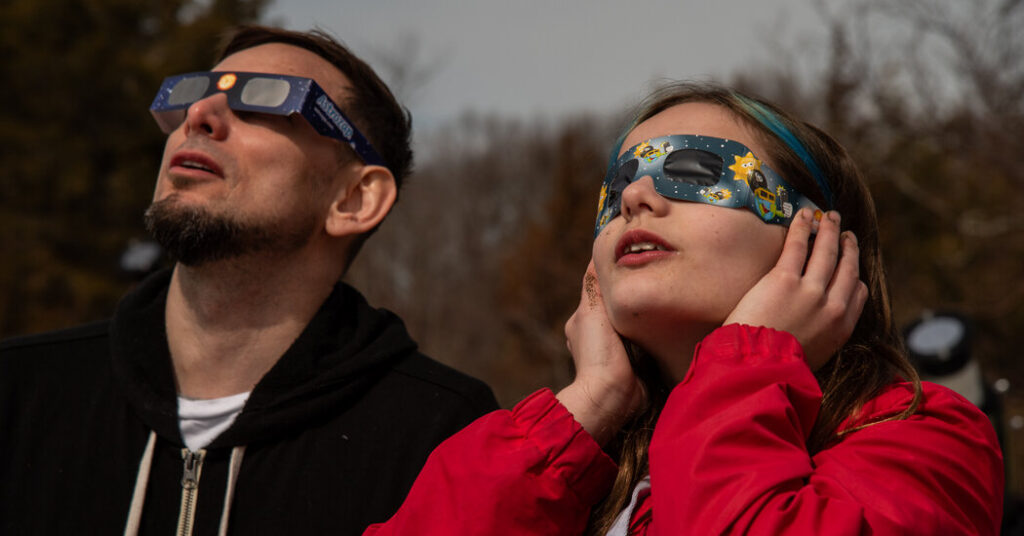
North America is not along the path of totality for today’s eclipse, which will plunge swaths of Greenland, Iceland, Spain and Portugal into darkness. But people in parts of Canada and the northern half of the United States will have the chance to see a partial solar eclipse.
Anchorage was one of the first major U.S. cities to experience it. Around 8:21 a.m. local time, the moon covered as much as 28 percent of the sun. A few minutes later, Fairbanks, Alaska, experienced a 35 percent eclipse, enough to make the sun resemble a crescent moon.
As the day progresses, smaller partial eclipses will be visible in the northern reaches of the West and Midwest. In Detroit, for example, a 2 percent eclipse — which might make it look as if a small chunk is missing from the sun — will occur around 1:49 p.m. Eastern time.
Slightly later, a partial eclipse will be visible from Maine — with Bangor experiencing 23 percent coverage at 2:05 p.m. — all the way down to northern North Carolina, where the Outer Banks will experience a 2 percent eclipse at the same time. In New York City, the partial eclipse will peak around 1:49 p.m., with 9 percent of the sun covered.
Several Canadian cities, including Toronto, Montreal and Ottawa, will also experience partial eclipses in the afternoon.
None of these should be viewed without special eye protection. Because the sun is never fully covered during any partial eclipse, looking at one can cause permanent damage to the eyes.
The post A Partial Eclipse Will Be Visible in Some of North America appeared first on New York Times.