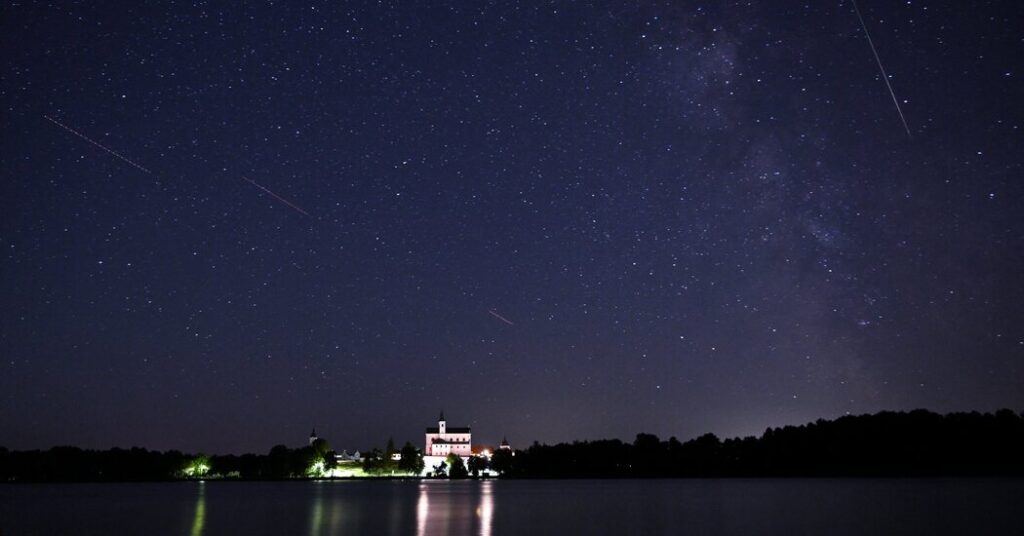
Looking for more cosmic wonder after Europe’s first solar total eclipse in decades? Then stay for the aftershow: The Perseids meteor shower will peak on Wednesday night into Thursday morning.
The Perseids are the summer’s strongest meteor shower — the fast, bright streaks with long tails are a favorite among skywatchers. Unlike the eclipse, which was only visible across a narrow swath of the Earth, the Perseids can be seen at night by anyone in the Northern Hemisphere. Solar eclipses occur during the new moon phase of the lunar cycle, so there will be no moonlight this year to wash out views of the annual shower.
For those along the path of totality, the solar eclipse thrust the sky into a deep twilight — but not likely dark enough to see the Perseids. The best time to catch a meteor is when the sky is at its darkest, usually between midnight and sunrise.
To watch the Perseids, find a place that is dark with a clear view of the night sky. Planetariums, local astronomy clubs or maps like this one can help you figure out where to go to escape excessive nighttime lighting. The shower will appear to radiate from a point within the constellation Perseus, which is visible in the north.
According to Peter Jenniskens, an astronomer at the SETI Institute in California, the shower will look different depending on the time of night. In the evening, Perseus will be close to the horizon, and streaks from the Perseids will appear long but faint. Closer to dawn, the constellation will have risen higher in the sky and the Perseids will shower at a higher rate, with short, swift tracks.
Meteor showers occur when Earth passes through the rubble trailing a comet or an asteroid orbiting the sun. The Perseids come from Comet Swift-Tuttle, which completes an orbit around the sun once every 133 years. As Swift-Tuttle nears the sun, it melts, releasing material that spreads along its orbit. This rubble intersects with the Earth for a few weeks every summer, and leaves behind glowing streams of light as it burns up in the atmosphere.
The post The Perseids, Summer’s Strongest Meteor Shower, Will Peak Tonight appeared first on New York Times.