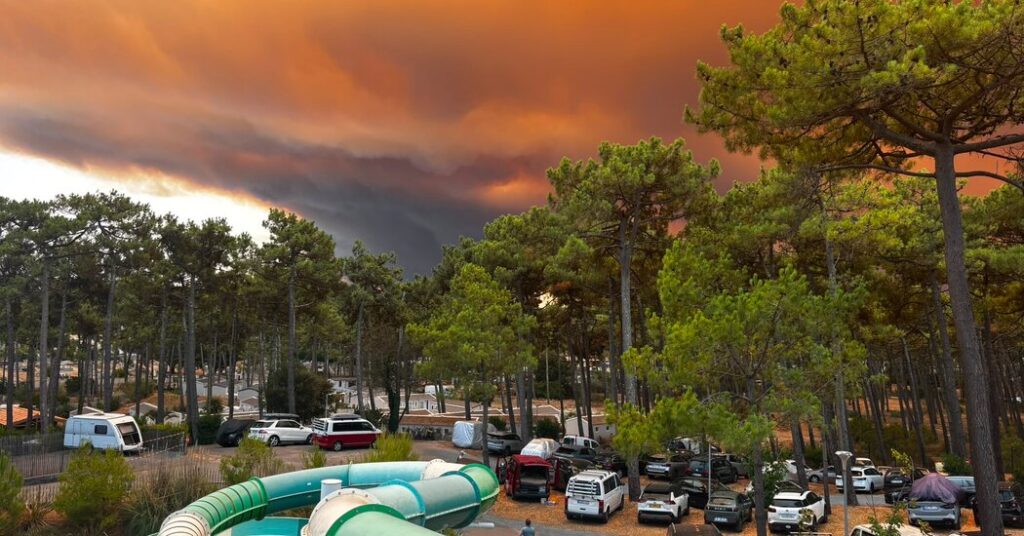
Standing on a paddle board in late July, Kryssi Whitehurst saw a plume of smoke slowly engulf the sky over a lake in southern France. Miles away, the Gironde wildfire would soon prompt one of the largest peacetime evacuations in French history.
Mrs. Whitehurst, from Britain, had traveled to stay in a cabin at one of the region’s beloved campgrounds on the Atlantic coast with her husband and two young children. When they rushed back from their outing, she said, a black and red cloud filled the sky as ash rained down.
“Everybody looked really, really scared,” said Mrs. Whitehurst, who went teary eyed to the reception desk, where she was assured the red smoke came from preventive fire retardant. Her family spent the next five days compulsively checking the news before they were told to evacuate halfway through their 10-day vacation.
The first half of summer in Europe has featured a grueling series of heat waves and widespread wildfires, which have burned more than 1.3 million acres across the European Union. The Danube and Rhine rivers hit record lows caused by drought from the prolonged heat waves, upending river cruises and forcing operators to cancel or change itineraries with alternative bus transfers and hotel stays.
After the hottest June-to-July period on record in Western Europe, the continent is now in the midst of its fifth heat wave since May. Temperatures are expected to reach 40 degrees Celsius (104 degrees Fahrenheit) or more, initially across parts of France, Spain and Italy, then in Central Europe, where some of the highest temperatures are expected in the Czech Republic, Germany and Poland.
Dozens of travelers told The Times that the sweltering season in Europe led them to reschedule travel dates, cancel tours of outdoor sites like the Roman Colosseum, leave trips early or plan future summer vacations to more temperate locations like Scandinavia or mountainous regions. Several people said they struggled with the lack of air conditioning and that their children or older travel companions experienced heat-related illnesses.
“The oppressive temperatures completely altered our trip, turning a visit to these beautiful destinations into something that felt more like a survival contest,” said Rebecca Hoyt, a clinical social worker from Colorado who visited southern Spain and France in early July. She’s already decided not to return next summer.
Climate factors are increasingly shaping where and how Europeans travel, according to a July report from the European Travel Commission. Eduardo Santander, the travel commission’s chief executive, said that the tourism sector must prepare for long-term shifts in seasonal travel, while strengthening resilience, crisis preparedness and communication with visitors.
Evolving Patterns, Subtle Shifts
Despite the fact that these patterns of extreme heat in Europe have been building for several years, travelers have largely been reluctant to change their plans entirely. Industry leaders say they have not seen a notable shift away from preferred summer destinations in Southern and Mediterranean Europe.
“For the past few years I’ve tried to swear off summer travel to Europe, and yet I keep going back,” said Sabina Piersol, an English teacher from San Francisco who did the “unthinkable” and ended her June trip to Paris three days early because of the heat.
Instead, travel patterns are gradually evolving, pointing toward a growing seasonal shift in demand, said Mr. Santander. Compared to last year, travel interest this year was slightly higher in June, signaling a small shift toward early-summer travel, according to the commission. Winter and spring arrivals to Southern Europe are growing, and Nordic regions are reporting record arrivals, he said.
Heat alone does not typically change immediate hotel demand for destinations in France, where a series of heat waves have forced popular sites like the Louvre and Eiffel Tower to close early, according to the MKG group, a market research firm based in Paris.
The shift is more subtle: In summer 2025, hotel occupancy rose faster in the French mountains than on the coast, according to the firm. Revenue per available room grew by double digits on the northern coastlines of the English Channel and Brittany.
Óscar Perelli del Amo, the chief executive of Exceltur, Spain’s national tourism industry association, said the tourism sector expects 10 percent revenue growth in Valencia and Murcia this year, despite soaring summer temperatures in both areas. In Madrid, international tourist expenditure reached 10 billion euros, or about $11.5 billion, in the first half of 2026, up 11 percent from the same period in 2025.
“I’m not worried about this season,” said Ana Rios, a retired nurse who rents out three vacation properties in Madrid. But if it continues to get hotter each year, she said, tourists — like the locals — will not want to stay in the city in the summer.
Operators in Greece expressed similar concerns. Vitorakis Michail, who runs a tour company on Crete, said that increasing heat waves and higher summer temperatures have gradually changed the profile of visitors to the island. “Over the past three to four years, we have seen a growing number of tourists choosing to visit in September and October instead of the peak summer months,” he said.
Avoiding a ‘Second Crisis’
As Europe confronts more unpredictable weather patterns and as tourists are increasingly exposed to extreme weather, local hospitality leaders say the wildfire response in France highlights a necessity for future economic stability: clear and precise crisis communication.
On July 26, Sophie Brocas, the prefect of the Nouvelle-Aquitaine region, strongly urged tourists not to travel to Gironde — an area about twice the size of Delaware — until the fire had been contained and for tourists already in the area to consider relocating to a different destination, since the situation could deteriorate.
A cascade of cancellations struck businesses across the entire region, according to the Union of Trades and Industries in the Hospitality Sector, France’s main hospitality union. Some hotels over 60 miles from the fire saw occupancy rates fall as low as 25 percent, the union said, down from 80 percent during the same time last year.
“Informing people transparently about a genuine risk is essential,” said Arthur Laborde, president of the union’s Landes chapter. “Extending that warning unnecessarily to an entire department can create a second crisis — an economic one — far beyond the area actually in danger.”
A fire that directly impacted 4 percent of the Gironde region caused hotel losses in the first 10 days of around seven million euros — a number that exceeded what every major French wildfire in the past decade combined cost the country’s hotels, according to the MKG Group. Before the fire, the agency reported hotels in the region were outpacing last summer’s turnout.
The firm has tracked the impact of wildfires for the past decade and never detected an effect beyond three miles from a burn perimeter. This time, bookings were down across an entire department, including areas more than 50 miles away, such as the wine region around Saint-Émilion.
Rail service and a major highway south of Bordeaux closed for several days, disrupting access to some cities miles from the fire, such as the bayside town of Arcachon.
“I hope within a few days, the phone will start ringing again,” Gilles Delepaux, a hotel manager in Arcachon, said in early August. He said he had to tell some workers to take days off as cancellations mounted.
Most of the impacted businesses are independently owned and sustain themselves throughout the year on the money they make in July and August, said Mr. Laborde, the union president. The group recently launched a campaign called “Don’t Abandon Us!” to recoup visitors.
On July 28, following progress in containing the fires, Serge Papin, the country’s tourism minister, encouraged people not to cancel their August holidays in unaffected areas and emphasized that the tourism season was not over.
Wendy Smith, a 71-year-old retiree from Palm Springs, Calif., was planning to travel during the second week of August along the Atlantic coast of France, from Brittany to Biarritz. But after the fires, she canceled her train tickets and apartment rentals in three oceanside towns. She instead flew straight from Paris to the southern tip of the country.
“My thought was that an extra tourist, even just traveling through the area, would not be helpful to anyone,” she said.
Ceylan Yeğinsu and Iliana Magra contributed reporting.
Follow New York Times Travel on Instagram and sign up for our Travel Dispatch newsletter to get expert tips on traveling smarter and inspiration for your next vacation. Dreaming up a future getaway or just armchair traveling? Check out our 52 Places to Go in 2026.
The post As Europe Faces Another Heat Wave, Travelers Are Forced to Adapt appeared first on New York Times.