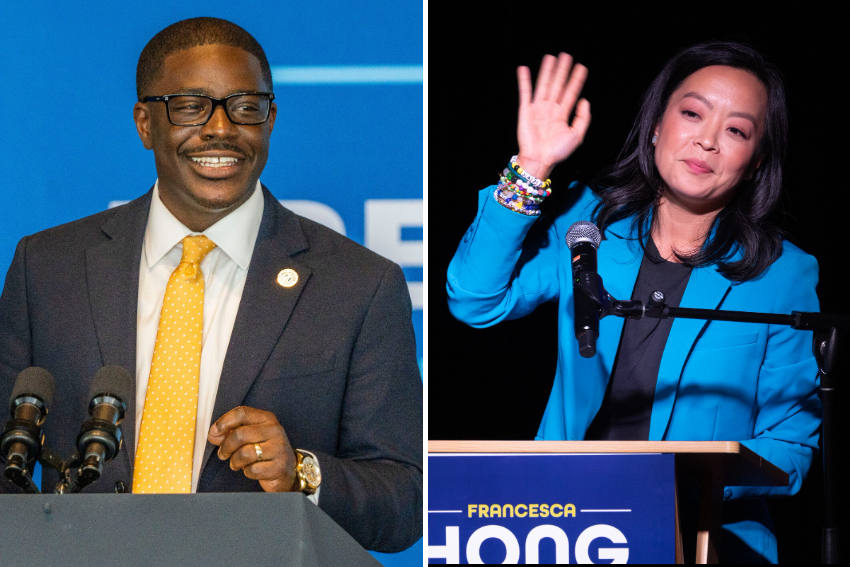
MIDDLETON, Wis. — For weeks, leftists celebrated and establishment Democrats fretted over what seemed increasingly inevitable: Francesca Hong, a state lawmaker and former restaurant owner, was poised to become the first democratic socialist to win a major-party nomination for statewide office in the modern era.
That came crashing down in the early-morning hours Wednesday as Milwaukee County Executive David Crowley, a relative moderate, defied polls to notch a narrow victory in Wisconsin’s Democratic primary for governor.
Supporters and detractors agreed that voters appeared to be increasingly worried over whether Hong could beat GOP nominee Tom Tiffany, a member of the House Freedom Caucus, in a state that voted twice for President Donald Trump.
Those questions became especially prominent in the final days of the campaign as Hong tried to explain old social media posts — including one that called for canceling Thanksgiving as a holiday — which were amplified in news accounts and outside ads.
Hong failed to run up her vote margins among people in highly educated, upper-middle-class areas, according to a Washington Post analysis, struggling with the same groups who have broken for socialists elsewhere — and who were probably most sensitive and attuned to an unfavorable news cycle.
“I didn’t think she was electable,” said Jon Friedberg, a 78-year-old retired teacher who was eating breakfast with a group of retirees in the Madison suburb of Middleton on Wednesday. “I was troubled by her irresponsible remarks.”
Alex Brower, a Milwaukee alderman and democratic socialist, tied such concerns to a last-minute scramble from party leaders as they sought a more moderate alternative to Hong and elevated Crowley, who had previously dropped out of the crowded primary.
“They broke the glass and they pulled the emergency lever here in Wisconsin,” said Brower, who canvassed for Hong. He compared the effort by centrist Democrats to their push against Bernie Sanders, the democratic socialist senator from Vermont, who won all but one county in Wisconsin in the 2016 Democratic presidential primary but lost the state in the 2020 nominating contest.
Hong’s defeat was a significant win for the party’s more moderate faction, which argued that a growing democratic socialist movement would not be able to succeed in a general election in a battleground state.
“We’re not New York, simply,” said Bob Wirch, a moderate state senator from Kenosha. “We’re a 50/50 state.”
While Hong won the younger, more college-educated areas that have favored more progressive candidates in congressional victories across the country, she did so by slim margins, often a percentage point or two.
Crowley ran up his numbers in the suburbs, with older voters and in less college-educated areas, often winning such counties by 10 or more points.
Wirch, who endorsed a third candidate in the primary, said the “drumbeat of anti-socialism propaganda” on television helped create fear that Hong could not defeat Tiffany, who voted to overturn the results of the 2020 presidential election.
Republicans and outside groups pushed heavily to draw attention to Hong’s past social media posts. The daughter of South Korean immigrants, Hong posted in 2019 that she felt uncomfortable in a popular fast-food restaurant because there were too “many old white people who didn’t think we spoke English.”
When CNN’s Kaitlan Collins asked her last week if she still wanted to cancel Thanksgiving, Hong’s response went viral.
“Thanksgiving is also a time that’s incredibly painful for many people in our communities,” she said. “And so I think there, I wanted to make sure that people understood that there are multiple views, but views can evolve.”
The Democratic Socialists of America, which also backed Hong, has leveraged strong grassroots canvassing efforts this summer to push its members to primary wins across liberal cities such as Philadelphia, Denver, New York and Detroit.
Other progressive candidates such as Abdul El-Sayed, who won a narrow primary victory last week in Michigan’s U.S. Senate race, have relied on their charisma and boldface endorsements to win those races with similar policy platforms.
“Man, that guy was very impressive,” Wirch said of El-Sayed. Hong, on the other hand, “was more of a symbol and a good representative but not a good communicator.”
Hong received nods from Rep. Ilhan Omar (D-Minnesota) and several progressive advocacy groups but was not endorsed by prominent socialist politicians such as Rep. Alexandria Ocasio-Cortez (D-New York) or Sanders.
The DSA, as it has in other races, leveraged its youthful volunteers to knock on tens of thousands of doors on Hong’s behalf. Yet, the tide around Hong could not lift her cash-strapped campaign. She did not run a single ad on TV.
Compared with El-Sayed, Hong especially struggled in middle-income areas and in very college-educated counties. She held her own in rural areas, but not enough to overcome Crowley’s advantage in the suburbs and among counties with fewer young voters.
“What we saw in the last week of the campaign was a lot of fear-based attacks on Francesca’s electability,” said State Assembly member Ryan Clancy, a democratic socialist from Milwaukee who said he knocked on nearly 1,000 doors for Hong. “Voters were choosing fear.”
Even in Wisconsin, which had the narrowest split in 2024’s presidential election results, the primary race presented something of a roller coaster.
Crowley suspended his campaign in early July as he saw a shrinking lane and other more moderate candidates surging.
But a little over a week later, Lt. Gov. Sara Rodriguez left the race amid a campaign finance scandal. Mandela Barnes, her predecessor, also bowed out at the end of the month.
Crowley jumped back in weeks before Election Day with a last-minute endorsement from outgoing Gov. Tony Evers, who cast doubt on Hong’s electability.
“The desperation in the last few weeks about stopping Fran was at a fever pitch,” said Brian Schimming, the Wisconsin GOP state party chair.
Crowley, who if elected would be the state’s first Black governor, grew up in poverty — his parents struggled with drug addiction, and he was evicted three times before he graduated high school — but quickly got involved in community organizing and local and state politics.
He served in the state legislature for three years before becoming the youngest person elected to lead Milwaukee County, the state’s largest, and graduated from college during his first term after dropping out at 19.
Crowley performed well with groups that are traditionally less progressive in Democratic primaries, and Hong won in her strong areas by only a few points.
At Hong’s election night party in Madison on Tuesday, hundreds of supporters crammed into a music hall to watch results and drink beer as songs by Prince, David Bowie and Madonna blared on the loudspeakers.
They waved hand-drawn signs, booed televised images of Trump and cheered as dwindling bits of positive news blared on televisions screens.
Hong thanked them in an 11:20 p.m. speech that urged unity, then sent them home, hours before the race was called for her opponent.
The next morning at breakfast in Middleton, some of those who sat with Friedberg characterized Hong’s performance as an important sign for the state and the country.
“What amazes me is her views are so counter to what I think is electable and what I think normal people think about — and she got a ton of votes,” said Terry Donnelly, 75, a retired dentist.
Armus and Morse reported from Washington.
The post How mainstream Democrats pulled off a big upset against a democratic socialist appeared first on Washington Post.